How NGN Case Studies Train Clinical Judgment: Anatomy of a 6-Item Testlet
An NGN case study is not one big question — it is a six-item testlet built around a single client whose situation unfolds as you go. Here is what one testlet is made of, how each item maps to a step of clinical judgment, and how to use missed cases to train that judgment.
This guide takes one NGN case study apart: the six items it is built from, how each maps to a step of the NCLEX Clinical Judgment Measurement Model (NCJMM), how the items are scored, and how to review the ones you miss. For the broader guide to reading and reasoning through case studies in general, start with the NGN case studies hub.
RN Test Pro is independent and is not affiliated with, endorsed by, or sponsored by NCSBN. The worked examples below are educational practice examples, not real NCLEX exam content.
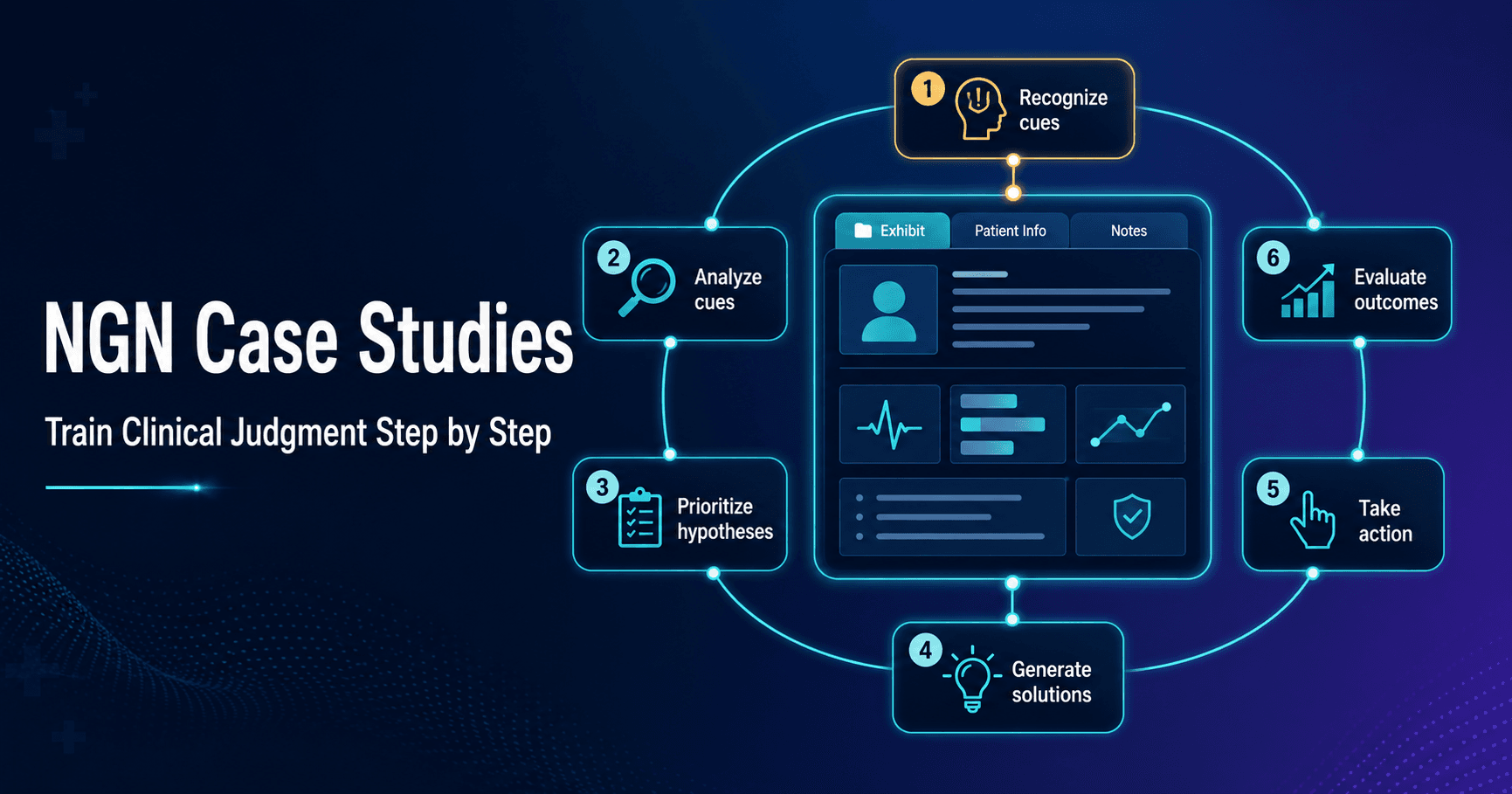
One unfolding client, six sequential items — each mapped to a step of the NCJMM.
Quick Answer: What an NGN Case Study Is
An NGN case study is a client scenario followed by six sequential items. The scenario may unfold as you move through the testlet, but each item should be answered from the information available at that point.
It is a six-item testlet
An NGN case study is one unfolding client scenario followed by six sequential items — not a single stand-alone question.
Three case studies, 18 items
The current NCLEX-RN and NCLEX-PN test plans include three scored clinical-judgment case studies — 18 case-study items in total — alongside the exam's stand-alone items.
Six items, six NCJMM steps
The items step through the model: recognize cues, analyze cues, prioritize hypotheses, generate solutions, take action, and evaluate outcomes.
The scenario unfolds; items do not chain
New data can appear as you go, but each item is answered and scored independently from the information available at that point.
You move forward, not back
Open every available exhibit and reason fully before you submit — once you confirm an item and move on, you cannot return to it.
Reviewed against 2026 NCLEX-RN and NCLEX-PN test plans, NCSBN NCJMM guidance, and NCSBN scoring-model guidance. RN Test Pro is independent and not affiliated with NCSBN.
Official NCLEX NGN Case-Study Facts Candidates Should Know
A few facts from the current test plans and NCSBN guidance set your expectations before you ever open a case study.
Each scored case study has six items
Expect a structured sequence of six items built around one client, not one isolated question.
Three case studies → 18 case-study items
Three scored clinical-judgment case studies appear on the exam, for 18 case-study items in total, plus separate stand-alone items.
Each item maps to an NCJMM step
The six items follow the six measurable steps of clinical judgment in order, so naming the step tells you what the item wants.
It applies to RN and PN candidates
The 2026 NCLEX-RN and NCLEX-PN test plans both use the same case-study structure and the same clinical-judgment model.
No backtracking
Items are answered one at a time; once you confirm and move on, you cannot return to a previous item.
Case studies stay inside the adaptive exam
Both the NCLEX-RN and NCLEX-PN are variable-length adaptive exams of 85 to 150 items with a five-hour time limit. The 18 case-study items are delivered inside that full exam, not as a separate test.
In other words, the NCLEX remains a computerized adaptive test, and case studies are delivered inside that adaptive exam rather than as a separate section. How many items you see — anywhere from 85 to 150 across the five-hour window — is a function of how the adaptive engine measures your ability, not a pass/fail signal in itself. For how the adaptive engine chooses and stops items, see the NCLEX scoring guide.
Anatomy of a Case-Study Screen
A case study feels far more predictable once you can name its parts. On screen, the case sits on one side as a medical-record-style panel while the active item sits on the other.
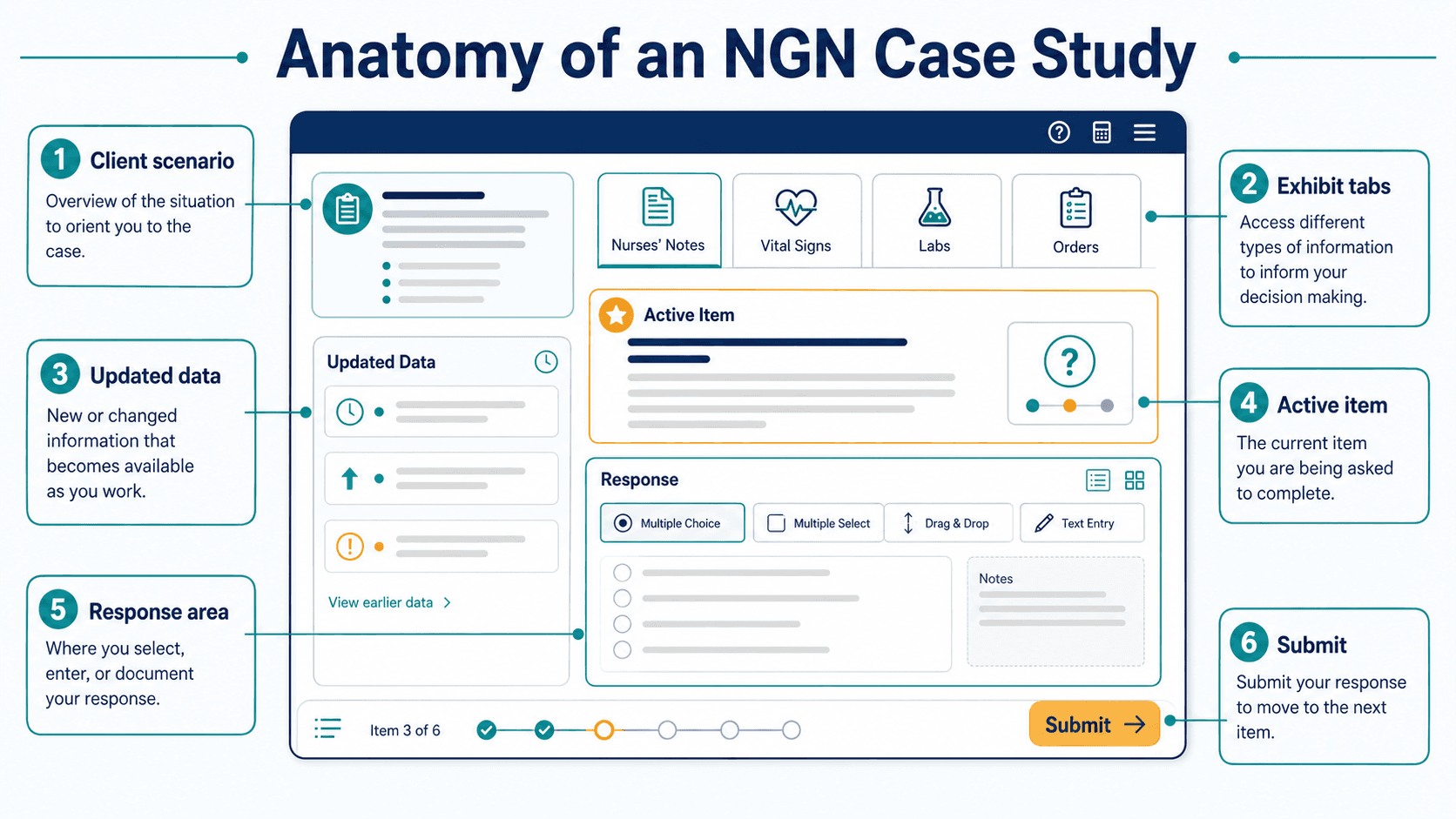
The scenario and exhibit tabs on one side, the active item and response area on the other.
Client scenario
The opening story: who the client is, why they are being seen, and the presentation that frames the whole testlet.
Exhibit tabs
Tabs such as nurses' notes, vital signs, laboratory results, history, and provider orders hold the cues. Open every available exhibit before you submit — the exam does not force you to open each tab, so the responsibility to read them is yours.
Updated data
As the case unfolds, new findings are layered in. A later vital sign, lab result, note, or order can change the priority.
Active item and response
The item on screen asks you to perform one clinical-judgment task — select options, complete a drop-down, classify findings in a matrix, drag responses to targets, or highlight text.
One item at a time
The six items follow the single scenario in NCJMM order, but each is answered on its own — your job is to answer the current item, not to solve the whole case at once.
Submit behavior
Once you confirm your answer and proceed, you cannot return to the previous item. Check every row, blank, selection, or target before moving on.
The exhibit tabs and the response interaction are where most points are won or lost. For the item formats themselves, see the NGN question types guide.
The Six-Item NCJMM Map
The six items are not random. Each one targets a single step of clinical judgment, in sequence. Naming the step an item is testing tells you what to do before you answer it.
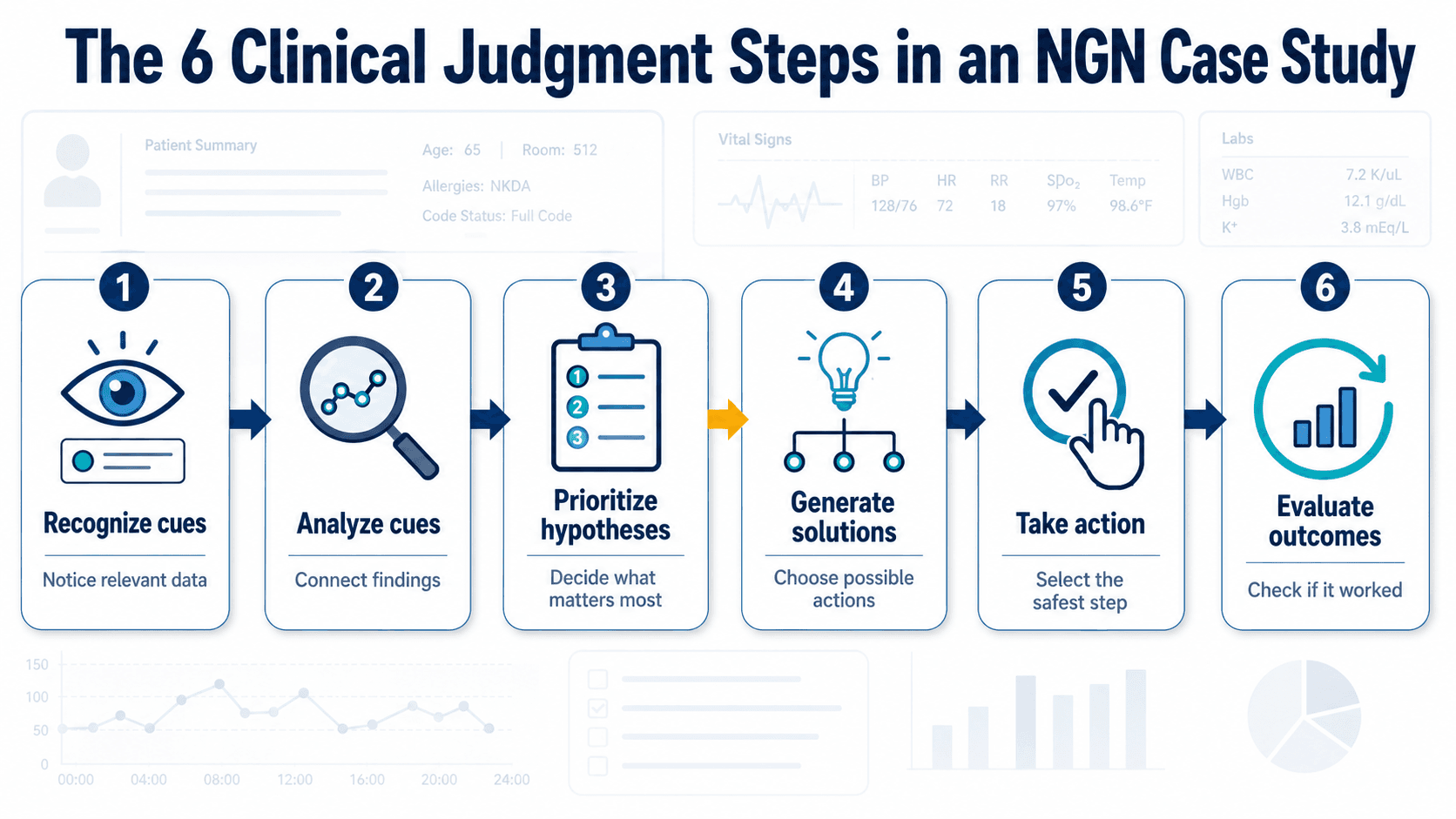
Recognize cues, analyze cues, prioritize hypotheses, generate solutions, take action, evaluate outcomes.
Recognize cues
What the item asks: Which findings matter for this client?
Safest first move: Open every exhibit and flag what is abnormal, unexpected, changing, or high-risk before you select anything.
Common trap: Selecting every abnormal value without judging which ones are actually relevant.
Analyze cues
What the item asks: What do the cues mean together?
Safest first move: Cluster the findings into a clinical pattern that fits the client's situation.
Common trap: Anchoring on one cue or a diagnosis label and ignoring the data that does not fit.
Prioritize hypotheses
What the item asks: Which problem is most likely or most urgent?
Safest first move: Rank the possibilities by likelihood and risk, and decide what needs attention first.
Common trap: Choosing a stable, chronic issue over an immediate threat.
Generate solutions
What the item asks: Which actions could address the priority concern?
Safest first move: Match safe, in-scope actions to the priority problem and the outcome you expect.
Common trap: Jumping to interventions before you have finished analyzing the cues.
Take action
What the item asks: What should the nurse do now?
Safest first move: Choose the safest in-scope action supported by the orders or protocol.
Common trap: Picking the action that sounds most active but is unsafe or out of scope.
Evaluate outcomes
What the item asks: Did the client improve, worsen, or need more action?
Safest first move: Compare the new findings against the priority problem.
Common trap: Treating a small change as full resolution, or skipping reassessment.
This is the same model behind every NGN item. For the framework in depth, see clinical judgment (NCJMM).
Find the NCJMM Step You Miss Most
Work through full six-item case studies with NCJMM-aligned items and step-by-step rationales, so you can see which reasoning step trips you up.
Practice Case StudiesImportant: Unfolding Does Not Mean Answer-Dependent
A case study unfolds, but that does not mean your answer to item 1 determines the correct answer to item 2. The client's data may evolve, yet each item is answered and scored independently from the information available at that point, and care is taken to avoid cueing one item with the next.
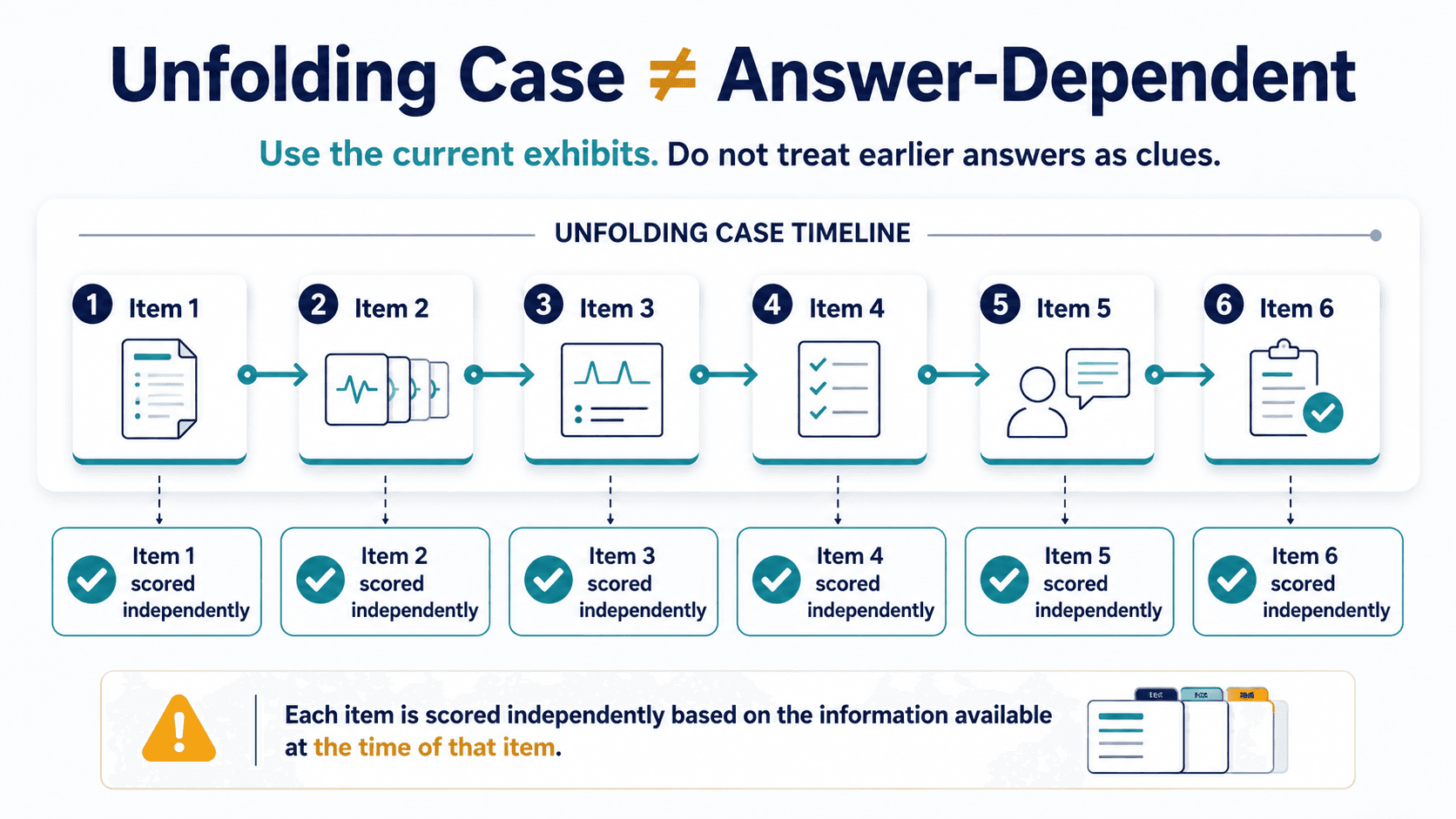
The scenario advances, but each item is scored on its own — earlier answers do not set later ones.
Do not use your prior answer as a clue
Answer the current item from the current exhibits and the current question stem. Never reason “because I chose X earlier, the next answer must be Y” — that assumption is exactly what the independent scoring is designed to defeat.
Worked Example: A Heart-Failure Testlet
Here is how one six-item testlet unfolds, mapped step by step and then in a short narrative. It is built for teaching, not taken from the exam.
Client scenario
An adult client arrives at the emergency department reporting worsening shortness of breath and has a history of heart failure. Initial findings: blood pressure 168/92, heart rate 118, respiratory rate 32, and oxygen saturation 88% on room air. You can open nurses' notes, vital signs, and the provider's orders.
This is an illustrative teaching example built to show how the six items work — not real exam content. The actions described are entry-level nursing responses; a practice case resembles how information unfolds, but it does not replace clinical supervision or real clinical autonomy.
Item 1: Recognize cues
Cue interpretation: SpO₂ 88% on room air, respiratory rate 32, heart rate 118, and worsening shortness of breath.
What the item rewards: Selecting the findings that signal impaired oxygenation and increased work of breathing.
Item 2: Analyze cues
Cue interpretation: Breathlessness, hypoxia, and tachypnea in a client with heart failure suggest pulmonary congestion or worsening heart-failure status.
What the item rewards: Connecting the cues into one pattern instead of reacting to a single number.
Item 3: Prioritize hypotheses
Cue interpretation: Impaired gas exchange is the most urgent concern to address first.
What the item rewards: Ranking oxygenation and breathing above less time-sensitive problems.
Item 4: Generate solutions
Cue interpretation: Reasonable options include upright positioning, oxygen as ordered or per protocol, respiratory reassessment, order review, preparing prescribed medications, and provider notification.
What the item rewards: Choosing interventions that fit the priority concern and stay within nursing scope.
Item 5: Take action
Cue interpretation: Support oxygenation and ease the work of breathing now, while following the orders and protocol.
What the item rewards: Selecting the safest current action, not a delayed or unsupported one.
Item 6: Evaluate outcomes
Cue interpretation: Improvement shows as a rising oxygen saturation, a slower respiratory rate, less distress, and clearer breath sounds.
What the item rewards: Judging whether the priority problem is resolving or needs escalation.
The lesson is that the testlet never rewards keyword matching. It rewards building a clinical picture, updating that picture as new data appear, and choosing actions that fit the client's current risk — exactly the reasoning the NCJMM is built to measure.
How Case-Study Items Are Scored
Case-study items may use different scoring models depending on the interaction and the number of correct keys. NCSBN describes three current scoring models: zero/one scoring, plus/minus scoring, and rationale scoring. Partial-credit (polytomous) scoring exists precisely so responses are not forced into a single “all correct or all incorrect” grouping.
Zero/one scoring
How it works: Each single response, row, blank, or target is scored correct or incorrect. A multi-point item sums the correct targets and does not subtract for wrong selections, so partial credit is possible and a multi-response item is not graded as one block.
In practice: Be precise, but know that missing one target does not always cost the whole item.
Plus/minus scoring
How it works: Correct selections add credit and incorrect selections subtract credit; a negative total is rounded up to zero.
In practice: Do not over-select — choose only what the scenario supports.
Rationale scoring
How it works: Linked responses earn credit only when the paired action-and-reason relationship is correct.
In practice: The action and its reason must fit together clinically.
The scoring rule attaches to the item, not to the case study, so a single six-item testlet can contain items scored by different rules. The exam does not label the scoring model on the screen. Some item formats strongly suggest a scoring model, but your safest strategy is to answer based on the clinical support in the scenario — select only what you can defend — rather than trying to game the scoring.
What this means for your practice
- Because incorrect choices can count against you on some item types, choose only what the scenario supports instead of selecting everything plausible.
- RN Test Pro practice scoring is educational feedback to guide your studying. It is not official NCLEX scoring and does not replicate the exam's methods.
- Item format and case-study difficulty do not predict your result — use practice to learn the reasoning, not to forecast a score.
For a deeper look at each method, see how partial-credit scoring works and the NCLEX scoring guide.
A Test-Day Routine for Every Case-Study Item
When a testlet appears, the same routine works every time. Run it on each item in order.
How to Review Missed Case Studies
A missed case study is useful only when you can say exactly which step failed and why. Turn each miss into a short, repeatable review.
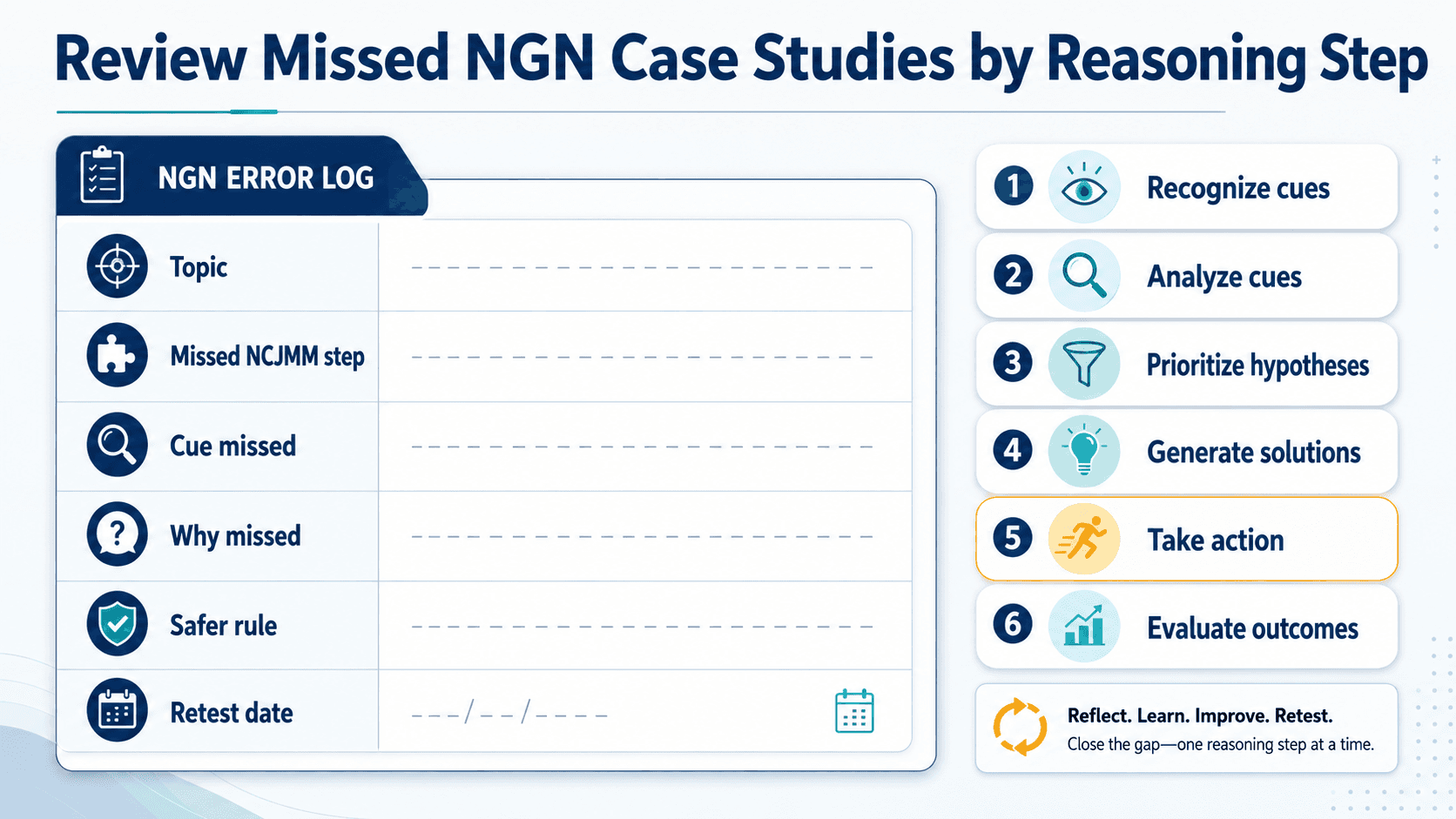
One short row per missed case study, filed by the NCJMM step that broke down.
Error-log template
Capture one row per missed case study — short enough to write in under a minute.
- Topic
- The clinical focus — heart failure, sepsis, DVT/PE, pediatric respiratory distress, and so on.
- Missed NCJMM step
- Recognize cues, analyze cues, prioritize hypotheses, generate solutions, take action, or evaluate outcomes.
- Cue missed
- The specific finding you skipped or misread.
- Why missed
- Skimmed an exhibit, anchored on a diagnosis, over-selected, acted too early, or ignored a trend.
- Safer rule
- A short rule you can reuse next time.
- Retest date
- When you will practice the same step again.
A filled example
The same template completed for one missed heart-failure case.
- Topic
- Heart-failure exacerbation / oxygenation
- Missed NCJMM step
- Recognize cues
- Cue missed
- SpO₂ 88% with a respiratory rate of 32
- Why missed
- Read the answer options before opening the vital-signs tab
- Safer rule
- Open every exhibit before selecting; prioritize oxygenation and breathing cues
- Retest date
- In 3 days, then again in 1 week
If the same step keeps slipping, send it into a schedule. The developing clinical judgment guide has drills for each step.
Common Mistakes by NCJMM Step
Most avoidable errors map cleanly to one of the six steps. Knowing the pattern helps you catch yourself before you submit.
Recognize cues
Mistake: Missing the cue that changes the priority.
Fix: Scan every exhibit and compare current data with earlier data.
Analyze cues
Mistake: Treating one abnormal value as the whole answer.
Fix: Connect the cues into a pattern before deciding.
Prioritize hypotheses
Mistake: Choosing the most familiar diagnosis instead of the most urgent concern.
Fix: Rank by risk, likelihood, and safety.
Generate solutions
Mistake: Picking actions before deciding which problem you are solving.
Fix: Match each possible action to the priority hypothesis.
Take action
Mistake: Choosing an action that sounds active but is unsafe or out of scope.
Fix: Choose the safest in-scope action the scenario, orders, or protocol support.
Evaluate outcomes
Mistake: Assuming the client improved without checking objective evidence.
Fix: Compare new findings to the original priority problem.
A Practice Plan for Case Studies
A practical case-study plan trains reasoning, not just content recall. Use a short cycle and repeat it.
Learn the six steps
Write the NCJMM steps from memory and define what each one asks you to do.
Practice full testlets
Complete full six-item case studies rather than isolated items, so you rehearse the whole reasoning sequence.
Review by missed step
Group your misses by NCJMM step. If “evaluate outcomes” keeps failing, drill outcome interpretation instead of rereading broad content.
Retest weak steps
Redo similar cases and compare your reasoning to see whether the same mistake is still happening.
For full sample testlets to run during days 2–4, work through the sepsis case study, the DVT and PE case study, and the pediatric respiratory-distress case study.
Practice Full Six-Item Case Studies
Run complete NGN case-study testlets with rationales tied to each NCJMM step, then use your misses to target the reasoning layer — not just the topic — you need most.
Practice Full NGN Case StudiesFrequently Asked Questions
How many items are in one NGN case study?
Six. Each scored case study is a six-item testlet built around one unfolding client, and the items follow the six NCJMM steps.
How many case studies are on the NCLEX?
The current NCLEX-RN and NCLEX-PN test plans include three scored clinical-judgment case studies, for 18 case-study items in total, alongside the exam's stand-alone items.
Are the six items scored together?
No. The case unfolds as one scenario, but each item is answered and scored independently, and care is taken to avoid cueing one item with another.
Can I go back to an earlier item in a case study?
No. Once you confirm an answer and move forward, you cannot return to the previous item, so open every exhibit and reason fully before you submit each item in the testlet.
Do all case-study items use the same scoring method?
No. The method depends on the item interaction and the number of correct keys. NCLEX scoring models include zero/one, plus/minus, and rationale scoring, and the exam does not label the model on the screen.
Is the heart-failure walkthrough real exam content?
No. It is an educational teaching example that shows how the six items work using entry-level nursing actions. It does not replace clinical supervision, and a practice score does not predict your NCLEX result.
Turn weak NCJMM steps into a study schedule
Note the NCJMM steps you miss in case-study rationales, then give them extra adaptive practice and case-study reps in a ready-made schedule you adapt to your time.
View study schedulesSources and Alignment Note
How this guide was reviewed
Reviewed against 2026 NCLEX-RN and NCLEX-PN test plans, NCSBN NCJMM guidance, and NCSBN scoring-model guidance. RN Test Pro is independent and not affiliated with NCSBN.
Specifically, this guide was reviewed against the 2026 NCLEX-RN and NCLEX-PN test plans (three scored clinical-judgment case studies of six items each, 18 case-study items in total), NCSBN’s Clinical Judgment Measurement Model, and NCSBN scoring-model guidance on partial credit (zero/one, plus/minus, and rationale scoring). It is educational NCLEX preparation content and does not replace official NCSBN materials, nursing-program guidance, facility policy, or clinical judgment. NCLEX®, NCLEX-RN®, and NCLEX-PN® are registered trademarks of the National Council of State Boards of Nursing, Inc.
Related Resources
NGN Case Studies (Full Guide)
The broader hub for reading, reasoning through, and answering case studies safely
NGN Question Types
Matrix, cloze, drag-and-drop, bow-tie, and the other item formats
Clinical Judgment (NCJMM)
The six-step model behind every case-study item
How Partial-Credit Scoring Works
Zero/one, plus/minus, and rationale scoring explained
NCLEX Scoring
How the adaptive exam scores items and decides pass or fail
Developing Clinical Judgment
Build the reasoning habit these testlets reward
NGN Sepsis Case Study
A full worked six-item testlet to practice
NGN DVT and PE Case Study
Another complete testlet to reason through
NGN Pediatric Respiratory Distress
A pediatric case study for extra practice
NCLEX Study Plan
Turn weak NCJMM steps into a schedule
All NCLEX Question Types
Every format you will meet across the exam