NCLEX Ethical Dilemmas: Patient Rights, Nursing Scope, and Safe Decisions
Ethics questions can feel like there is no clear answer — but on the NCLEX there is a safest, most appropriate nursing action. The reliable approach is to protect the client's rights, keep within nursing scope, promote safety, avoid deception, and escalate through the chain of command when the issue is complex.
Ethics appears within Client Rights, Ethical Practice, and Management of Care on the NCLEX. These questions are less about philosophy and more about safe, scope-appropriate nursing action: recognizing the client's rights, avoiding harm and deception, and using facility policy and the chain of command when a situation is complex. This guide gives you a framework and applies it to the situations the exam returns to.
Quick Answer: How to Handle Ethics Questions on the NCLEX
- The safest answer usually protects the client's rights, keeps the nurse within scope, and promotes safety.
- It avoids deception — the nurse does not lie or give false reassurance.
- When the issue is complex or outside nursing scope, it uses the chain of command and escalates appropriately.
- Ethical questions may involve competing principles, but the NCLEX asks for the safest, most appropriate nursing action.
- Practice feedback is educational — it helps you recognize patterns, not predict an official result.
What NCLEX Ethics Questions Really Test
Ethics items show up within Client Rights, Ethical Practice, and Management of Care, and they lean heavily on communication and advocacy. Common themes include patient safety, autonomy, informed consent, confidentiality, and advocacy. Expect questions that ask you to:
- Recognize and report ethical concerns affecting client care
- Protect client rights such as privacy, dignity, and informed participation
- Know the nurse's role in informed consent and advocacy
- Maintain confidentiality and escalate privacy concerns appropriately
- Respect a competent client's refusal of treatment
- Respond to advance directives and family disagreement through proper channels
For how these map to the test plan and formats, see the NCLEX Client Needs categories and the NCLEX question types guide.
The Ethical Decision Framework
When an ethics question appears, run it through the same five lenses. This keeps your answer anchored to safe, in-scope action rather than personal opinion.
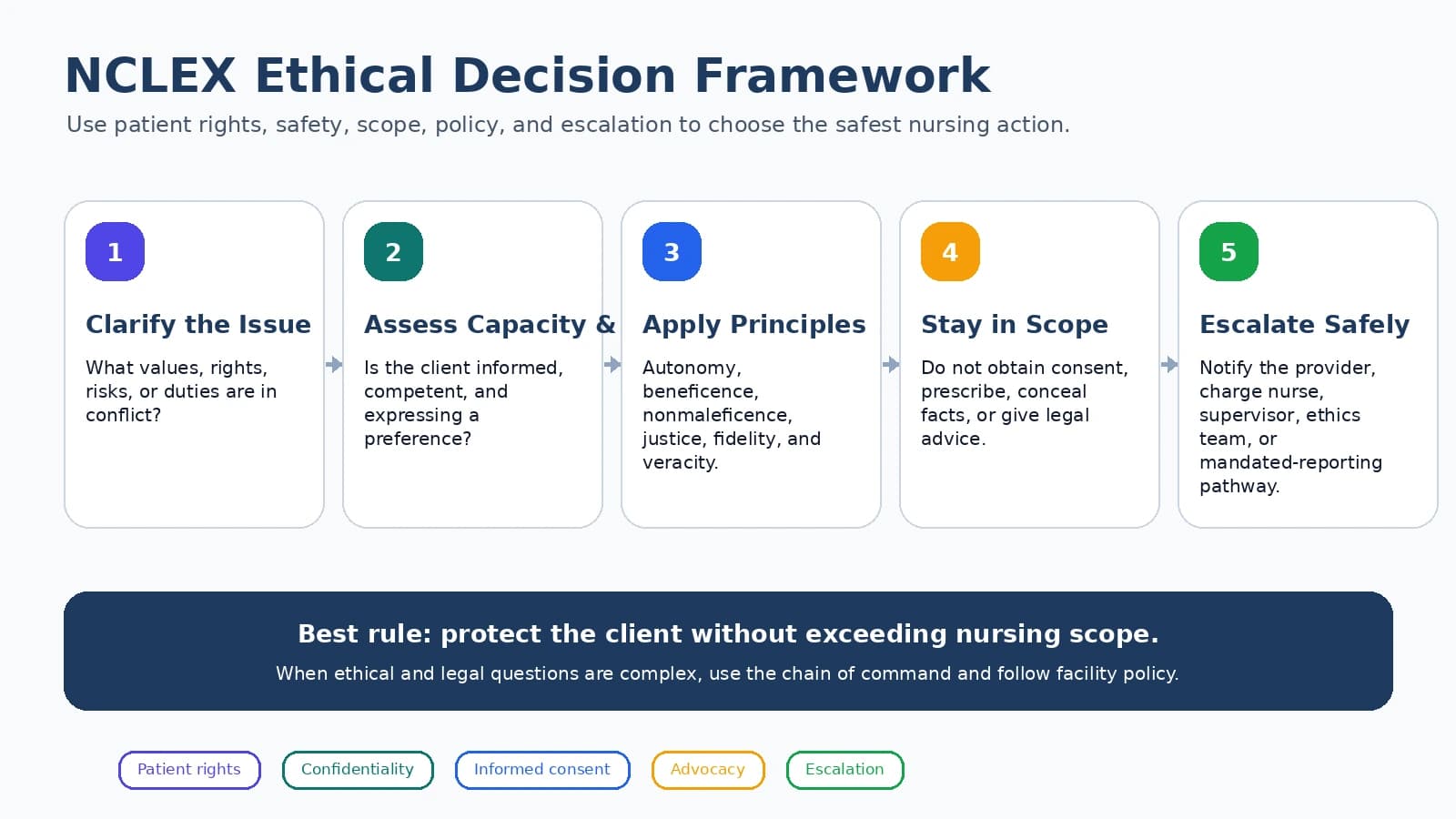
Patient rights, safety, nursing scope, facility policy, and escalation — the lenses behind a safe ethics answer.
Protect patient rights
Start from the client's rights — privacy, dignity, informed participation, and the right to make their own decisions when competent.
Prioritize safety
Keep the client and others safe; an unsafe situation reframes what the most appropriate action is.
Stay within nursing scope
Choose the action that is the nurse's to take — advocacy, assessment, witnessing, teaching — rather than a provider-only or out-of-scope action.
Follow facility policy
Use the local process for the situation, including consent procedures, privacy rules, and documentation.
Escalate appropriately
When the issue is complex or outside scope, involve the provider, charge nurse, supervisor, or an ethics consult through the chain of command.
Core Ethical Principles, with Scope-Safe Examples
Six principles underpin most ethics questions. Know them by what they mean and a safe nursing example — the ANA Code of Ethics is the professional standard behind them.
| Principle | What it means | Scope-safe example |
|---|---|---|
| Autonomy | Respect the client's informed choices | Support a competent client's decision to accept or decline care after they understand it. |
| Beneficence | Act for the client's benefit | Choose actions that promote the client's well-being within nursing scope. |
| Nonmaleficence | Avoid harm | Prevent foreseeable harm — for example, clarifying an order that appears unsafe before acting. |
| Justice | Fair and equitable care | Provide care fairly, without bias based on background or ability to pay. |
| Veracity | Truthfulness, no deception | Be honest with the client; do not lie or give false reassurance. |
| Fidelity | Keep commitments, maintain trust | Follow through on what you tell the client and honor the nurse–client relationship. |
Patient Rights and Nursing Actions
Many ethics items turn on protecting a specific client right. Recognizing the right at stake usually points to the safe action.
- Privacy and confidentiality of their health information
- Informed participation in decisions about their own care
- Refusal of treatment when they are competent to decide
- Dignity and respectful treatment
- Information in language they can understand
- Access to support and advocacy according to facility policy
Informed Consent: What the Nurse Does and Does Not Do
This is one of the most testable ethics topics, and the distinction matters: the provider obtains consent; the nurse witnesses and advocates.
- The provider performing the procedure is responsible for obtaining informed consent and explaining the risks, benefits, and alternatives.
- The nurse may witness the client's signature according to facility policy.
- The nurse assesses whether the client appears to understand and is consenting freely.
- If the client seems confused, coerced, or uninformed, the nurse pauses and escalates to the provider rather than proceeding.
- The nurse documents appropriately and advocates for the client throughout.
Confidentiality, Privacy, and When to Escalate
Confidentiality questions reward discretion and the minimum-necessary habit. HIPAA gives clients rights over their health information and sets rules and limits on who may access and receive it; on the exam, keep the principle broad and apply it through facility policy rather than legal specifics.
- Discuss client information privately and only with those involved in the client's care.
- Share the minimum necessary information for the task at hand.
- Do not release information to family or others who are not authorized, even when they ask directly.
- Escalate privacy concerns and suspected breaches through facility policy and the chain of command.
Refusal of Treatment and Autonomy
Autonomy means a competent client can decline care, and the nurse's role is to inform and support rather than pressure.
- A competent client may refuse treatment, even when the team disagrees with the choice.
- Assess the client's understanding of the situation and the consequences.
- Explore their concerns and provide information in terms they understand.
- Notify the provider, document the refusal, and continue to provide respectful care.
- Do not coerce or pressure the client into a decision.
Advance Directives and Family Conflict
Advance directives express the client's own wishes. When family members disagree, the safe move is never to override the directive on your own — it is to escalate.
- Valid advance directives and the client's expressed wishes guide care according to facility policy.
- If family members disagree with a valid directive, the nurse does not independently override it.
- Escalate the conflict through the provider, charge nurse, supervisor, and ethics consult as appropriate.
- Document the situation and the steps taken.
The reasoning here mirrors the clinical judgment framework: recognize the conflict, weigh what matters, act within scope, and escalate when needed.
Mandatory Reporting and Safety Concerns
Some situations carry a duty to act. Keep the wording broad and route it through law and policy rather than memorizing specifics.
Report through proper channels
- Suspected abuse or neglect, threats to safety, impaired practice, or unsafe care may require reporting, depending on applicable law and facility policy.
- Follow facility policy and the chain of command rather than acting on assumptions.
- Document objective observations and the actions you took.
- When unsure of the requirement, consult the appropriate resource — supervisor, risk management, or an ethics consult — through proper channels.
Practice NCLEX Ethics Questions
Work through NCLEX-style ethics and client-rights questions with rationales that explain the safest, most appropriate nursing action. Use the educational feedback to find your weak patterns.
Start PracticingEthical vs. Legal vs. Facility Policy
These three overlap but are not the same, and the exam sometimes hinges on telling them apart. This page is NCLEX preparation and nursing-scope education — it does not provide legal advice.
| Type | What it is | Example |
|---|---|---|
| Ethical issue | A conflict between values or principles | Family wants information withheld from a competent client who wants to know |
| Legal issue | A statute, regulation, or mandatory requirement | A reporting obligation defined by law and facility policy |
| Facility policy | The local process for acting and escalating | The consent procedure, privacy rules, and chain of command at your workplace |
In practice they often overlap — a single situation can raise an ethical concern, a legal requirement, and a policy process at once. The safe nursing answer respects all three and escalates when they conflict.
How Ethics Connects to NCJMM Clinical Judgment
Ethics questions are clinical judgment in another form. The NCLEX Clinical Judgment Measurement Model (NCJMM) maps cleanly onto ethical reasoning.
| NCJMM step | Applied to an ethics question |
|---|---|
| Recognize cues | Notice the ethical concern and the client's rights and wishes in the scenario. |
| Analyze cues | Identify which principles are in tension and what is within nursing scope. |
| Prioritize hypotheses | Decide what matters most — usually client safety, rights, and staying in scope. |
| Generate solutions | Consider appropriate nursing actions and when escalation is needed. |
| Take action | Choose the safest, most appropriate action: advocate, assess, witness, escalate, or document. |
| Evaluate outcomes | Judge whether the client's rights and safety are protected and what should happen next. |
For more on how this model drives the newer item types, see the Next Generation NCLEX guide and NGN case studies.
Practice Example: Family Asks the Nurse to Hide a Diagnosis
Scenario: A client's family asks the nurse not to tell the client about a new serious diagnosis. This is an illustrative teaching example, not real exam content.
This situation pits the family's wishes against the client's right to honest information. Here is a safe answer pattern that stays within nursing scope:
Do not lie to the client
Veracity matters — the nurse does not deceive the client or give false reassurance, even at the family's request.
Assess what the client knows and wants to know
Find out the client's current understanding and their wishes about receiving information, which guides the next steps.
Stay within scope on diagnosis and prognosis
The nurse does not independently disclose provider-only diagnosis or prognosis details that are outside nursing scope.
Notify and involve the provider
Bring the provider into the conversation, since communicating the diagnosis and prognosis is their responsibility.
Advocate for honest, culturally sensitive communication
Support communication that respects the client's right to information and their cultural context.
Escalate if conflict persists
Use an ethics consult and the chain of command if the disagreement continues.
Common Mistakes
Most avoidable ethics errors come from a handful of habits:
- Letting a family's preference override a competent client's own decision.
- Offering legal advice instead of following policy and escalating.
- Treating the nurse as the one who obtains informed consent, rather than witnessing and advocating.
- Lying to a client or giving false reassurance.
- Sharing private information with people who are not authorized to receive it.
- Ignoring facility policy or the chain of command.
- Defaulting to 'call the provider' without first identifying the nursing action the question is asking for.
Follow a ready-made NCLEX study schedule
Turn this approach into a weekly schedule with adaptive practice, NGN-style questions, rationales, and educational feedback. Use it to decide what to review next.
View study schedulesSources and Alignment Note
How this guide was reviewed
Reviewed against the 2026 NCLEX-RN and NCLEX-PN test plans, ANA Code of Ethics for Nurses, HIPAA privacy guidance, and NCLEX Clinical Judgment Measurement Model guidance. This page is educational NCLEX preparation content and does not provide legal advice or replace facility policy, provider orders, ethics consultation, nursing program guidance, or clinical judgment. RN Test Pro is independent and not affiliated with or endorsed by NCSBN. NCLEX® is a registered trademark of the National Council of State Boards of Nursing, Inc.
Related Resources
Client Needs Categories →
Where ethics and client rights sit within the test plan.
Clinical Judgment →
The NCJMM model behind safe ethical reasoning.
NGN Case Studies →
How unfolding cases test judgment across six steps.
NCLEX Study Tips →
Study smarter and build clinical judgment.
30/60/90 Study Plan →
Fit ethics review into a realistic timeline.
NCLEX Question Types →
The formats ethics items can take on the exam.
RN NCLEX Prep →
Adaptive practice built for the RN candidate path.
PN NCLEX Prep →
Adaptive practice built for the PN candidate path.