NCLEX Study Plan: 30-Day, 60-Day, and 90-Day Schedules That Adapt
A good NCLEX study plan is not just a calendar — it is a feedback loop. Choose a timeline, follow the weekly structure, review rationales carefully, and adjust based on your actual missed-question patterns.
Quick Answer: Which Study Plan Should You Choose?
Choose based on your real situation, not panic. The right timeline depends on how much time you have, how strong your baseline is, how many hours you can study without burning out, and how well you learn from missed questions.
| Timeline | Best fit | Daily study time | Main risk |
|---|---|---|---|
| 30 days | Recent graduate, strong baseline, exam date already close | 4–6 focused hours | Burnout and shallow review |
| 60 days | Most candidates who need structure and steady progress | 2–4 focused hours | Drifting without weekly adjustment |
| 90 days | Working candidates, longer gap since graduation, or major content gaps | 1.5–3 focused hours | Losing momentum |
Do not choose the shortest plan just because you want the exam finished. Choose the plan you can actually complete. To turn any of these into a personalized schedule, use the adaptive NCLEX study plan.
Current NCLEX Facts Your Plan Must Reflect
Your study plan should match the current exam, not old NCLEX advice.
| NCLEX fact | What it means for studying |
|---|---|
| NCLEX-RN and NCLEX-PN are computerized adaptive tests | Practice should include mixed questions and adaptive-style review, not only fixed-topic quizzes. |
| Exam length is 85 to 150 total items | Do not build your plan around old 75/145 item limits. |
| Time limit is five hours | Build stamina, but do not practice with panic timing. |
| There are 15 unscored pretest items | Treat every item seriously — you cannot tell which are pretest. |
| NGN includes case studies and stand-alone items | Practice case studies, cue recognition, prioritization, and outcome evaluation. |
| NCLEX is pass/fail | Practice percentages are study feedback, not official pass/fail predictions. |
For how content coverage maps to the test plan, see the NCLEX Client Needs categories, and for why exam length and raw percentages do not predict pass or fail, see the NCLEX scoring guide.
30 / 60 / 90 Plan Chooser
Use this as a quick visual reference for who each timeline fits and how to adjust as you go.
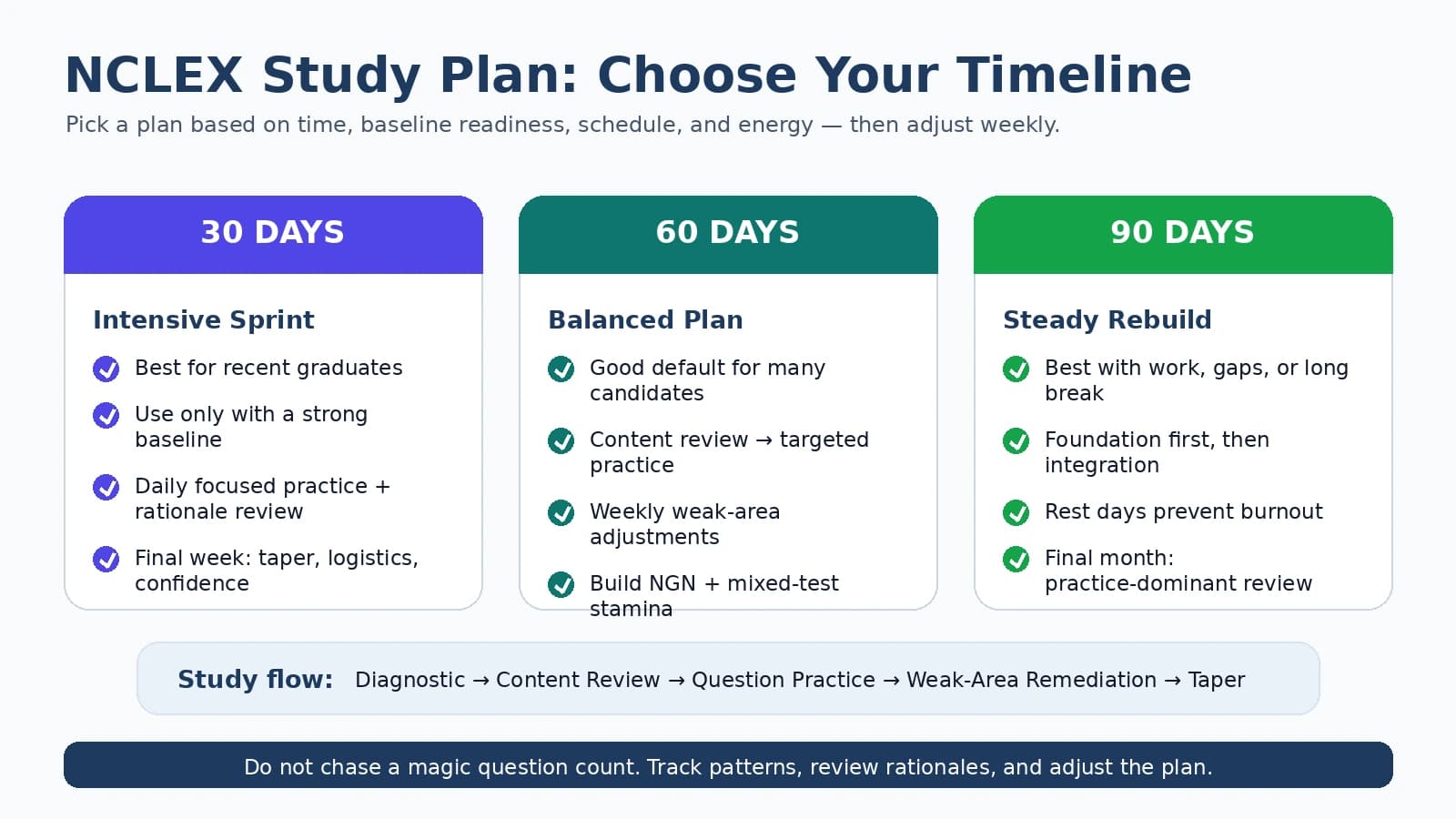
Match the timeline to your baseline, available hours, and how you learn from missed questions.
How to Use These Plans Safely
The question targets in this guide are ranges, not rules. A student who answers 60 questions and reviews every rationale well may learn more than a student who rushes through 150 questions and reviews nothing.
Use each plan as a structure, then adjust based on:
- missed-question patterns and weak Client Needs categories
- clinical judgment errors
- medication and lab-value gaps
- stamina and fatigue
- practice-platform readiness indicators
- exam date and daily schedule
Practice scores are platform feedback, not pass/fail predictions
Avoid treating any raw practice percentage as a guaranteed pass or fail. Different question banks use different difficulty levels and scoring methods. Use your scores to decide what to review next, not to predict your official result.
30-Day NCLEX Study Plan: Intensive Sprint
The 30-day plan is for candidates who have a strong baseline and can study several focused hours most days. Use it if you recently graduated, your platform shows few major content gaps, you can study 4–6 focused hours most days, and you can review rationales carefully. Do not use it if you are missing large content areas, working long shifts with little recovery time, or repeatedly skipping rationale review.
Week 1: Diagnostic and rapid foundation repair
Goal: Find weak areas and repair the biggest foundations.
- Take a diagnostic or mixed readiness set.
- Review the current NCLEX format and item types.
- Review fundamentals, safety, infection control, and prioritization.
- Begin pharmacology and lab-value review.
- Practice 50–85 questions per day if you can review rationales fully.
Week 2: Weak-area targeting and clinical judgment
Goal: Stop repeating the same mistakes.
- Spend 60–70% of study time on weak areas.
- Practice NGN case studies several days this week.
- Review Management of Care, delegation, safety, and pharmacology.
- Use mixed sets so you do not memorize topic order.
- Practice 60–100 questions per day only if rationale review stays high quality.
Week 3: Mixed practice and stamina
Goal: Integrate content under exam-like conditions.
- Complete mixed-topic practice sets.
- Include NGN case studies and stand-alone clinical judgment items.
- Practice pacing without rushing.
- Do one longer simulation if fatigue is a problem.
- Review every missed item and every lucky correct answer.
Week 4: Final review and taper
Goal: Stabilize, not overload.
- Review weak-area notes and do short mixed sets.
- Review lab values, medication safety, prioritization, and test-day rules.
- Stop adding new resources.
- Taper study volume in the final 48 hours.
- Final 24 hours: light review only, confirm logistics, and sleep.
60-Day NCLEX Study Plan: Balanced Default
The 60-day plan is a balanced default for many candidates because it allows time for both content review and practice without turning every day into a sprint. Use it if you need structure but are not starting from zero, you can study 2–4 focused hours most days, you want time for remediation, and you need a sustainable pace.
Phase 1: Foundation and diagnostic (weeks 1–2)
Goal: Create a baseline and stop guessing what to study.
- Take a diagnostic assessment.
- Review fundamentals, infection control, safety, and basic care.
- Start pharmacology foundations and lab-value interpretation.
- Complete 30–60 questions per study day.
Phase 2: Core adult health (weeks 3–4)
Goal: Build the content base needed for clinical judgment.
- Cardiovascular, respiratory, neurologic, endocrine, renal, and GI content.
- Prioritization and delegation.
- Medication safety connected to each system.
- 50–85 questions per study day.
Phase 3: Specialty areas and management (weeks 5–6)
Goal: Cover under-studied areas and integrate them with prioritization.
- Maternal-newborn, pediatrics, and mental health.
- Management of Care, safety, and infection control.
- NGN case studies several times each week.
Phase 4: Integration (weeks 7–8)
Goal: Shift from learning content to applying it safely.
- Mixed practice and NGN case studies.
- Longer timed sets and weak-area remediation.
- Test-day logistics and final taper.
90-Day NCLEX Study Plan: Steady Rebuild
The 90-day plan is best if you are working full-time, have been out of school longer, or need to rebuild foundations. Use it if you have major content gaps, your schedule is inconsistent, you need rest days built in, you learn better with gradual repetition, or you are balancing work, family, or school.
Month 1: Rebuild foundations
Goal: Rebuild the knowledge base before heavy mixed practice.
- Nursing process, safety, fundamentals, and infection control.
- Basic pharmacology, lab values, and electrolytes.
- Cardiovascular and respiratory foundations.
- 25–50 questions per study day.
Month 2: Expand content and clinical judgment
Goal: Connect content areas to cue recognition, prioritization, and safe action.
- Adult health systems, maternal-newborn, pediatrics, and mental health.
- Management of Care.
- NGN case studies.
- 40–75 questions per study day.
Month 3: Practice-dominant review
Goal: Move from knowing content to applying it consistently.
- Mixed practice and adaptive-style weak-area targeting.
- Case studies and timed sets.
- Practice simulations and final-week taper.
- 60–100 questions per study day if rationale review stays complete.
How Many Questions Per Day Should You Do?
There is no magic number. Use these ranges as starting points, then prioritize full rationale review over raw volume.
| Timeline | Starting range | Higher-volume days |
|---|---|---|
| 30 days | 50–85 questions | 85–120 if rationales are fully reviewed |
| 60 days | 30–75 questions | 75–100 during integration weeks |
| 90 days | 25–60 questions | 60–100 during the final month |
Stop increasing volume if you skip rationales, repeat the same mistakes, feel rushed, stop writing down patterns, or fatigue makes your scores drop. The goal is not to finish the largest number of questions — it is to change how you answer the next similar question.
How to Review Rationales
Use this five-step review method so practice questions actually become learning.
- 1Identify the tested concept.
- 2Write why the correct answer is safer or more complete.
- 3Identify why each distractor is wrong or lower priority.
- 4Tag the error type: knowledge gap, misread stem, prioritization error, medication/lab error, or clinical judgment error.
- 5Add one short rule to your review sheet.
For example, a missed item about a client with new shortness of breath after surgery is a prioritization error, and the rule to capture is: an acute respiratory change beats routine pain, teaching, and discharge tasks. For the framework behind cue recognition and prioritization, see the clinical judgment framework and the NCLEX question types guide.
Practice Exams and Simulations
Practice exams should have a purpose. Use three types.
| Type | Purpose | When to use |
|---|---|---|
| Diagnostic | Find baseline strengths and gaps | Start of plan |
| Readiness check | Measure progress after remediation | Every 1–2 weeks |
| Stamina simulation | Practice sustained focus | Final third of plan |
A full stamina simulation should reflect current NCLEX structure: up to 150 items within the five-hour testing window. Shorter practice sets are still useful for remediation, but do not call old 75-item or 145-item sets “full-length NCLEX” simulations. For why adaptive-style practice matters, see the Computer Adaptive Testing guide and the Next Generation NCLEX guide.
How to Adjust Your Plan Each Week
Review your performance once per week, then extend, hold, or accelerate based on the data.
Extend your timeline if:
- you are skipping rationale review
- multiple content areas remain weak
- practice fatigue is increasing
- you repeatedly miss safety, prioritization, or pharmacology questions
- you cannot complete the weekly plan without sacrificing sleep
Stay on your timeline if:
- weak areas are improving
- rationale review is consistent
- you can explain why wrong answers are wrong
- NGN case studies feel more organized
- your final-week logistics are under control
Compress or accelerate only if:
- your platform readiness indicators are consistently strong
- missed questions are scattered rather than patterned
- you are not burning out
- you have completed mixed practice and NGN case studies
- your exam date and eligibility window require it
Map missed items to a clinical judgment step
When you review missed questions, do not stop at the topic. Map each item to the clinical judgment step it tested. This turns a vague “I keep getting these wrong” into a specific reasoning skill to rebuild. Train all six steps weekly.
| CJMM step | Study action |
|---|---|
| Recognize cues | Identify abnormal, relevant, and urgent findings. |
| Analyze cues | Connect findings to likely clinical problems. |
| Prioritize hypotheses | Decide what is most dangerous or most likely. |
| Generate solutions | Choose safe nursing interventions. |
| Take action | Select the best first or next action. |
| Evaluate outcomes | Decide whether the intervention worked. |
If your performance plateaus
If your scores stop improving, do not simply add more questions. Identify the error type behind the plateau and apply the matching fix.
| Plateau pattern | Likely problem | Fix |
|---|---|---|
| Same content area missed repeatedly | Content gap | Return to focused review. |
| Priority questions missed | Clinical judgment gap | Practice ABCs, acute change, safety, delegation. |
| SATA or matrix errors | Selection discipline | Select only options you can clinically defend. |
| NGN case errors | Cue analysis gap | Map each item to a CJMM step. |
| Timed sets decline | Fatigue or pacing | Shorter sets, rest, pacing practice. |
Final Week Before NCLEX
The final week should not be a content marathon. Taper intensity as the exam approaches. For logistics and test-day focus, see our NCLEX test-day strategies and NCLEX study tips, and refresh ranges with our NCLEX lab values guide.
7 to 4 days before
- Finish major remediation.
- Continue mixed sets and review persistent weak areas.
- Practice NGN case studies.
- Check test-day rules.
3 to 2 days before
- Light mixed practice.
- Review your personal rules sheet.
- Stop adding new resources.
- Confirm ID, route, appointment time, and break plan.
1 day before
- Light review only — no new content.
- Prepare test-day items.
- Sleep.
Put this schedule to work
Use adaptive NCLEX-style practice, rationales, NGN-style questions, and performance feedback to adjust your plan. Use the feedback to decide what to review next — not as an official NCLEX pass/fail prediction.
View study schedulesPrefer to start with questions first? Practice adaptive NCLEX-style questions and let your results shape the plan.
Frequently Asked Questions
How long should I study for the NCLEX?
Many candidates use 30, 60, or 90 days. The right timeline depends on your baseline diagnostic, work schedule, graduation date, content gaps, and how consistently you can study. If you have major content gaps or limited daily time, choose a longer plan.
Is 30 days enough to study for the NCLEX?
It can be enough for a recent graduate with a strong diagnostic baseline and several focused study hours per day. It is usually not enough if you have major content gaps, are working full-time, or have been out of school for a long time.
How many NCLEX questions should I do per day?
Quality matters more than volume. A useful range is 25–75 questions per day for early or limited-time study, 75–125 for moderate study, and higher only if you can still review every rationale carefully. Volume without rationale review does not improve clinical judgment.
Should I focus more on content or practice questions?
Early preparation usually needs more content review. Later preparation should shift toward mixed practice, NGN case studies, and rationale review. Do not do practice questions blindly if you cannot understand why answers are correct or unsafe.
Should I study by body system or by Client Needs category?
Use both. Body systems help organize content knowledge. Client Needs categories help you prepare for how the NCLEX classifies and balances exam content across Safety, Health Promotion, Psychosocial, Basic Care, Pharmacology, Reduction of Risk, Physiological Adaptation, and Management of Care.
How should I study for NCLEX while working full-time?
Use the 90-day plan or a modified 60-day plan. Study in shorter blocks, protect sleep, schedule weekly review days, and avoid unrealistic daily question goals. Consistent shorter sessions outperform marathon weekend cram sessions.
Sources and Alignment Note
How this guide was reviewed
Reviewed against the 2026 NCLEX Candidate Bulletin and 2026 NCLEX-RN Test Plan. Study timelines and question-volume ranges are educational planning guidance, not official NCLEX pass/fail predictors. RN Test Pro is independent and not affiliated with or endorsed by NCSBN. NCLEX® is a registered trademark of the National Council of State Boards of Nursing, Inc.
Related Resources
Adaptive Study Plan →
Turn a timeline into a personalized, data-driven schedule.
NCLEX Study Tips →
Evidence-based methods to study smarter, not just longer.
Test Day Strategies →
What to bring, how breaks work, and how to stay focused.
NCLEX Scoring Guide →
Why exam length and raw percentages do not predict pass or fail.
RN NCLEX Prep →
Adaptive practice built for the RN candidate path.
PN NCLEX Prep →
Adaptive practice built for the PN candidate path.