Physiological Adaptation for NCLEX: Shock, ABGs, Emergencies, and Acute Changes
Physiological Adaptation questions test whether you can recognize when the body is failing to compensate and choose the safest nursing response.
This category is not just “hard med-surg.” It is where NCLEX asks:
- Which patient is deteriorating?
- Which finding is life-threatening?
- Which intervention should happen first?
- Which complication is developing?
- Which lab or ABG trend matters most?
- Which response shows treatment is working?
- When should the nurse escalate?
The key is to connect the patient’s cues to the body system at risk: airway, breathing, circulation, perfusion, neurologic status, fluid balance, or metabolic function.
Physiological Adaptation at a Glance
Physiological Adaptation sits under the larger Physiological Integrity Client Needs category. On the 2026 NCLEX test plans:
- NCLEX-RN: Physiological Adaptation accounts for 11–17% of content-area items.
- NCLEX-PN: Physiological Adaptation accounts for 7–13% of content-area items.
This category includes care for clients with acute, chronic, or life-threatening physical health conditions. Common NCLEX topics include:
- Shock and poor tissue perfusion
- Respiratory distress or respiratory failure
- Fluid and electrolyte imbalance and ABGs
- Sepsis and infection-related deterioration
- DKA, HHS, and endocrine emergencies
- Stroke and neurologic changes
- Postoperative complications
- Chest tubes, drains, dialysis, ventilators, pacing devices, and telemetry
- Wound care, ostomy care, suctioning, tracheostomy care, and invasive-procedure monitoring
About this guide
What This Category Is Really Testing
Physiological Adaptation is about clinical deterioration and response. A strong answer usually does one of these:
- Recognizes unstable ABCs
- Identifies poor perfusion early
- Connects labs, symptoms, and vital signs
- Acts before compensation fails
- Uses ordered emergency protocols safely
- Protects airway, breathing, circulation, and neurologic function
- Monitors response after treatment
- Escalates when the patient is worsening
A weak answer often does one of these:
- Documents before treating an unstable patient
- Gives routine teaching during an emergency
- Treats one lab value without assessing the patient
- Ignores a worsening trend
- Delays escalation for shock, sepsis, stroke, or respiratory failure
- Chooses a medication or fluid change without an order/protocol
- Uses outdated rules, such as withholding oxygen from a hypoxemic COPD patient
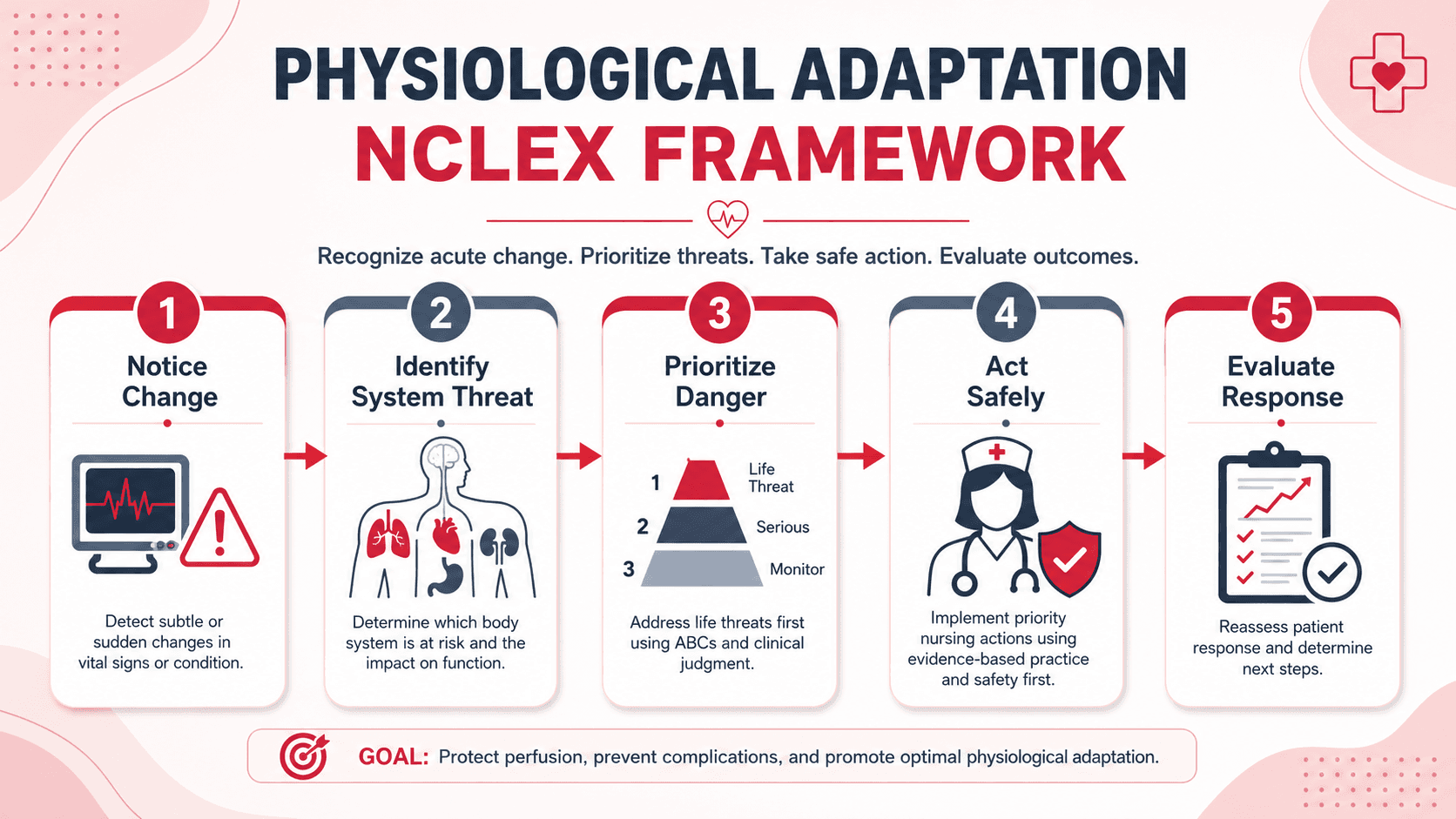
The NCLEX Deterioration Framework
Use this five-step method — it mirrors the same clinical judgment the exam measures.
1. Notice the change
Ask: What is different from baseline? Watch for new confusion or decreased level of consciousness, dyspnea or increased work of breathing, falling oxygen saturation, chest pain, hypotension or symptomatic hypertension, tachycardia or bradycardia, weak/absent pulses, cool/clammy/mottled/cyanotic skin, low urine output, new bleeding or increasing drainage, seizure activity, ECG changes, worsening ABGs or electrolytes, and fever with hypotension or altered mental status. A single value matters less than the pattern — NCLEX tests whether you notice the trend before collapse.
2. Identify the system threat
Ask: Which body system is in danger right now? — airway obstruction, impaired gas exchange, poor cardiac output, shock or poor perfusion, neurologic injury, fluid overload or deficit, an electrolyte emergency, acid-base imbalance, infection progressing to sepsis, or a procedure-related complication.
3. Prioritize the danger
Use this order: (1) airway, (2) breathing/oxygenation, (3) circulation/perfusion/bleeding, (4) acute neurologic change, (5) severe metabolic/electrolyte problem, (6) safety threat from deterioration, (7) routine care/teaching/documentation. ABCs still matter, but do not use them mechanically — active hemorrhage, severe hyperkalemia with ECG changes, or new stroke symptoms can be just as urgent as a breathing problem.
4. Act safely within scope
Safe actions may include raising the head of the bed, applying oxygen per order/protocol, staying with the patient, calling rapid response, notifying the provider/RN, obtaining focused data, placing the patient on cardiac/respiratory monitoring, preparing for ordered medications/fluids/labs/imaging/procedures, holding or questioning unsafe medications, implementing seizure/aspiration/fall/bleeding precautions, and reassessing. Avoid independent treatment decisions that require a provider order unless the question gives a standing order, protocol, or emergency scope.
5. Evaluate the response
Ask whether breathing, oxygen saturation, blood pressure/heart rate/perfusion, urine output, mental status, the ECG, and the ABG/lab trend improved — and whether the patient developed a new complication. Physiological Adaptation tests whether you know what improvement or worsening looks like.
Shock and Perfusion: How to Recognize the Pattern
Shock means tissues are not getting enough oxygenated blood to meet metabolic needs. Septic, anaphylactic, and neurogenic shock are the three subtypes of distributive shock.
| Shock type | Main problem | Common cues | Priority nursing thinking |
|---|---|---|---|
| Hypovolemic | Loss of volume | Tachycardia, hypotension, cool clammy skin, flat neck veins, low urine output, bleeding, dehydration | Stop fluid/blood loss, support circulation, anticipate ordered fluids or blood products, monitor urine output and mentation |
| Cardiogenic | Pump failure | Chest pain, pulmonary edema, crackles, JVD, cool extremities, hypotension, dysrhythmias | Support oxygenation, reduce workload as ordered, monitor rhythm/perfusion, avoid fluid overload |
| Septic (distributive) | Infection with vasodilation and capillary leak | Fever or hypothermia, tachycardia, tachypnea, hypotension, altered mental status, elevated lactate, warm skin early | Recognize early; anticipate ordered cultures before antibiotics, lactate, broad-spectrum antibiotics, ~30 mL/kg crystalloid, and norepinephrine if hypotension persists; monitor MAP ≥65, urine output, and lactate; escalate |
| Anaphylactic (distributive) | Severe allergic reaction | Wheezing, stridor, angioedema, hives, hypotension, anxiety, GI symptoms | Stop exposure, call for help, maintain airway, anticipate epinephrine and oxygen, monitor for worsening airway compromise |
| Neurogenic (distributive) | Loss of sympathetic tone (spinal cord injury, often above T6) | Hypotension WITH bradycardia and warm, dry skin below the injury — the bradycardia distinguishes it from other (tachycardic) shocks | Maintain spinal precautions if relevant, support BP as ordered, monitor temperature and perfusion. Do not confuse with spinal shock (areflexia/flaccidity, a neurologic—not circulatory—state) |
| Obstructive | Mechanical blockage of circulation | JVD, hypotension, dyspnea; muffled heart sounds (tamponade) or absent breath sounds with tracheal deviation (tension pneumothorax); massive PE causes acute right-heart failure | Recognize tension pneumothorax, cardiac tamponade, or massive PE cues and escalate immediately |
High-yield shock cue: Low urine output, altered mental status, weak pulses, and cool skin often show poor perfusion before blood pressure fully collapses.
Respiratory Distress and Failure
Urgent respiratory cues include stridor, severe dyspnea, accessory-muscle use, cyanosis, inability to speak full sentences, falling oxygen saturation, new confusion/restlessness, slow respirations after opioids/sedation, crackles with fluid overload, a silent chest in severe asthma, and worsening PaCO₂ or pH on ABG.
COPD oxygen safety
Pulmonary edema often presents with dyspnea, crackles, hypoxemia, pink frothy sputum in severe cases, anxiety, and sudden weight gain. Priority actions may include high-Fowler’s positioning, oxygen as ordered, respiratory assessment, provider/RN notification, and preparing for ordered diuretics.
Opioid or sedation-related respiratory depression shows a falling respiratory rate, a hard -to-arouse client, falling oxygen saturation, and possibly pinpoint pupils. Support airway and breathing first (sedation precedes respiratory depression), call for help, and anticipate naloxone per order/protocol — naloxone is shorter-acting than many opioids, so monitor closely for re-sedation.
Fluids, Electrolytes, and ABGs
Fluid and electrolyte problems become Physiological Adaptation questions when the patient is symptomatic or unstable — see the full fluid and electrolyte imbalance guide. High-priority patterns include hyperkalemia with ECG changes, hyponatremia with seizures, fluid overload with respiratory distress, dehydration with hypotension, hypocalcemia with tetany after thyroid surgery, hypermagnesemia with decreased reflexes and respiratory depression, metabolic acidosis with shock or DKA, and respiratory acidosis with hypoventilation or COPD exacerbation.
| Pattern | Meaning | Common causes |
|---|---|---|
| Low pH + high PaCO₂ | Respiratory acidosis | Hypoventilation, COPD exacerbation, respiratory depression |
| High pH + low PaCO₂ | Respiratory alkalosis | Hyperventilation, anxiety, pain, early sepsis, hypoxemia |
| Low pH + low HCO₃ | Metabolic acidosis | DKA, renal failure, shock, severe diarrhea |
| High pH + high HCO₃ | Metabolic alkalosis | Vomiting, NG suction, diuretics |
Always interpret ABGs with the patient’s respiratory effort, oxygenation, diagnosis, and trend. Common study ranges: pH 7.35–7.45, PaCO₂ 35–45 mmHg, HCO₃ 22–26 mEq/L.
DKA, HHS, and Endocrine Emergencies
DKA cues include hyperglycemia, Kussmaul respirations, fruity breath, dehydration, abdominal pain, metabolic acidosis, and altered mental status.
The DKA potassium rule
HHS presents with very high glucose, severe dehydration, altered mental status, and little or no ketosis, often in an older adult with type 2 diabetes. Priority thinking: fluid resuscitation as ordered, neurologic monitoring, glucose/electrolyte trends, and prevention of shock.
Thyroid and adrenal emergencies NCLEX may test: thyroid storm (fever, tachycardia, hypertension, agitation), myxedema coma (hypothermia, bradycardia, hypotension, decreased mental status), and adrenal crisis (hypotension, weakness, hypoglycemia, hyperkalemia, shock risk). Recognize instability and escalate promptly.
Neurologic Emergencies and Stroke
New neurologic changes are high priority: sudden facial droop, arm weakness, speech difficulty, sudden vision or balance change, new confusion, a severe sudden headache, seizure, decreased level of consciousness, unequal pupils, or a Cushing response with increased ICP.
For suspected stroke, use BE-FAST: Balance, Eyes (vision), Face drooping, Arm weakness, Speech difficulty, Time to activate emergency response. Nursing priorities:
- Identify last-known-well time
- Activate the stroke protocol
- Check blood glucose (hypoglycemia is a stroke mimic)
- Perform a focused neuro assessment
- Maintain airway and aspiration precautions; keep the client NPO until swallowing is screened
- Prepare for ordered imaging and treatment evaluation, and monitor for deterioration
Do not delay stroke activation for routine documentation or nonurgent teaching.
Therapeutic Procedures and Devices
Physiological Adaptation includes care for patients with devices and procedures that can quickly become high risk — many connect to IV therapy and ordered pharmacology.
| Device / procedure | What to monitor | Dangerous cue |
|---|---|---|
| Chest tube | Respiratory status, drainage, bubbling, tidaling, insertion site, system position | Sudden dyspnea, absent breath sounds, tracheal deviation, tube dislodgement, large sudden output |
| Mechanical ventilation | Oxygenation, breath sounds, alarms, secretions, sedation level, synchrony | High-pressure alarm with distress, low-pressure alarm from disconnection, sudden desaturation |
| Surgical drain | Amount, color, trend, site, pain, vital signs | Sudden increase in bright red drainage, hypotension, tachycardia |
| Dialysis | BP, access site, bleeding, weight, electrolytes, mental status | Hypotension, hyperkalemia, access bleeding, disequilibrium symptoms |
| Telemetry | Rhythm, rate, symptoms, electrolytes, perfusion | New dysrhythmia with chest pain, syncope, hypotension, or potassium abnormality |
| Pacemaker | Rate, capture, sensing, pulses, dizziness, syncope | Failure to capture, symptomatic bradycardia, loss of pulse |
| Tracheostomy | Airway patency, secretions, oxygenation, stoma, emergency supplies | Respiratory distress, dislodgement, obstruction, bleeding |
| Ostomy | Stoma color, output, skin, hydration | Dusky/black stoma, no output with pain/distention, severe dehydration |
How NGN Tests Physiological Adaptation
NGN cases often show physiologic decline over time across tabs such as nurses’ notes, vital signs, labs, ABGs, the MAR, intake/output, provider orders, and diagnostic reports. Work the Next Generation NCLEX method — recognize cues, analyze which system is failing, prioritize the most dangerous hypothesis, generate safe interventions, take action, and evaluate. The same content appears across the full range of NCLEX question types:
| NGN item type | Physiological Adaptation example |
|---|---|
| Case study | Track sepsis progression from fever and tachycardia to hypotension and low urine output |
| Matrix | Mark findings as expected, concerning, or requiring immediate follow-up |
| Bow-tie | Match the shock type with priority actions and monitoring outcomes |
| SATA | Select interventions for pulmonary edema, DKA, seizure precautions, or a chest-tube complication |
| Highlight | Identify cues that show deterioration |
| Trend | Compare labs, ABGs, vital signs, urine output, and weight over time |
Practice Physiological Adaptation Questions
Practice Physiological Adaptation questions with shock, ABGs, fluid/electrolytes, and emergency-care rationales that explain why unsafe distractors are wrong.
Start PracticingNCLEX-Style Practice Scenarios
Scenario 1 — Pulmonary edema
A client with heart failure has worsening dyspnea, crackles in both lung bases, 3+ edema, respiratory rate 28/min, and oxygen saturation 88% on room air.
What should the nurse do first?
- A. Teach the client about sodium restriction
- B. Place the client flat to improve venous return
- C. Raise the head of the bed and apply oxygen according to protocol/order
- D. Prepare the client for immediate cardioversion
Rationale: The client has impaired oxygenation and signs of fluid overload. High-Fowler's positioning and oxygen support breathing while the nurse assesses and escalates and anticipates ordered diuretics. Teaching is not the priority during respiratory distress, and these actions are done together, not as a forced either/or.
Scenario 2 — DKA and potassium monitoring
A client with DKA is started on IV fluids and insulin therapy. The nurse reviews serial potassium levels.
Which finding requires close follow-up during insulin treatment?
- A. Potassium trending downward from 4.8 to 3.4 mEq/L
- B. Glucose trending downward from 650 to 420 mg/dL
- C. Respiratory rate decreasing as acidosis improves
- D. Fruity breath becoming less noticeable
Rationale: Insulin shifts potassium into cells, so serum potassium can fall during treatment even when total-body potassium is depleted. Hypokalemia increases dysrhythmia risk and may require replacement per protocol. Potassium is checked before insulin is started, and insulin is typically held with replacement first if potassium is already low.
Scenario 3 — COPD exacerbation
A client with a COPD exacerbation is using accessory muscles. Oxygen saturation is 84% on room air. The client is anxious and speaking in short phrases.
What is the safest nursing action?
- A. Withhold oxygen because COPD clients rely on hypoxic drive
- B. Apply controlled oxygen according to order/protocol and monitor response
- C. Encourage the client to ambulate to improve ventilation
- D. Offer oral fluids and reassess in one hour
Rationale: Hypoxemia is dangerous and oxygen is never withheld from a hypoxemic client. Controlled oxygen should be titrated to ordered targets (often about 88–92% when CO₂ retention is a risk) while monitoring respiratory effort, mental status, SpO₂, and ABGs, and escalating to noninvasive ventilation if respiratory acidosis worsens.
Scenario 4 — Sepsis deterioration
A client admitted with pneumonia now has temperature 39.1°C, heart rate 124/min, respiratory rate 30/min, blood pressure 86/48 mmHg, confusion, and urine output 15 mL/hr.
What is the priority?
- A. Document the findings and reassess in 4 hours
- B. Encourage deep breathing and coughing only
- C. Recognize possible septic shock and activate urgent escalation
- D. Provide discharge teaching about antibiotics
Rationale: Fever, tachycardia, tachypnea, hypotension, confusion, and low urine output suggest sepsis with poor perfusion. The nurse should escalate immediately and anticipate ordered sepsis care — cultures before antibiotics, lactate, broad-spectrum antibiotics, fluid resuscitation, and vasopressors if hypotension persists.
Scenario 5 — Suspected stroke
A client suddenly develops facial drooping, slurred speech, and right arm weakness. The family says the client was normal 40 minutes ago.
What should the nurse do first?
- A. Give oral fluids to prevent dehydration
- B. Activate stroke protocol and determine last-known-well time
- C. Wait to see whether symptoms resolve
- D. Place the client in Trendelenburg position
Rationale: Sudden focal neurologic deficits are stroke warning signs and time is critical. Activate stroke response, identify last-known-well, check blood glucose (hypoglycemia is a stroke mimic), assess neurologic status, keep the client NPO until a swallow screen, and prepare for ordered imaging and treatment evaluation.
Common Physiological Adaptation Traps
Trap 1: “Assess” when the patient needs action
Assessment matters, but obvious life-threatening cues require immediate action and escalation, not more data-gathering.
Trap 2: Withholding oxygen in COPD
Use controlled oxygen and monitor response. Do not leave a hypoxemic client unoxygenated because of the oversimplified “hypoxic drive” rule.
Trap 3: Treating the lab, not the patient
A lab value matters more when it matches symptoms, ECG changes, trends, medications, or renal/cardiac risk.
Trap 4: Forgetting potassium during DKA
Insulin can rapidly lower serum potassium. Check potassium before insulin and monitor potassium and rhythm during treatment.
Trap 5: Documenting before stabilizing
Document after urgent safety actions are started. Do not document first during respiratory distress, shock, stroke, seizure, or severe dysrhythmia.
Trap 6: Missing early shock
A normal blood pressure does not rule out early shock. Watch for tachycardia, low urine output, cool skin, altered mental status, and rising lactate.
Trap 7: Acting outside scope or without an order
Medication, IV-fluid, oxygen, and device actions must be supported by orders, protocols, scope, and facility policy.
Practice Physiological Adaptation With RN Test Pro
Physiological Adaptation gets easier when you practice the same reasoning pattern repeatedly:
- Recognize deterioration
- Connect cues to the body system at risk
- Prioritize airway, breathing, circulation, perfusion, and neuro status
- Choose safe nursing actions
- Evaluate whether the patient improves
- Learn why unsafe distractors are wrong
RN Test Pro helps you practice shock, respiratory failure, ABGs, fluid/electrolytes, DKA, stroke, sepsis, postoperative complications, and NGN case studies with clinical-judgment rationales. Turn your review into a schedule with an NCLEX study plan, and compare this category with Reduction of Risk Potential and infection control.
Frequently Asked Questions
What percentage of NCLEX is Physiological Adaptation?
On the 2026 test plans, Physiological Adaptation accounts for 11–17% of NCLEX-RN content-area items and 7–13% of NCLEX-PN content-area items.
What is the main idea of Physiological Adaptation?
It tests whether you can care for clients with acute, chronic, or life-threatening physical health conditions. The exam focuses on recognizing deterioration, prioritizing interventions, managing complications, and evaluating treatment response.
What topics are highest yield?
Shock, respiratory distress, sepsis, fluid/electrolyte imbalance, ABGs, DKA/HHS, stroke, postoperative complications, chest tubes, ventilators, dialysis, telemetry, and emergency response are high-yield topics.
How do I answer shock questions?
Identify the likely shock type, then prioritize perfusion and oxygenation. Watch for hypotension, tachycardia, altered mental status, low urine output, cool skin, rising lactate, or signs of bleeding/infection. Remember neurogenic shock is the exception — it pairs hypotension with bradycardia.
What should I remember about COPD oxygen questions?
Do not withhold oxygen from a hypoxemic COPD client. Use controlled oxygen delivery, follow ordered targets (often about 88–92% when CO₂ retention is a risk), and monitor for CO₂ retention or worsening respiratory status, escalating to noninvasive ventilation if acidosis worsens.
What is the DKA potassium trap?
Total-body potassium is often depleted, but serum potassium may look high, normal, or low at first. Potassium is checked before insulin, insulin is typically held with replacement first if potassium is low, and once insulin starts serum potassium can drop quickly.
What is the difference between Reduction of Risk Potential and Physiological Adaptation?
Reduction of Risk Potential focuses on catching complications early and preventing worsening. Physiological Adaptation focuses more on managing active acute, chronic, or life-threatening physiologic problems.
How does NGN test this category?
NGN often gives changing vital signs, labs, ABGs, intake/output, medications, and nursing notes. You must recognize cues, interpret trends, prioritize the main problem, choose safe actions, and evaluate outcomes.
Build Emergency-Recognition Confidence the Way NCLEX Tests It
Practice shock, ABGs, DKA, stroke, and sepsis scenarios with clinical-judgment rationales, and track your weak high-acuity areas.
Get Started FreeRelated Topics
Fluid & Electrolytes
Lab values, ABGs, and IV-fluid safety in one place.
Reduction of Risk Potential
Catching complications early vs managing active deterioration.
IV Therapy
IV fluids, sepsis/DKA fluids, access, and complications.
Infection Control
From infection to sepsis, plus device-related prevention.
Clinical Judgment (CJMM)
The reasoning model behind NGN deterioration cases.