Management of Care NCLEX: Prioritization, Delegation, and RN Leadership
One of the most important NCLEX-RN areas—and the single largest subcategory on the exam. It tests whether you can keep patients safe while coordinating care, setting priorities, delegating appropriately, and using nursing judgment.
This is not just a “leadership” topic. On the NCLEX, Management of Care questions often ask:
- Which patient should the nurse assess first?
- Which task can be delegated?
- Which assignment is safest for an LPN/LVN or UAP?
- What should the nurse do when a patient refuses treatment?
- What information must be included in handoff?
- When should the nurse escalate a concern?
The safest way to answer these questions is to slow down, identify the patient risk, decide what requires RN judgment, and then choose the action that protects the patient.
Management of Care at a Glance
Management of Care is a subcategory under Safe and Effective Care Environment on the NCLEX-RN test plan. That parent category has two subcategories: Management of Care and Safety and Infection Prevention and Control.
Under the current NCSBN NCLEX-RN test plan (effective April 2026, unchanged from the prior 2023 plan), Management of Care accounts for 15–21% of content-area items — the single largest subcategory on the exam.
It includes nursing responsibilities such as:
- Prioritizing care based on acuity
- Delegating and supervising care
- Providing and receiving handoff
- Advocating for client rights and needs
- Maintaining confidentiality and privacy
- Participating in quality improvement
- Collaborating with the health care team
- Verifying orders and consent
- Using referrals and resources
- Recognizing legal and ethical responsibilities
For RN candidates, this area matters because the RN is responsible for clinical judgment, care coordination, delegation decisions, and evaluation of outcomes.
About this guide
What Management of Care Questions Are Really Asking
Most Management of Care questions are not asking whether you memorized a rule. They are asking whether you can make a safe nursing decision when several things are happening at once.
A strong Management of Care answer usually does one of these:
- Protects the patient from immediate harm
- Keeps unstable patients with the RN
- Delegates only predictable, routine tasks
- Uses the appropriate team member
- Communicates clearly and specifically
- Respects patient rights and informed choices
- Follows the nursing process
- Escalates when the situation is outside the nurse’s authority or competence
A weak answer often does the opposite:
- Delegates assessment or nursing judgment
- Focuses on convenience instead of safety
- Delays care for an unstable patient
- Lets family override a competent adult patient
- Gives vague instructions to UAP
- Treats a new or worsening finding as routine
- Acts outside scope or facility policy
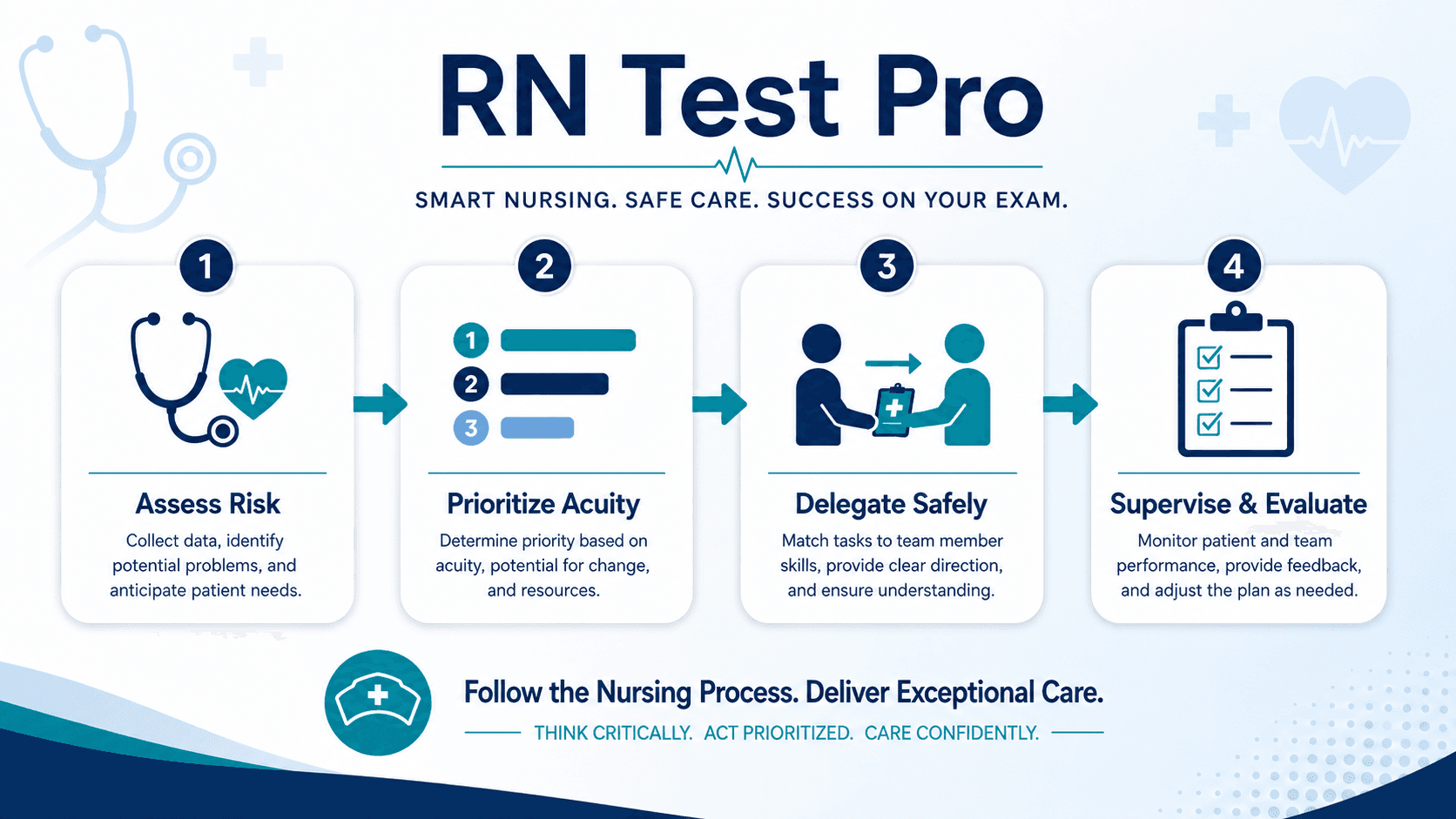
The RN Decision Framework
Use this framework when you see a Management of Care question.
1. Assess the risk
Ask: “Is anyone unstable or at risk of immediate harm?” Look for:
- Airway or breathing changes
- Circulation problems
- New confusion or neurological change
- Hemorrhage or shock signs
- Chest pain
- Severe allergic reaction
- Sepsis cues
- Sudden change from baseline
- Safety threats such as suicide risk, abuse, falls, or violence
An unstable patient usually requires RN assessment and action before routine tasks.
2. Decide what requires RN judgment
The RN should retain tasks that require:
- Initial or focused assessment
- Interpretation of data
- Care planning
- Patient teaching that requires nursing judgment
- Evaluation of patient response
- Triage or prioritization
- Clinical decisions for unstable patients
- Complex communication or escalation
A UAP may collect data such as vital signs in appropriate situations, but the RN interprets the findings and decides what they mean.
3. Delegate or assign only when the situation is appropriate
Before delegating, ask:
- Is the patient stable?
- Is the outcome predictable?
- Is the task routine?
- Is the team member trained and competent?
- Is the task allowed by state scope, facility policy, and job description?
- Did the RN give clear instructions and reporting parameters?
- Will the RN follow up and evaluate the outcome?
When those answers are not clear, the RN should not delegate the task as written.
4. Supervise and evaluate
Delegation does not end when the task is assigned. The RN must:
- Give specific directions
- Define when to report back
- Remain available for questions
- Follow up on completion
- Evaluate the patient outcome
- Intervene if the patient condition changes
Delegation on the NCLEX
Delegation questions usually test whether you know the difference between doing a task and using nursing judgment.
The exact scope of LPN/LVN and UAP practice varies by state, facility policy, patient stability, and the competence of the team member. For NCLEX-style questions, use the safest general rule: the RN retains assessment, interpretation, planning, teaching that requires judgment, and evaluation.
| Team member | Often appropriate when the patient is stable and policy allows | Do not assign or delegate |
|---|---|---|
| RN | Initial assessment, unstable patients, care planning, teaching, evaluation, complex decision-making, triage, provider communication for significant changes | RN-only judgment tasks should not be passed to others |
| LPN/LVN | Focused data collection, routine medication administration when allowed, dressing changes, care for stable patients with predictable outcomes, reinforcement of teaching | Initial assessment, independent care planning, evaluation of outcomes, triage of unstable patients, complex teaching |
| UAP | Hygiene, ambulation for stable patients, feeding low-risk patients, routine vital signs, intake/output, repositioning, specimen collection if trained | Assessment, interpretation, teaching, medication administration, sterile or invasive procedures, decisions about unstable patients |
The Five Rights of Delegation
Use the Five Rights to test whether the delegation is safe:
- Right task — Is the task appropriate to delegate?
- Right circumstance — Is the patient stable and the situation predictable?
- Right person — Is the team member competent and allowed to perform it?
- Right direction and communication — Were instructions clear and specific?
- Right supervision and evaluation — Will the RN monitor, follow up, and evaluate the result?
What the RN should usually retain
The RN should usually keep responsibility for:
- Initial admission assessment
- Assessment of new or worsening symptoms
- Clinical interpretation of vital signs, labs, or trends
- Care plan development or revision
- Discharge teaching that requires nursing judgment
- Evaluation of whether an intervention worked
- Prioritizing multiple unstable patients
- Contacting the provider about significant changes
- Ethical or legal conflicts requiring advocacy
Prioritization Frameworks That Actually Help
NCLEX priority questions often include several reasonable actions. The correct answer is the safest action for the current situation. For focused drilling, see our guide to NCLEX priority questions.
ABCs: airway, breathing, circulation
Start with airway, breathing, and circulation when the patient may be unstable. Examples:
- Stridor, choking, severe respiratory distress: airway
- Low oxygen saturation, dyspnea, crackles, increasing work of breathing: breathing
- Hypotension, bleeding, weak pulse, signs of shock: circulation
ABCs are most useful when there is a real physiologic threat. Do not use ABCs mechanically if the scenario is stable and asking about teaching, delegation, or legal rights.
Unstable before stable
A new or worsening change usually takes priority over a chronic, expected, or stable finding.
- New confusion in a patient with atrial fibrillation is more urgent than chronic joint pain.
- Sudden shortness of breath after surgery is more urgent than routine discharge teaching.
Acute before chronic
Acute problems generally outrank chronic stable problems.
- New chest pain is more urgent than long-term hypertension education.
- New unilateral weakness is more urgent than a scheduled dressing change.
Actual problem before potential problem
A current threat usually outranks a possible future problem.
- Active bleeding is more urgent than a future fall-risk teaching plan.
- Current hypoglycemia is more urgent than later nutrition teaching.
Assessment before action — but not always
If the nurse lacks enough data, assessment is often first. But when the problem is already clear and life-threatening, immediate action may be first.
- If a patient is not breathing, begin emergency response rather than asking more questions.
- If a patient reports mild nausea after a new medication, assess further before escalating.
Legal, Ethical, and Communication Topics
Management of Care includes more than priority and delegation. It also tests whether the nurse protects patient rights and communicates safely. For a deeper treatment, see ethical practice on the NCLEX.
Informed consent and refusal
The provider is responsible for explaining the procedure, risks, benefits, and alternatives. The nurse’s role is to verify that the patient appears informed, voluntary, and able to ask questions.
If the patient does not understand the procedure, the nurse should stop the process and notify the provider.
If a competent adult refuses treatment, the nurse should respect the refusal, assess understanding, notify the provider, document objectively, and support discussion of appropriate alternatives.
Confidentiality and privacy
The nurse must protect patient information. NCLEX questions may test social media, hallway conversations, accessing charts without need, or sharing information with family members without permission.
Mandatory reporting
The nurse must recognize situations that require reporting according to law and policy, such as suspected abuse, neglect, certain communicable diseases, or threats of harm.
Handoff and SBAR
Safe handoff includes the information the next nurse needs to continue care safely. A strong SBAR handoff includes:
- Situation: What is happening now?
- Background: What relevant history or context matters?
- Assessment: What does the nurse observe or interpret?
- Recommendation: What needs to happen next?
Do not give vague handoff such as “patient is fine” when there are pending labs, abnormal findings, new medications, or unresolved concerns.
Advance directives and patient rights
Management of Care questions may ask what the nurse should do when family wishes conflict with the patient’s documented wishes. The nurse should advocate for the patient’s known preferences and escalate through the appropriate chain of command or ethics resources when needed.
How NGN Tests Management of Care
NGN questions may test Management of Care through case studies, matrix items, bow-tie items, SATA, or stand-alone clinical judgment items — see the Next Generation NCLEX guide and the full range of NCLEX question types. The same topic can appear at different clinical judgment steps:
| CJMM step | Management of Care example |
|---|---|
| Recognize cues | Identify which patient report contains the most urgent safety concern |
| Analyze cues | Determine whether a finding suggests deterioration or routine care |
| Prioritize hypotheses | Decide which patient problem requires immediate attention |
| Generate solutions | Choose the safest plan for delegation, communication, or escalation |
| Take action | Select the best first nursing action |
| Evaluate outcomes | Decide whether delegated care, teaching, or escalation was effective |
The key is not memorizing the item format. The key is recognizing what kind of judgment the question is asking you to make.
Worked NCLEX-Style Examples
Example 1 — Which patient should the RN assess first?
The nurse receives report on four patients:
- 1. A postoperative day 1 patient reporting sudden shortness of breath and chest pain
- 2. A patient with chronic arthritis requesting help repositioning
- 3. A patient awaiting discharge teaching for a new medication
- 4. A stable patient requesting assistance with a meal tray
Rationale: Sudden shortness of breath and chest pain after surgery may indicate a life-threatening respiratory or circulatory complication. This patient is unstable and requires immediate RN assessment.
Example 2 — What can be delegated to UAP?
The RN is caring for four patients. Which task is most appropriate to delegate to unlicensed assistive personnel (UAP)?
- A. Teach a patient how to use a new anticoagulant
- B. Assess a patient with new confusion
- C. Ambulate a stable postoperative patient according to the activity order
- D. Evaluate whether pain medication was effective
Rationale: Ambulating a stable patient according to clear instructions is a routine task that may be appropriate for UAP. Teaching, assessment of a new change, and evaluation require nursing judgment and should remain with the RN.
Example 3 — Patient refuses treatment
A competent adult patient refuses a blood transfusion after the provider explains the risks and benefits. The family demands that the nurse “make the patient accept it.”
- A. Tell the family they can sign consent for the patient
- B. Respect the patient’s refusal and notify the provider of the decision
- C. Begin the transfusion because the treatment is medically necessary
- D. Ask the UAP to convince the patient while the nurse prepares supplies
Rationale: A competent adult has the right to refuse treatment. The nurse should support patient autonomy, verify understanding, notify the provider, document objectively, and help facilitate further discussion if needed.
Practice Management of Care Questions
Practice Management of Care questions with delegation, prioritization, and NGN-style rationales that explain why unsafe distractors are wrong.
Start PracticingCommon Management of Care Traps
Trap 1: Delegating because the RN is busy
NCLEX does not reward unsafe delegation just because the nurse has limited time. Patient safety comes before convenience.
Trap 2: Treating data collection as assessment
A UAP may collect vital signs in appropriate situations. The RN interprets abnormal findings and decides what to do next.
Trap 3: Ignoring patient stability
Stable, predictable patients are more appropriate for delegation or assignment to LPN/LVN or UAP. Unstable or changing patients usually require RN judgment.
Trap 4: Letting family override the patient
Family input matters, but a competent adult patient’s informed decision takes priority.
Trap 5: Choosing teaching before safety
Teaching is important, but immediate physiologic or safety threats come first.
Trap 6: Forgetting follow-up
Delegation requires supervision and evaluation. The RN must confirm the task was completed and decide whether the outcome is safe.
Practice Management of Care With RN Test Pro
Management of Care improves when you practice the reasoning, not just the vocabulary. RN Test Pro helps you practice:
- Prioritization questions
- Delegation decisions
- RN vs LPN/LVN vs UAP scenarios
- NGN-style case studies
- Rationales that explain why unsafe distractors are wrong
- Weak-area tracking by NCLEX category
Start with a diagnostic quiz, then focus your practice on delegation, priority-setting, and clinical judgment. If you want a structured schedule, build an NCLEX study plan, or go deeper with RN Management of Care practice.
Frequently Asked Questions
Is Management of Care only for RN candidates?
Management of Care is an NCLEX-RN subcategory. PN candidates are tested on the related PN subcategory called Coordinated Care. RN questions place more emphasis on delegation, supervision, prioritization, leadership, and evaluation of care.
What percentage of the NCLEX-RN is Management of Care?
Under the current NCSBN NCLEX-RN test plan (effective April 2026, unchanged from the prior 2023 plan), Management of Care accounts for 15–21% of content-area items — the single largest subcategory.
Can the RN delegate assessment?
No. The RN should not delegate nursing assessment, interpretation, care planning, or evaluation. A team member may collect data if appropriate, but the RN interprets the data and decides what it means.
Can UAP take vital signs?
Yes, in appropriate stable situations and when trained. The RN must give clear instructions, define what to report, and interpret the findings.
Can an LPN/LVN administer medications?
It depends on state scope, facility policy, patient condition, medication type, route, order/protocol, and competence. On NCLEX-RN questions, keep complex, unstable, or judgment-heavy medication situations with the RN.
What is the safest way to answer delegation questions?
Use the Five Rights of Delegation: right task, right circumstance, right person, right direction/communication, and right supervision/evaluation.
When should I use ABCs vs. Maslow's hierarchy?
Use ABCs (Airway, Breathing, Circulation) for unstable patients—immediate life threats take priority. Use Maslow's hierarchy for stable patients with competing needs: physiological needs before safety, safety before belonging, etc. If a patient has both an ABC issue and a self-esteem concern, ABC wins.
How does CAT affect Management of Care questions?
The NCLEX's Computerized Adaptive Testing (CAT) system presents Management of Care questions calibrated to your ability. If you answer correctly, subsequent questions become more complex—testing nuanced delegation scenarios or advanced prioritization. Questions chosen for YOUR ability level ensure you're challenged appropriately.
Build Clinical Judgment for Management of Care
Practice Management of Care questions with delegation, prioritization, and NGN-style rationales, and track your weak areas by NCLEX category.
Get Started FreeRelated Topics
NCLEX Priority Questions
Frameworks to rank patients and choose the safest first action.
Ethical Practice
Consent, refusal, confidentiality, and patient advocacy on the NCLEX.
Safety & Infection Control
The other subcategory under Safe and Effective Care Environment.
Clinical Judgment (CJMM)
The six-step model NGN uses to measure your decision-making.
Next Generation NCLEX
Case studies, matrix, and bow-tie items that test care management.
RN Management of Care
Applied RN practice on delegation, prioritization, and ethical dilemmas.