NCLEX-PN NGN Strategies: Clinical Judgment, Case Studies, and Scope-Safe Answers
Next Generation NCLEX questions test whether you can think through a patient situation, recognize what matters, act safely within practical/vocational nursing scope, and communicate changes clearly.
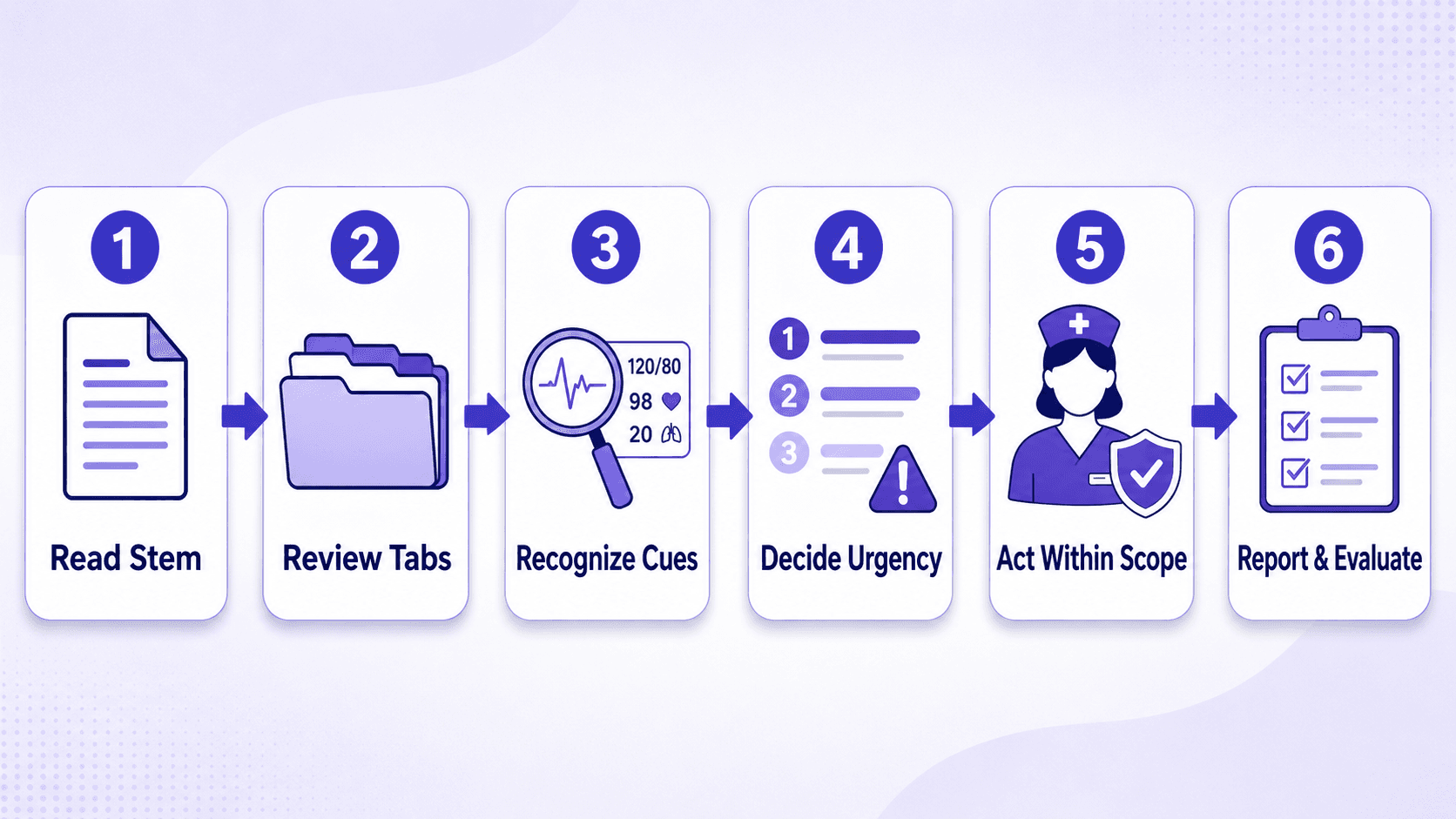
For PN candidates, NGN success is not about memorizing item names. It is about answering one question:
What is the safest practical nursing action for this patient right now?
That may mean providing direct care. It may mean collecting more data. It may mean reporting a significant change to the RN or provider according to policy. It may also mean avoiding an answer that sounds helpful but goes beyond PN scope.
PN NGN at a Glance
NGN is not a separate exam. It is the current Next Generation NCLEX format with stronger emphasis on clinical judgment. On the NCLEX-PN, clinical judgment is tested through:
- Three scored case-study item sets, totaling 18 items (six items per case, one for each clinical judgment step)
- Additional stand-alone clinical judgment items — approximately 10%, selected depending on exam length
- An exam that is 85 to 150 items over a five-hour period (each exam also includes unscored pretest items)
- Item formats such as matrix, bow-tie, cloze/drop-down, highlight, trend, extended multiple response, and traditional multiple choice
There is no fixed percentage for each NGN item format. Do not try to predict how many bow-tie or matrix questions you will get. Prepare for the reasoning underneath all formats, and see how these formats work in our NCLEX question types guide and the broader Client Needs blueprint.
Scope reminder
About this guide
What NGN Is Testing on the NCLEX-PN
NGN questions measure clinical judgment. For PN candidates, that means you must be able to:
- Recognize abnormal findings and changes from baseline
- Decide which cues are most important
- Identify when a patient may be deteriorating
- Provide safe interventions within PN scope
- Follow the plan of care and facility policy
- Communicate clearly with the RN or health care team
- Document relevant findings
- Evaluate and report the patient’s response
A strong PN answer is usually safe, specific, and within scope. A weak PN answer often does one of these:
- Delays care for a serious change
- Tries to diagnose instead of reporting findings
- Changes medication, IV fluid, or oxygen therapy without an order or protocol
- Ignores patient safety
- Selects every possible option instead of only defensible options
- Documents before addressing an urgent problem
- Treats a new abnormal finding as routine
The Six Clinical Judgment Steps for PN Candidates
The NCSBN Clinical Judgment Measurement Model, often shortened to NCJMM or CJMM, is the testing framework used to measure clinical judgment on NGN items. It is commonly taught as six steps. You do not need to recite the model during the exam, but you do need to think through it — see our full clinical judgment guide for the model itself.
1. Recognize cues
Ask: What patient information matters? Cues include vital signs, pain reports, mental status, skin color and temperature, intake and output, lab values with reference ranges, new symptoms, changes from baseline, medication timing, safety risks, and family or caregiver statements.
PN example: A patient who was alert this morning is now confused, diaphoretic, and tremulous. Those are important cues because they may indicate hypoglycemia, a medication effect, infection, or another urgent change.
2. Analyze cues
Ask: What do these findings mean together? Do not treat every abnormal finding as equally important — look for clusters. A falling blood pressure, rising heart rate, cool pale skin, and increased surgical drainage are more concerning together than any one finding alone, and suggest possible bleeding or hypovolemia.
3. Prioritize hypotheses
Ask: What is the most urgent concern? Use airway/breathing/circulation, new or worsening change, actual before potential, unstable before stable, and safety risk before routine care. A patient whose oxygen saturation drops from 94% to 89% with new shortness of breath is more urgent than a stable patient waiting for routine hygiene.
4. Generate solutions
Ask: What actions would help, and which are within PN scope? PN-level solutions may include repositioning, checking vital signs or blood glucose, maintaining safety, following an existing protocol, providing allowed direct care, reporting findings, and documenting after urgent needs are addressed. Avoid actions that require independent diagnosis, new provider orders, or out-of-scope changes to treatment.
5. Take action
Ask: What should be done first? The first action should match the urgency.
- For possible hypoglycemia in an awake patient who can swallow: give fast-acting carbohydrate per protocol, then reassess and report.
- For new respiratory distress: position upright, verify oxygen delivery, follow existing orders or protocol if allowed, and notify the RN immediately.
- For suspected bleeding after surgery: keep the patient safe, obtain current data as needed, and report the change urgently.
6. Evaluate outcomes
Ask: Did the patient improve, worsen, or need escalation? Evaluation may include rechecking vital signs or blood glucose, reassessing respiratory status, observing for adverse medication effects, reporting whether the intervention worked, and documenting the response. Do not stop at “task completed” — NGN often tests whether you know what response should happen next.
A Scope-Safe Strategy for Every PN NGN Item
Use this method on case studies, matrix questions, bow-tie items, SATA, and stand-alone NGN questions.
Step 1: Read the question before studying every detail
Find out what the item is asking: Which cues matter? What do they mean? What is the priority? What action should the PN take? What outcome should the PN expect? What should be reported?
Step 2: Review all available exhibit tabs
NGN items may include nurses’ notes, vital signs, labs, medication records, intake/output, provider orders, or progress notes. Do not answer from one tab if the case gives multiple tabs — the key cue may be a trend.
Step 3: Look for change from baseline
A new change is often more important than a single abnormal number: heart rate 112 when baseline was 82, oxygen saturation 89% when baseline was 94%, new confusion, new crackles, increasing drainage, sudden weakness, or a new rash after a medication.
Step 4: Decide whether the action is within PN scope
Ask: Is this direct care I can provide? Is this data collection or interpretation? Is there an existing order or protocol? Does this require RN assessment, provider notification, or emergency response? Is the patient stable or changing?
Step 5: Choose only defensible answers
For SATA and matrix items, do not select an option just because it sounds partly related. For each option ask: Is it safe? Is it within PN scope? Is it supported by the scenario? Is it needed now? Could it cause harm or delay care? If you cannot clinically defend the option, do not select it.
PN Scope: What to Do, What to Report, What to Avoid
This table is a study guide, not a state practice act. Always follow your state scope, facility policy, job description, and supervision requirements. PN/LPN/VN assignment and delegation authority varies by jurisdiction.
| Situation | Usually appropriate PN action | Report or escalate when | Avoid choosing |
|---|---|---|---|
| Stable patient needs routine care | Provide hygiene, mobility help, feeding assistance, comfort measures, and ordered care | Patient becomes unstable, refuses care, or has a new symptom | Ignoring changes because the task is routine |
| New abnormal vital sign | Recheck if appropriate, compare with baseline, assess related symptoms, report significant change | Abnormal finding is new, worsening, or paired with symptoms | Treating abnormal trends as routine |
| Medication concern | Verify the order, check the rights, monitor for expected and adverse effects, report concerns | Dose seems unsafe, an allergy exists, an adverse reaction occurs, or the patient refuses | Changing the dose or holding a medication without policy or order guidance |
| Hypoglycemia symptoms | Check glucose; give fast-acting carbohydrate if the patient is awake and can swallow safely, per protocol; reassess | Altered mental status, unsafe swallowing, persistent low glucose, or worsening symptoms | Giving oral intake to a patient who cannot swallow safely |
| Respiratory distress | Position upright, verify oxygen setup, stay with the patient, follow ordered parameters if allowed | New dyspnea, falling oxygen saturation, cyanosis, or worsening work of breathing | Independently making unsupported oxygen or medication changes |
| Postoperative change | Collect current data, maintain safety, report increasing pain, bleeding, drainage, dizziness, or unstable vitals | Signs of hemorrhage, shock, infection, respiratory compromise, or sudden neuro change | Waiting to document before escalating urgent findings |
| Patient teaching | Reinforce teaching and clarify routine instructions within the care plan | New questions that require provider/RN explanation, or the patient misunderstands high-risk care | Providing complex teaching outside your role or inventing instructions |
| Delegation / assignment | Follow the assignment, communicate clearly, and perform tasks within your competence | An assigned task is unsafe, outside scope, or the patient's condition changes | Accepting an unsafe assignment without speaking up |
How to Handle Each NGN Item Type
The same reasoning works across formats. For a deeper look at each format, see the NCLEX question types guide.
| Item type | What to do |
|---|---|
| Case study | Read the stem, review all tabs, track changes over time, and answer each item based on the current question. |
| Bow-tie | Identify the main problem first, then match the actions and the monitoring/outcomes that fit that problem. |
| Matrix / grid | Treat each row independently. Do not assume one row tells you the answer to another row. |
| Highlight | Highlight only cues that change the patient's priority, risk, or action. Do not highlight every abnormal detail. |
| Cloze / drop-down | Read the full sentence before choosing. The selected words must make clinical sense together. |
| Trend | Compare current data with prior data. The trend is often more important than one number. |
| SATA / extended multiple response | Treat each option as true or false. Select only options that are safe, supported, and within scope. |
Partial-Credit Strategy Without Overselecting
NGN items may use partial-credit scoring when more than one answer is correct. That helps when you know part of the answer — but partial credit is not permission to guess. Some scoring methods may subtract for incorrect selections, which means overselecting can hurt your score.
Select only what you can defend
PN-Level NGN Practice Scenarios
Scenario 1 — Postoperative patient with a changing condition
You are caring for a 58-year-old patient one day after abdominal surgery. Morning findings:
- • Blood pressure: 102/64 mmHg (previously 128/78)
- • Heart rate: 112/min (previously 82/min)
- • Skin: cool and pale
- • Surgical drain: 200 mL sanguineous drainage (previously 50 mL)
- • Patient says, “I feel dizzy when I sit up.”
Which cues require immediate attention?
- • Drop in blood pressure
- • Increased heart rate
- • Cool, pale skin
- • Increased sanguineous drainage
- • Dizziness when sitting up
Rationale: The findings cluster together and suggest possible bleeding or hypovolemia. The priority is not routine documentation or pain medication. The PN should keep the patient safe, collect current data as needed, and report the findings urgently to the RN or appropriate clinician according to policy.
Scenario 2 — Diabetic patient with possible hypoglycemia
A 62-year-old patient with type 2 diabetes is awake but confused, diaphoretic, and tremulous. The patient skipped lunch. Bedside glucose is 52 mg/dL.
- • Blood glucose: 52 mg/dL
- • Skin: diaphoretic, clammy
- • Neurological: confused, tremulous
- • Vital signs: heart rate 94/min, BP 130/82 mmHg
What is the best first action?
- • Give fast-acting carbohydrate if the patient can swallow safely and facility protocol allows, then reassess and report.
Rationale: The cues indicate hypoglycemia. If the patient is awake and can swallow, fast-acting carbohydrate is a time-sensitive intervention commonly addressed by protocol. If the patient cannot swallow safely or worsens, call for immediate help and do not give oral intake.
Scenario 3 — Patient with new respiratory symptoms
A 71-year-old patient admitted for heart failure has been stable on oxygen by nasal cannula. Current findings:
- • Respiratory rate: 28/min (previously 18/min)
- • Oxygen saturation: 89% (previously 94%)
- • New crackles in bilateral lower lobes
- • Patient says, “I can’t catch my breath.”
- • Patient is sitting upright and leaning forward
Which actions are appropriate for the PN? (Select all that apply.)
- • Maintain upright positioning
- • Verify oxygen delivery and tubing placement
- • Notify the RN immediately
- • Stay with the patient and monitor closely
- • Document findings after urgent action is underway
Rationale: This is a new respiratory change. The PN should support breathing, avoid delay, and escalate promptly. Documentation matters, but it is not the first priority when the patient is showing respiratory distress. Do not independently make unsupported oxygen or medication changes.
Practice PN NGN Case Studies
Practice PN NGN case studies with scope-safe rationales that explain why unsafe or out-of-scope distractors are wrong.
Start PracticingCommon PN NGN Traps
Trap 1: “Report to the RN” for everything
Reporting is important, but it is not always the only action. If the patient needs immediate safe direct care within PN scope, do not delay that care.
Trap 2: Acting outside scope because the option sounds helpful
An answer can sound clinically reasonable and still be wrong if it requires an order, protocol, RN assessment, provider decision, or action outside PN scope.
Trap 3: Ignoring baseline changes
A value may look only mildly abnormal, but a major change from baseline can signal deterioration.
Trap 4: Selecting too many SATA options
Partial credit can help, but overselecting can lose points. Pick only what is safe, supported, and within scope.
Trap 5: Documenting before addressing urgent needs
Document after urgent safety actions are started. Do not choose documentation as the first action when the patient is unstable.
Trap 6: Treating ABCs as the only rule
ABCs matter, but NGN questions also test safety, trends, scope, communication, patient rights, and evaluation of outcomes.
Practice PN NGN Questions With RN Test Pro
PN NGN questions get easier when you practice the reasoning pattern:
- Identify the cue
- Interpret the cue
- Decide urgency
- Act within PN scope
- Report or escalate when needed
- Evaluate the response
RN Test Pro helps you practice PN-level NGN case studies, item formats, partial-credit questions, and rationales written around practical/vocational nursing scope. Start PN NGN practice and review rationales that explain why unsafe or out-of-scope distractors are wrong — then turn it into a schedule with an NCLEX study plan, or read broader PN NCLEX strategies.
Frequently Asked Questions
Is NGN different for PN candidates?
The clinical judgment framework is the same, but the content matches PN entry-level scope. PN questions emphasize coordinated care, direct care, safety, communication, data collection, and escalation of significant changes.
How many NGN questions are on the NCLEX-PN?
Every candidate receives three scored clinical judgment case-study item sets, totaling 18 items (six items per case, one for each clinical judgment step). Additional stand-alone clinical judgment items make up approximately 10% of the exam, selected depending on exam length. That 10% figure refers to stand-alone clinical judgment items overall—NCSBN does not publish a fixed percentage for any individual item format (bow-tie, matrix, cloze, and so on). The NCLEX-PN is 85 to 150 items over a five-hour period.
Should PN candidates always report abnormal findings to the RN?
Report significant, new, worsening, unsafe, or out-of-scope findings. But do not delay immediate direct care that is clearly within PN scope, such as positioning a short-of-breath patient upright or following a hypoglycemia protocol for a patient who can swallow safely.
Can PN candidates get bow-tie or matrix questions?
Yes. PN candidates should be prepared for NGN-style item formats such as bow-tie, matrix, cloze/drop-down, highlight, trend, and extended multiple response. The exact mix is not fixed for every candidate, and there is no published percentage for each format.
How should I approach SATA questions?
Treat each option independently. Select it only if it is safe, supported by the case, within PN scope, and answers the question being asked.
What is the biggest mistake PN candidates make on NGN questions?
The biggest mistake is choosing an answer that sounds active but is not scope-safe. A correct PN answer must protect the patient and fit the practical/vocational nurse role.
Build PN Clinical Judgment the Way NGN Tests It
Practice PN NGN case studies with scope-safe rationales, track your weak areas, and prepare for every NGN item format.
Get Started FreeRelated Topics
Next Generation NCLEX
How NGN works across the whole exam, for RN and PN.
NCLEX Question Types
Bow-tie, matrix, cloze, highlight, trend, and SATA formats.
NCLEX Scoring & Partial Credit
How plus/minus and other partial-credit methods work.
RN vs PN NCLEX
How scope and emphasis differ between the two exams.
Computerized Adaptive Testing
Why you can’t predict difficulty from how a question feels.
NCLEX-PN Overview
The PN hub: scope, blueprint, and exam-day prep.