How to Develop Clinical Judgment for NGN NCLEX
Practice the six clinical-judgment skills in Layer 3 of the NCJMM, review reasoning errors, and work through an original practice scenario.
Why Clinical Judgment Matters on the NGN
Clinical judgment is the ability to make sound nursing decisions based on available patient information. It is the primary skill the Next Generation NCLEX (NGN) is designed to measure. Every NGN question — whether a case study, bowtie, or trend item — tests some aspect of clinical judgment.
The NCSBN developed a specific framework to define and measure this skill: the Clinical Judgment Measurement Model (NCJMM). This article uses the six Layer 3 skills to organize practice. NCSBN uses the NCJMM as a framework for developing and assessing clinical-judgment items. For a comprehensive overview, see our complete clinical judgment guide.
What Is the NCJMM?
The NCJMM is NCSBN's framework for measuring clinical judgment. The six directly measurable cognitive skills discussed here belong to Layer 3 of that model. It is not a study technique — it is the model the NCLEX uses to write and score clinical-judgment items.
In an NCLEX case study, the six items follow those skills in sequence. Clinical judgment itself is iterative, so new information may require reassessment. Learning to work the sequence consciously and systematically is the skill this article practices.
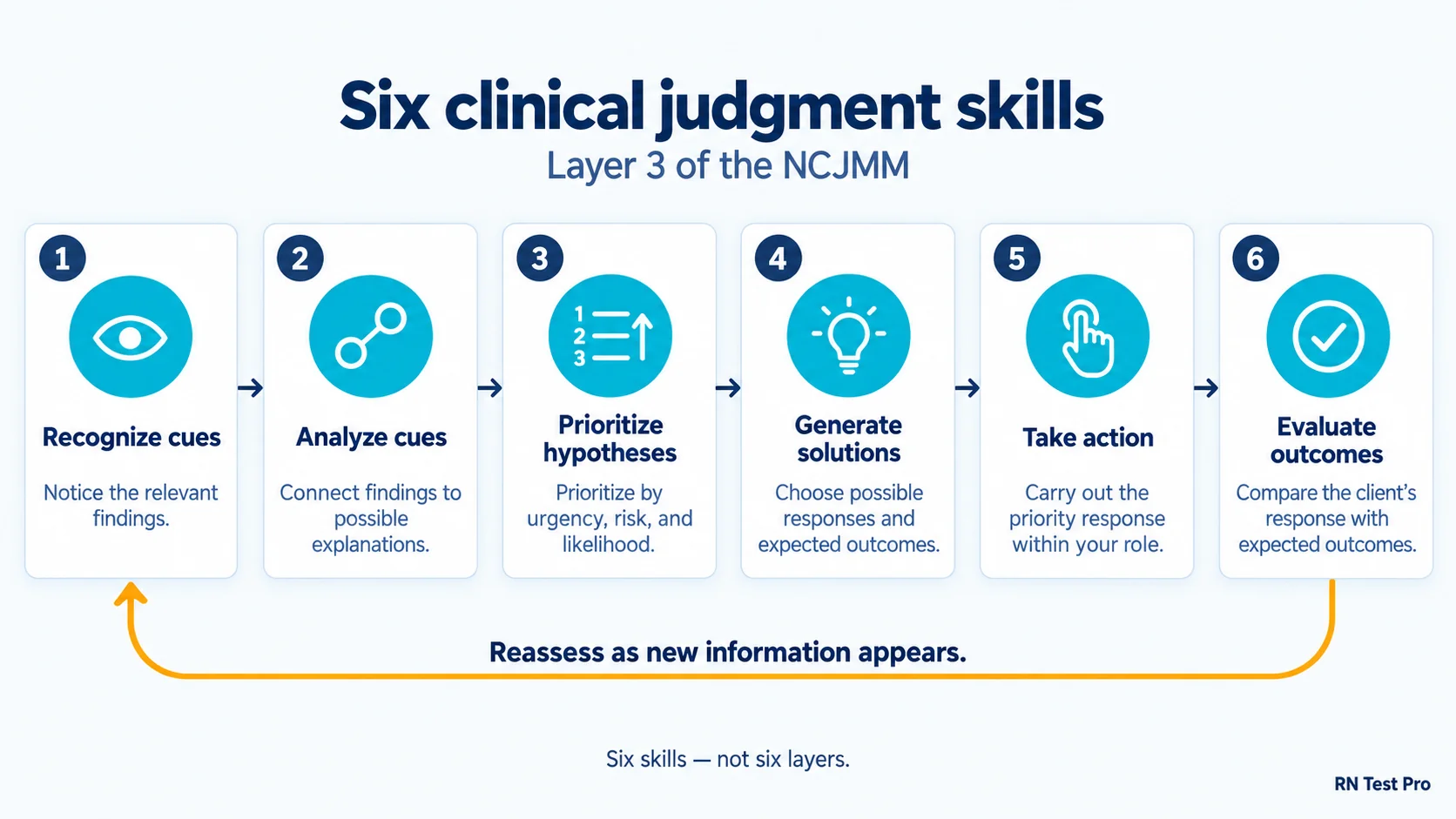
The 6 NCJMM Steps
Each of the six steps is a distinct cognitive skill; together they form Layer 3 of the NCJMM, the part of the model the exam measures directly. Here is what each step means, what students commonly miss, and how to apply it on exam day:
Step 1: Recognize Cues
Identify relevant information from the patient scenario. Cues can be subjective (patient reports) or objective (vital signs, lab values, assessment findings).
Example: Patient reports shortness of breath (subjective); SpO₂ 88%, RR 28 (objective).
Students often miss: Overlooking subtle cues like mild restlessness or slight changes from baseline.
Exam tip: Look for abnormal findings, changes from baseline, and risk factors.
Step 2: Analyze Cues
Interpret the significance of cues within the clinical context. Determine which cues are urgent, expected, or indicate complications.
Example: Interpret SpO₂ 88% alongside the prescribed target, baseline, work of breathing, mental status, and other findings.
Students often miss: Treating all abnormal findings as equally urgent instead of weighing them in context.
Exam tip: Ask: What do these cues mean together? Are they expected or unexpected for this patient?
Step 3: Prioritize Hypotheses
Generate and rank potential explanations. Consider the most life-threatening possibilities first using ABCs and Maslow's hierarchy.
Example: Hypoxia could be from pneumonia, PE, or heart failure — prioritize based on ABCs.
Students often miss: Ranking by one rule of thumb. Prioritize concerns using the client's findings, urgency, likelihood, and risk — not a blanket actual-versus-potential rule.
Exam tip: Use ABCs and Maslow's to rank hypotheses. Address life-threatening causes first.
Step 4: Generate Solutions
Identify interventions that address the prioritized hypotheses. Consider multiple options and pick the most appropriate one.
Example: For hypoxia: elevate HOB, apply oxygen, assess lung sounds, notify provider.
Students often miss: Jumping to the first intervention that comes to mind without considering alternatives.
Exam tip: Think: What actions will improve patient outcomes right now?
Step 5: Take Action
Implement the selected interventions. On NGN, this means selecting the correct answer or completing the required action within scope of practice.
Example: Follow the prescribed oxygen target and applicable protocol, and promptly reassess oxygenation and respiratory status.
Students often miss: Selecting interventions outside the RN scope (e.g., prescribing medications).
Exam tip: Ensure every action is within the nurse's scope of practice.
Step 6: Evaluate Outcomes
Assess whether the interventions achieved the desired outcome. Determine if the plan should continue, be modified, or if new actions are needed.
Example: Check whether oxygen saturation is within the prescribed target and whether respiratory effort, rate, and mental status have improved.
Students often miss: Not reassessing after an intervention and missing signs that the plan needs to change.
Exam tip: Compare patient status before and after every intervention.
Try a Clinical Judgment Case Study
Apply all 6 NCJMM steps in a realistic patient scenario, with a rationale for every step.
Practice NCJMM CasesNCJMM vs the Nursing Process
Students frequently ask how the NCJMM relates to the nursing process they learned in school. The two frameworks are complementary — the nursing process describes how care is delivered, while the NCJMM describes the cognitive skills tested on the NGN. The table below is an illustrative comparison, not an official one-to-one mapping:
| Nursing Process | NCJMM Step | What to Think During the Question |
|---|---|---|
| Assessment | Recognize Cues | What data is relevant here? |
| Diagnosis | Analyze Cues | What do these findings mean together? |
| Planning | Prioritize Hypotheses | What is the most likely — and most dangerous — explanation? |
| Planning | Generate Solutions | What interventions address the priority? |
| Implementation | Take Action | Which action do I do first and is it within my scope? |
| Evaluation | Evaluate Outcomes | Did it work? Do I need to adjust? |
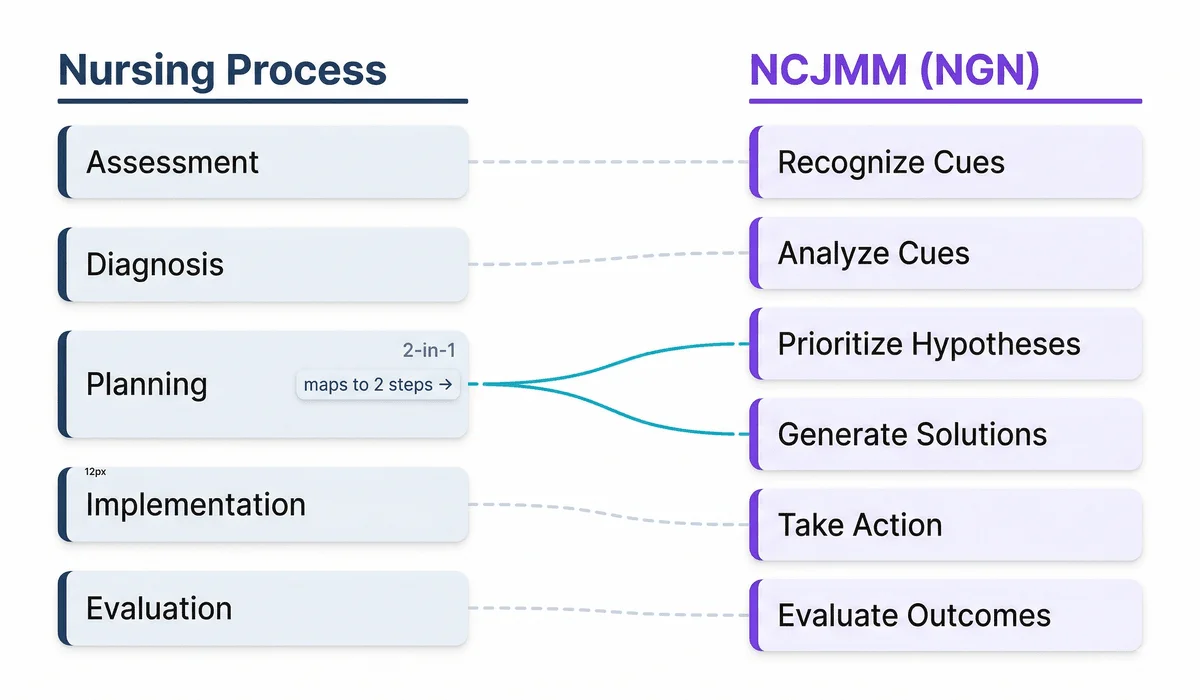
The six Layer 3 skills can be discussed alongside the nursing process: the Planning phase corresponds to two of them (Prioritize Hypotheses and Generate Solutions). The NCJMM is an assessment framework, not a replacement for that process. For more on prioritization frameworks like ABCs and Maslow's, see our dedicated guide.
How NGN Questions Test Clinical Judgment
The NGN uses several item formats to measure clinical judgment. For each item, identify the clinical task being asked and follow the instructions for that response format:
Case Studies
NCJMM focus: All six skills
Multi-part questions following a patient through the care continuum. You walk through recognizing cues, analyzing, prioritizing, intervening, and evaluating — exactly like real practice.
Bowtie Items
NCJMM focus: Condition, actions, parameters to monitor
You choose the two actions to take on the left, the most likely condition in the centre, and the two parameters to monitor on the right — five response targets in one item.
Trend Items
NCJMM focus: Changes over time; focus depends on the task
Analyze patient data across multiple time points. You must recognize which changes are clinically significant and which are expected variation.
Stand-alone Items
NCJMM focus: Varies
An independently administered question. The response format and the clinical-judgment skills assessed depend on the item.
For detailed strategies on each format, see our guides on NGN case study strategies and NGN question types explained.
Practice Scenario: Apply the Six Layer 3 Skills
The scenario below illustrates how to organize findings across the six clinical-judgment skills. Use it as an educational example, not a treatment protocol.
Respiratory Distress in COPDRespiratory
Scenario: A 68-year-old patient with COPD is admitted with increased shortness of breath. On admission: RR 24, SpO₂ 91% on 2L O₂, using accessory muscles, anxious.
RR 24 (tachypnea), SpO₂ 91% on 2L O₂, accessory muscle use (increased work of breathing), anxiety.
SpO₂ 91% may be within an acceptable COPD range (target 88-92%), but accessory muscle use, tachypnea, and anxiety together indicate worsening respiratory distress. The overall clinical picture — not the SpO₂ alone — drives the urgency.
Airway/breathing compromise is the priority (ABCs). Consider COPD exacerbation, pneumonia, or PE.
Elevate HOB, verify O₂ flow, auscultate lungs, consider bronchodilator, notify provider.
Position patient upright, confirm oxygen delivery, auscultate, administer bronchodilator per orders.
Is SpO₂ within the prescribed target, and have respiratory effort, rate, and mental status improved?
NCLEX Takeaway: In COPD, SpO₂ alone does not tell the full story — a number within the 88-92% target can still mean trouble. Assess the whole picture: work of breathing, mental status, and trend from baseline.
Common Clinical Judgment Mistakes
Use the following checks when reviewing your practice answers and rationales:
Acting before analyzing
Check that the selected intervention addresses the priority concern supported by the findings, rather than reacting to one cue in isolation.
Missing trend changes
Focusing on the most recent data point without comparing it to earlier values. A BP of 110/70 might be normal — or it might be a 30-point drop from two hours ago.
Prioritizing by a blanket rule
Prioritize concerns using the client's findings, urgency, likelihood, and risk — not a blanket actual-versus-potential rule. A high-risk potential problem can outrank a stable confirmed one.
Relying on memorization instead of reasoning
NGN questions are designed so that memorized facts alone are not enough. You need to reason through the scenario using the NCJMM steps.
Failing to reassess after intervention
After an intervention, identify which findings would show improvement or deterioration and what should be reassessed.
2-Week Clinical Judgment Practice Plan
The following two-week schedule is a suggested practice routine, not a validated time-to-improvement estimate or an NCSBN requirement. Adjust the time spent on each activity to your review needs.
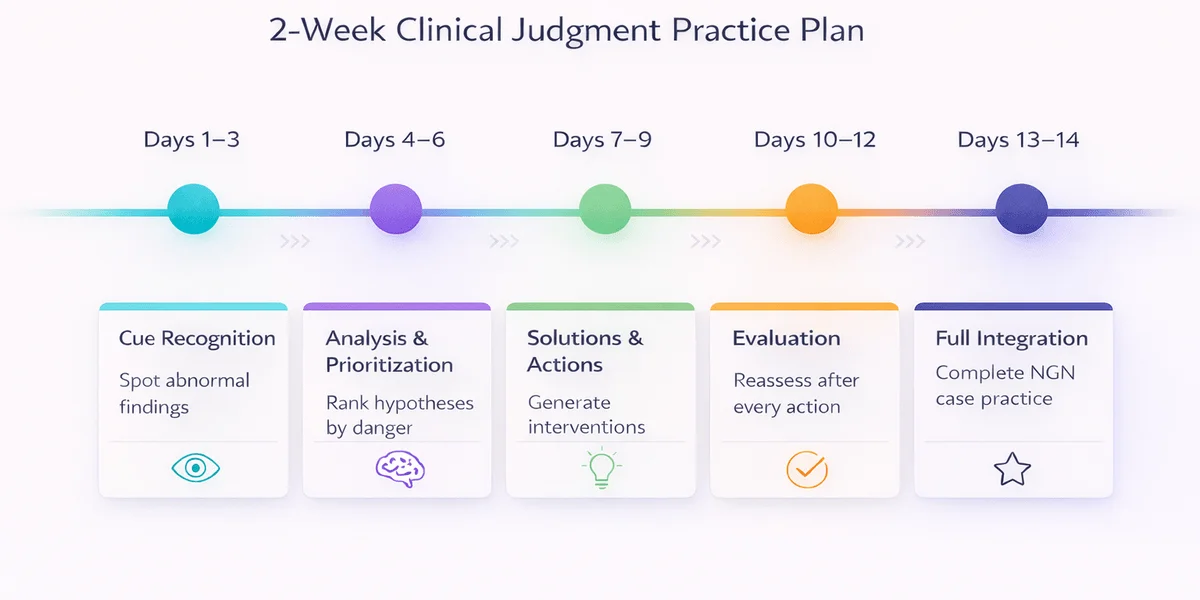
Read patient scenarios and list every abnormal finding. Practice separating subjective from objective data. Identify what is relevant versus what is noise.
For each scenario, explain what the cues mean together. Rank hypotheses using ABCs and Maslow's. Practice identifying the most dangerous possibility first.
Generate 3–4 possible interventions per scenario before choosing one. Check each action against RN scope of practice. Practice sequencing interventions.
After selecting interventions, define what improvement looks like. Practice asking: did it work? What if it didn't? When do I escalate?
Work through complete NGN-style case studies end-to-end. Apply all six skills for each question set. Review rationales for every answer — right or wrong.
Want a longer runway? Our study schedules lay out 30-, 60- and 90-day plans you can adapt to your available study time.
See How RN Test Pro Trains All 6 NCJMM Steps
Adaptive practice uses your current practice estimate to select questions, and your category breakdown helps you choose what to review next.
Explore FeaturesHow RN Test Pro Builds Clinical Judgment
Our platform is designed around the NCJMM, not bolted on top of generic question banks. Every feature maps directly to how clinical judgment is built and measured:
NGN-style case studies
Practice all 6 NCJMM skills in realistic six-step case studies.
Case-study rationales
Each case-study question includes a rationale for reviewing the answer.
Category-based performance tracking
See your strengths and weaknesses by client-needs category, not just an overall score.
Adaptive question selection
Adaptive question selection uses your current practice ability estimate and preset difficulty values.
See our full features overview or check pricing to get started.
Frequently Asked Questions
How long does it take to develop clinical judgment skills?
Progress varies. Use practice rationales to identify which of the six Layer 3 skills need attention rather than assuming that a fixed number of weeks establishes competence.
What clinical-judgment mistakes should I watch for?
Watch for overlooking relevant findings, interpreting a cue without its clinical context, choosing an intervention before identifying the priority concern, and failing to evaluate the response. Prioritize concerns using the client's findings, urgency, likelihood, and risk—not a blanket actual-versus-potential rule.
How can I practice clinical judgment without clinical experience?
Simulated practice lets you rehearse the reasoning without hands-on clinical time. Work through NGN-style case studies that present realistic patient scenarios, and explain your reasoning in NCJMM language — say out loud: 'I recognize this cue, I analyze it as…, I prioritize this because…' Then compare your reasoning with the rationale.
How is the NCJMM different from the nursing process?
They are complementary frameworks. The nursing process (assessment, diagnosis, planning, implementation, evaluation) is a broad framework for patient care delivery. The NCJMM specifically measures the cognitive skills tested on the NGN: recognize cues, analyze cues, prioritize hypotheses, generate solutions, take action, and evaluate outcomes. The NCJMM steps map closely to nursing process steps, but are designed for exam-based clinical judgment assessment.
How do case studies and individual items assess clinical judgment?
Case study questions test all six NCJMM skills across a single patient scenario. Bowtie items ask for the most likely condition, two actions to take, and two parameters to monitor in one item. Trend items specifically assess your skill at analyzing changes over time. Read each prompt to identify the reasoning task rather than inferring it from the response format alone.
Is clinical judgment the same as critical thinking on the NCLEX?
They overlap but are not identical. Critical thinking is a broader skill — it includes logic, analysis, and evaluation across any context. Clinical judgment is the nursing-specific application of critical thinking to patient care decisions. The NCLEX uses the NCJMM to measure clinical judgment specifically, which means you need to practice applying critical thinking within realistic patient scenarios, not just in abstract reasoning exercises.
What should I do when I feel stuck on an NGN case study?
Reread the current item's question and relevant exhibits. Identify the clinical-judgment task and explain how the findings support your answer before reviewing the rationale.
Continue Learning
- Clinical Judgment (NCJMM) — Comprehensive Guide
- Anatomy of an NGN Case-Study Testlet — How a 6-Item Testlet Works
- NGN Clinical Judgment — 4 Worked Mini Case Studies
- Next Generation NCLEX (NGN) — Question Types and Scoring
- NGN Case Studies — Multi-Part Question Strategies
- Prioritization Frameworks — ABCs, Maslow's, and Clinical Decision-Making
Build Expert Clinical Judgment with RN Test Pro
Practice NGN-style case studies with a rationale for every step, and use your category breakdown to decide what to practice next.
Practice NGN Clinical Judgment QuestionsThis content is for exam-preparation education and does not constitute clinical practice advice. Always follow your institution's protocols and evidence-based clinical guidelines in practice settings.