NGN Case Studies for NCLEX: How to Read, Reason, and Answer Safely
NGN case studies are not about memorizing cases — they measure clinical judgment. The reliable way to answer them is to read the unfolding scenario carefully, reason through the six NCJMM steps, and choose the safest, most appropriate action for that client.
If NGN case studies feel intimidating, it helps to remember what they are actually measuring: clinical judgment. Each one follows a single client through an unfolding scenario and asks you to reason the way a safe nurse does — noticing the right cues, making sense of them, deciding what matters most, acting safely, and evaluating the result. This guide shows how to read them and work through each layer using the NCLEX Clinical Judgment Measurement Model (NCJMM).
Quick Answer: What NGN Case Studies Test
- NGN case studies measure clinical judgment — how you move from noticing cues to taking and evaluating safe action.
- They are built on the NCLEX Clinical Judgment Measurement Model (NCJMM), which breaks judgment into six steps.
- A single unfolding scenario presents a client, then layers in new data through tabs such as nurses' notes, vital signs, labs, and orders.
- Each case study includes a set of items that follow the NCJMM layers, often using formats like extended multiple response, matrix, drag-and-drop, and cloze (drop-down).
- The skill is reading carefully, weighing the whole scenario, and choosing the safest, most appropriate action — not pattern-matching a single keyword.
For the bigger picture of the exam changes, see the Next Generation NCLEX guide and the clinical judgment framework.
Current NCLEX Facts About Case Studies
Build your expectations on the current test plan rather than older descriptions.
Three scored case studies
Current NCLEX-RN and NCLEX-PN test plans include three scored clinical judgment case studies.
Six items each
Each scored case study contains six items, which step through the NCJMM layers for one unfolding client scenario.
18 case-study items total
Three case studies with six items each means 18 scored case-study items in total, alongside the exam's stand-alone items.
Part of a larger exam
Case studies are an important part of clinical judgment measurement, but they sit within a longer exam that also uses stand-alone questions.
Move forward, not back
On the NCLEX, once you confirm an answer and move on, you generally cannot return to a previous item — so read and reason fully before you proceed.
Remember that question count, item format, and case-study difficulty do not predict your result. For how the exam is scored overall, see the NCLEX scoring guide.
The NGN Case-Study Workflow
Every case study follows the same underlying flow. Picture it as a loop from recognizing cues to evaluating outcomes.
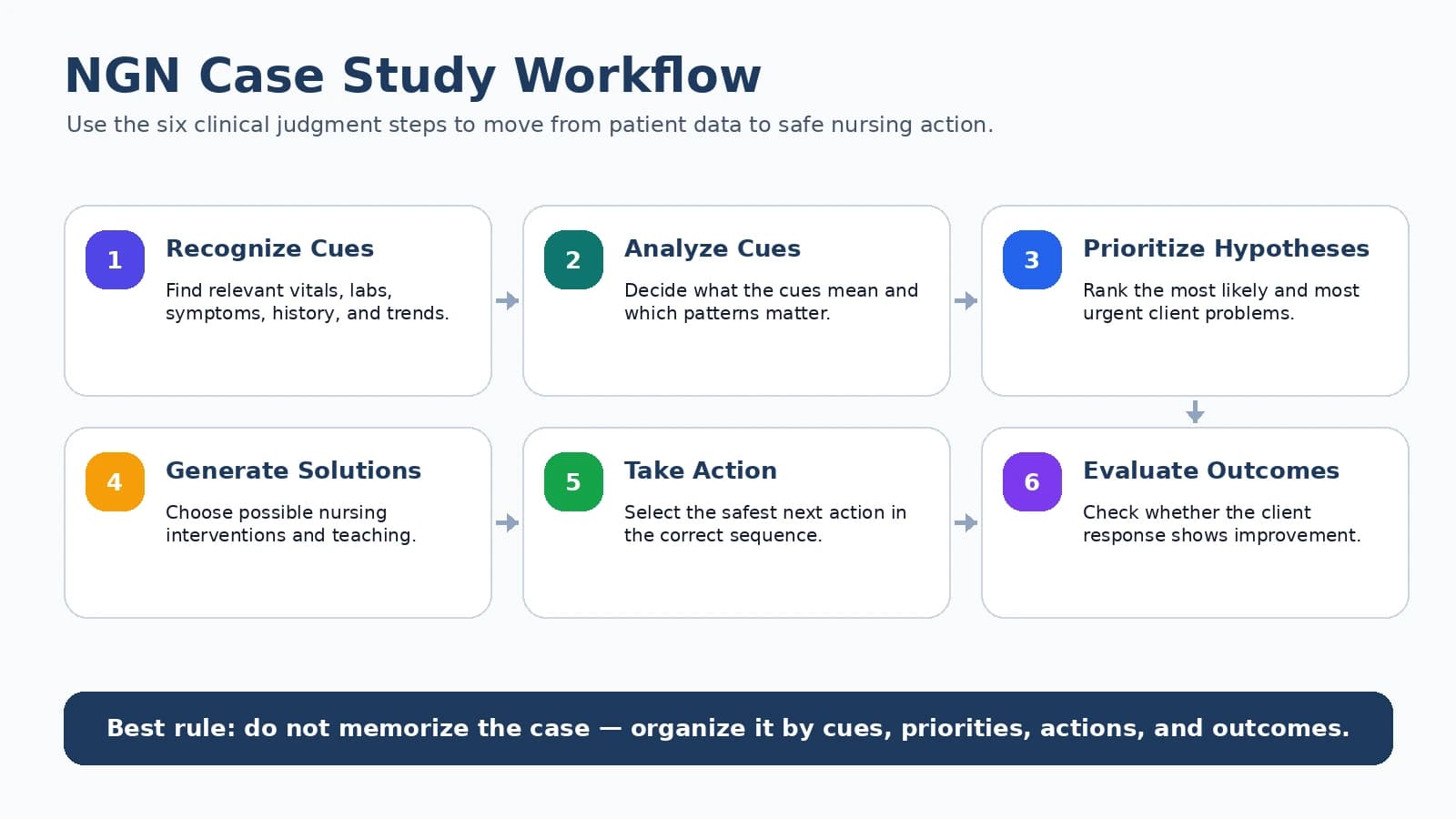
The six NCJMM steps, from recognizing cues through evaluating outcomes for one unfolding client.
The Six NCJMM Steps
The NCLEX Clinical Judgment Measurement Model (NCJMM) breaks clinical judgment into six layers. NGN case-study items map onto these steps, so naming the step an item is testing helps you answer it.
Recognize cues
Notice the relevant findings in the scenario and exhibits — what is abnormal, concerning, or expected.
Analyze cues
Connect those findings to the client's situation: what fits together, and what the data suggest.
Prioritize hypotheses
Decide which concerns are most likely and most urgent, and which need attention first.
Generate solutions
Identify appropriate actions and expected outcomes for the priority concern.
Take action
Choose the safest, most appropriate intervention or interventions for this client.
Evaluate outcomes
Judge whether the client is responding as expected and what should happen next.
How to Read an Unfolding Case
A case study is not a wall of text to skim — it is a client whose situation develops. Read it deliberately:
- Start with the opening scenario to understand who the client is and why they are being seen.
- Open each exhibit tab and read it against the scenario, watching for what is new or changing.
- Let the data accumulate — later tabs often add the cue that changes the priority.
- Reason fully before you confirm an item, since you generally move forward and do not return to a previous item.
- Re-read the actual question stem so you answer what is asked, at the right NCJMM layer.
What to Look For in Exhibits
Exhibits are where the cues live. Each type rewards a slightly different kind of attention.
Vital signs
Trends matter as much as single values — compare against earlier readings and expected ranges.
Laboratory results
Look for values outside expected ranges and connect them to the client's presentation.
Medications
Consider what each drug does, its key risks, and how it interacts with the current findings.
Nurses' notes
Watch for changes over time — a new symptom or a worsening trend is often the key cue.
Provider orders
Check what has been ordered and whether anything conflicts with the client's current status.
History & assessment
Background and physical findings frame what is normal or concerning for this specific client.
How to Answer Each NCJMM Layer
Items tend to track the NCJMM layers, often using formats such as matrix, extended multiple response, drag-and-drop, and cloze (drop-down). The table maps the layer to what it usually asks and how to approach it. For more on the formats themselves, see the NCLEX question types guide.
| NCJMM layer | Common item formats | How to approach it |
|---|---|---|
| Recognize / analyze cues | Often matrix or extended multiple response | Select the findings that are relevant or concerning, supported by the scenario — not every abnormal value is the priority. |
| Prioritize hypotheses | Often cloze (drop-down) or matrix | Choose the most likely and most urgent explanation; let the full picture, not one keyword, decide. |
| Generate solutions / take action | Often extended multiple response or drag-and-drop | Pick the safest, most appropriate actions for the priority concern; avoid actions that are unsafe or out of scope. |
| Evaluate outcomes | Often matrix or cloze | Judge whether each finding shows improvement, no change, or worsening, and what it means for next steps. |
Priority frameworks such as airway-breathing-circulation and safety help organize your thinking, but the correct answer depends on the full scenario rather than a single rule applied automatically.
Partial-Credit Scoring, Explained Safely
Many NGN items have more than one correct element, so they are not simply right-or-wrong. Official NCLEX scoring uses several approaches for these items, including plus/minus scoring (where incorrect selections can offset correct ones), zero/one scoring (all-or-nothing for the item), and rationale scoring (where linked parts of an answer are evaluated together). The exact method depends on the item type.
What this means for your practice
- Because incorrect choices can count against you on some item types, avoid over-selecting — choose what the scenario genuinely supports.
- RN Test Pro practice scoring is educational feedback to guide your studying. It is not official NCLEX scoring and does not replicate the exam's methods.
- Question count, item format, and case-study difficulty do not predict your result — use practice to learn, not to forecast a score.
For a broader explanation of how the exam determines pass or fail, see the NCLEX scoring guide.
Chest-Pain Example: A Reasoning Walkthrough
Here is how the six NCJMM steps work on a familiar scenario. This is an illustrative teaching example built to show the reasoning pathway — not real exam content.
Scenario: An adult client on a medical-surgical unit reports new chest discomfort that began about 20 minutes ago. You have access to vital signs, nurses' notes, and provider orders.
Step 1 — Recognize cues
Pick out the relevant findings: new chest discomfort, when it started, and any related changes in the vital signs or notes such as heart rate, blood pressure, oxygen saturation, or reported shortness of breath.
Step 2 — Analyze cues
Connect the findings: new chest discomfort in this client could reflect a cardiac cause, so consider how the cues fit together rather than treating any one number in isolation.
Step 3 — Prioritize hypotheses
Decide what is most urgent. A potential cardiac event is both serious and time-sensitive, so it rises to the top of the list of explanations to address — while keeping other possibilities in mind.
Step 4 — Generate solutions
Identify appropriate actions and their expected outcomes — for example, assessing the client further, reviewing what has been ordered, and planning to notify the provider, with the goal of stabilizing the client and clarifying the cause.
Step 5 — Take action
Choose the safest, most appropriate interventions for this client and situation, following provider orders and facility protocol. Priority frameworks help organize your thinking, but the right action depends on the full scenario in front of you.
Step 6 — Evaluate outcomes
Reassess after acting: is the client's discomfort improving, unchanged, or worsening, and do the vital signs support that? Your evaluation guides whether to continue, escalate, or adjust the plan.
Notice that the walkthrough never relies on a single keyword. Each step weighs the whole picture — which is exactly what the items reward. For more practice in this reasoning style, see developing clinical judgment.
Common Mistakes
Most avoidable errors on case studies come from a handful of habits:
- Answering from a single keyword instead of weighing the whole scenario.
- Ignoring trends in the exhibits and reacting only to one value.
- Choosing an action that is unsafe or outside the nurse's scope because it 'sounds' active.
- Rushing past the analyze and prioritize steps and jumping straight to action.
- Assuming a fixed rule always wins — priority frameworks help organize thinking, but the correct answer depends on the full scenario.
- Treating a practice score as a prediction of your actual NCLEX result.
Practice NGN Case-Study Questions
Work through full unfolding case studies with NCJMM-aligned items and rationales that explain the safest action at each step. Use the educational feedback to find and fix your weak layers.
Start PracticingA Practice Plan for Case Studies
A focused plan builds the reasoning habit first, then sharpens the layers you find hardest.
Learn the six steps first
Get comfortable with the NCJMM layers before drilling cases, so you recognize what each item is really asking.
Practice full cases, not just items
Work through complete unfolding scenarios so you build the habit of reading exhibits and reasoning across layers.
Review the reasoning, not just the score
For every case, revisit why the safest action was correct and why each distractor was not — that is where the learning is.
Target weak layers
If you consistently miss 'take action' or 'evaluate outcomes,' focus there rather than re-reading content you already know.
Ready-made walkthroughs to practice on: case study 1, case study 2, and case study 3. Fit them into a timeline with the 30/60/90 NCLEX study plan.
Follow a ready-made NCLEX study schedule
Turn this approach into a weekly schedule with adaptive practice, NGN-style case studies, rationales, and educational feedback. Use it to decide what to review next.
View study schedulesSources and Alignment Note
How this guide was reviewed
Reviewed against the 2026 NCLEX-RN and NCLEX-PN test plans, NCLEX Clinical Judgment Measurement Model guidance, and NCLEX scoring guidance. This page is educational NCLEX preparation content and does not replace official NCSBN materials, nursing program guidance, facility policy, or clinical judgment. RN Test Pro is independent and not affiliated with or endorsed by NCSBN. NCLEX® is a registered trademark of the National Council of State Boards of Nursing, Inc.
Related Resources
Next Generation NCLEX →
What changed with NGN and how clinical judgment is measured.
Clinical Judgment →
The NCJMM model behind every case-study item.
Developing Clinical Judgment →
Build the reasoning habit that case studies reward.
NCLEX Question Types →
Matrix, cloze, drag-and-drop, and the other NGN formats.
RN NCLEX Prep →
Adaptive practice built for the RN candidate path.
PN NCLEX Prep →
Adaptive practice built for the PN candidate path.