NCLEX Partial-Credit Scoring: 0/1, Plus/Minus, and Rationale Explained
Some NCLEX items award partial credit. This guide explains the three official scoring methods — zero/one, plus/minus, and rationale — with worked SATA, bow-tie, and rationale-pair examples, and shows how those item scores feed the adaptive pass/fail decision.
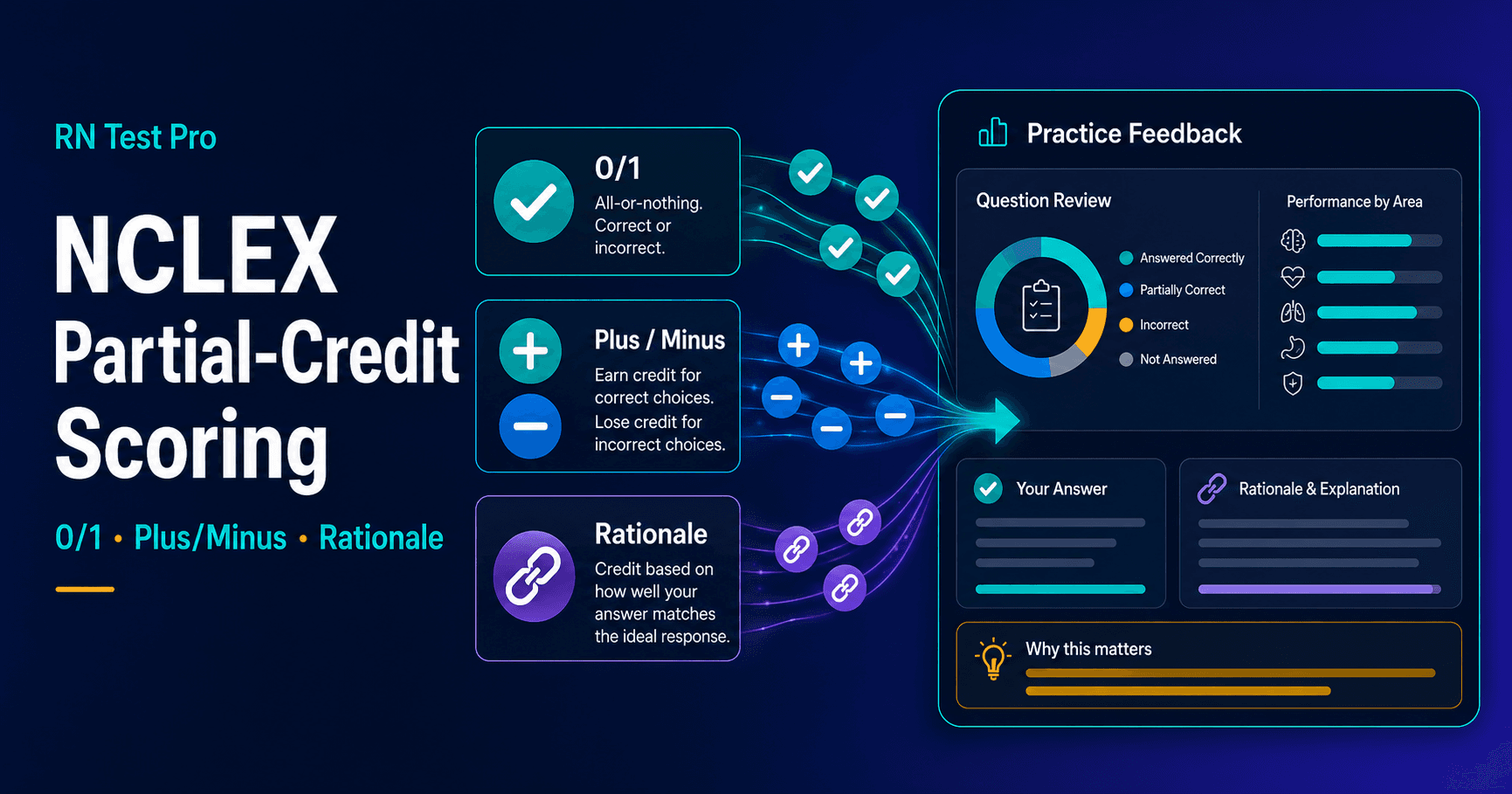
Partial credit on the NCLEX flows through three scoring methods: zero/one, plus/minus, and rationale.
Quick Answer: How Partial Credit Works
Partial credit on the NCLEX is governed by one practical rule and three scoring methods. The rule: partial credit applies when an item has multiple scored response opportunities — multiple correct selections, rows, blanks, targets, or linked response pairs. NCSBN states it more formally as scoring that exists for items for which more than one key exists. The methods NCSBN uses to turn your responses into score points are zero/one, plus/minus, and rationale scoring. Here is the whole picture at a glance.
Multiple scored responses → partial credit
Partial credit applies when an item has multiple scored response opportunities — multiple selections, rows, blanks, targets, or linked pairs. NCSBN frames it as scoring for items for which more than one key exists. A single-answer item is still all-or-nothing.
Three official methods
NCSBN maps your responses to score points using zero/one, plus/minus, and rationale scoring.
Plus/minus can subtract
On plus/minus items each incorrect selection subtracts a point, and the total is floored at zero — it never goes negative.
Zero/one never subtracts
Zero/one awards a point per correct response and takes nothing away; multi-point 0/1 items still award credit target by target.
Rationale must cohere
Rationale scoring credits a linked pair — an action and its reason — only when both parts are correct together.
Pass/fail isn’t a point total
Item scores feed your CAT ability estimate; pass/fail compares that estimate to the passing standard, not a visible running score.
For the test-day tactics that follow from this scoring math — and how the adaptive algorithm turns item scores into a pass or fail — see NCLEX Scoring Explained.
First, What Counts as Partial Credit?
The deciding factor is not how new or unusual an item looks — it is whether the item offers more than one scored response opportunity. An item with a single correct key, like a standard multiple-choice question, is scored all-or-nothing: you earn the point only if your one answer is right. An item with multiple scored responses — several selections, rows, blanks, targets, or a linked pair — can be scored with partial credit, so you earn points for the parts you get right even when you miss others. NCSBN describes this as partial-credit scoring for items for which more than one key exists.
Many of these partial-credit opportunities appear in the NGN-style formats emphasized when the Next Generation NCLEX launched April 1, 2023 to better measure clinical judgment and decision-making: matrix, bow-tie, cloze/table, and drop-down rationale items. Select-all-that-apply is the exception worth calling out: SATA existed before NGN, but under current NCSBN scoring guidance it is listed under plus/minus partial-credit scoring. So item format and scoring model are related but not identical — the labels and launch date are context, not the rule. NCSBN applies three scoring methods — zero/one, plus/minus, and rationale — to map candidate responses onto score points, and which method applies depends on the item’s structure and whether its parts are independent or linked.
The Three Official Scoring Models
Each model answers three questions: how it works, what item types it applies to, and what your strategy should be. Read them with the caveat below in mind.
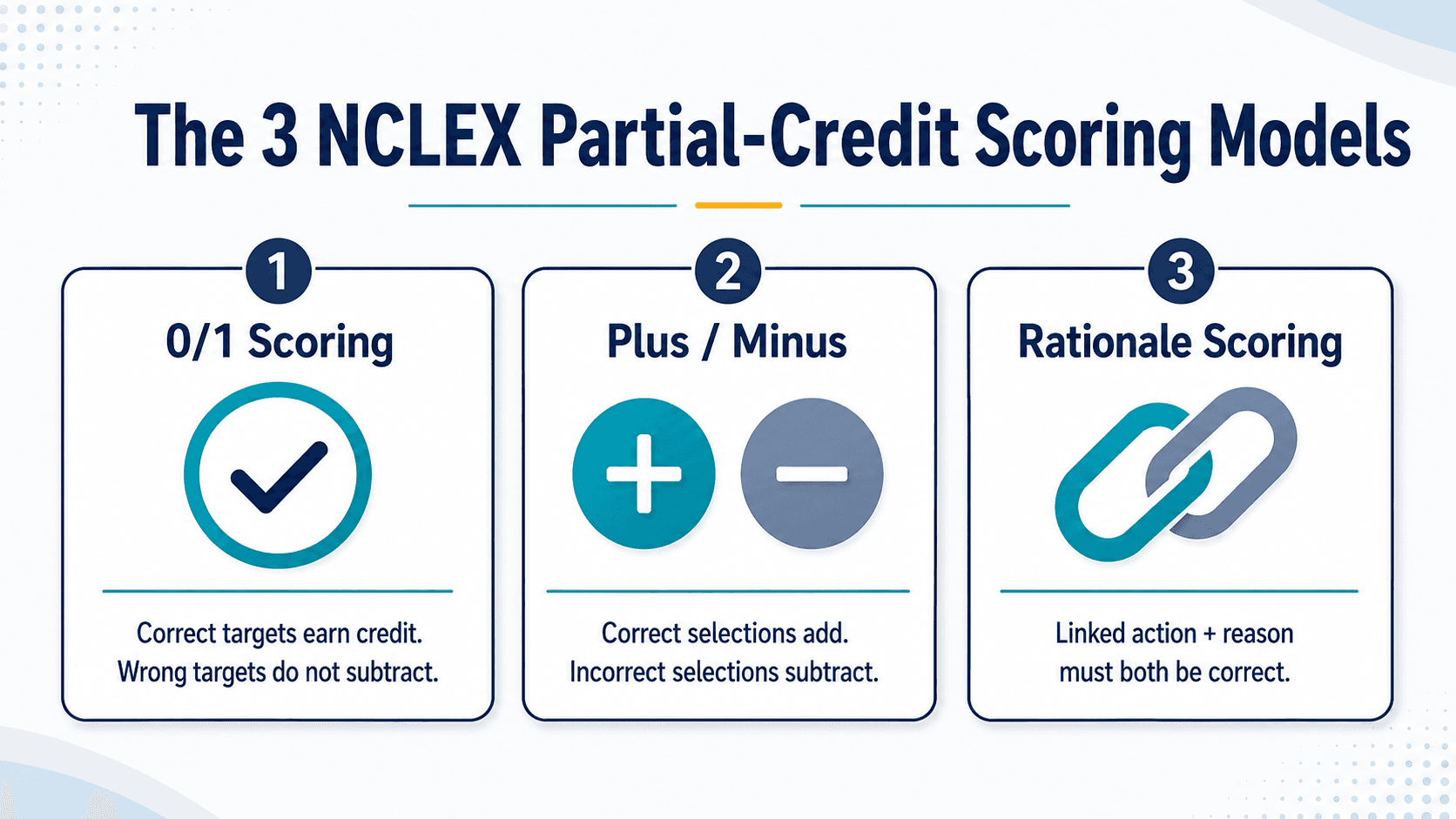
Zero/one only adds, plus/minus can subtract, and rationale credits an action-and-reason pair only when both cohere.
Zero/one (0/1) scoring
How it works
Each correct response earns 1 point; each incorrect or missed response earns 0. Nothing is subtracted. On a multi-part item the points are summed across independent targets, so your item score is simply how many you got right.
Examples: NCSBN applies 0/1 to matrix multiple-choice (one selection per row), Select-N items (“select 3”), drop-down cloze and table items, and bow-tie items (which top out at 5 targets).
Your strategy
Because a wrong pick carries no extra penalty, answer every target with your best reasoned choice — leaving one blank earns 0.
Plus/minus (+/−) scoring
How it works
Each correct selection adds a point and each incorrect selection subtracts one. A negative total rounds up to zero, so an item never scores below 0 — but wrong picks erase correct ones up to that floor.
Examples: NCSBN applies plus/minus where you may select as many or as few options as apply — most commonly select-all-that-apply (SATA) and matrix multiple-response items.
Your strategy
Select only the options you can clinically defend. Padding your answer “to be safe” can cancel the credit you already earned.
Rationale (linked-pair) scoring
How it works
Two linked responses — typically an action and the reason that justifies it — are scored together. You earn the point only when both responses in the pair are correct; one right half earns nothing for that pair.
Examples: NCSBN applies rationale scoring to linked drop-down items built in the “[action] because of [reason]” structure, where the two blanks depend on each other.
Your strategy
Choose the action and its reason as a single decision. Reason through why before you commit, because a correct action attached to the wrong reason scores zero for the pair.
Partial credit is not permission to guess. The live NCLEX does not label the scoring model. Follow the response rule and select only what the clinical data supports.
Read the lead-in, note how many options to select and whether two blanks are linked, and let the scoring take care of itself — reverse-engineering points from an item’s appearance only distracts you from the clinical question.
Four Scoring Situations, Side by Side
One source of confusion is that “0/1” describes two different situations, and plus/minus and rationale are different again. Keeping these four straight tells you when over-selecting hurts and when it doesn’t.
Single-answer 0/1
One correct key. Full credit only if your one answer is right — there is no partial credit. Standard multiple-choice items work this way.
Multi-point 0/1
Several independent targets, each scored 0/1 and summed; wrong picks do not subtract. Bow-tie, Select-N, matrix multiple-choice, and cloze items.
Plus/minus
Correct selections add, incorrect selections subtract, and the total is floored at zero. SATA and matrix multiple-response items.
Rationale (linked pair)
Two dependent responses scored together; both halves must be correct to earn the point. Drop-down rationale items.
Item Format vs. Scoring Model
Item format and scoring model are related but not identical. The same 0/1 rule can score a bow-tie, a Select-N item, and a cloze table, while a single format like matrix can use 0/1 or plus/minus depending on whether each row takes one answer or several. Don’t assume a format’s look tells you its scoring — read the response rule. For a full tour of the formats themselves, see NGN Question Types and the NCLEX Question Types hub.
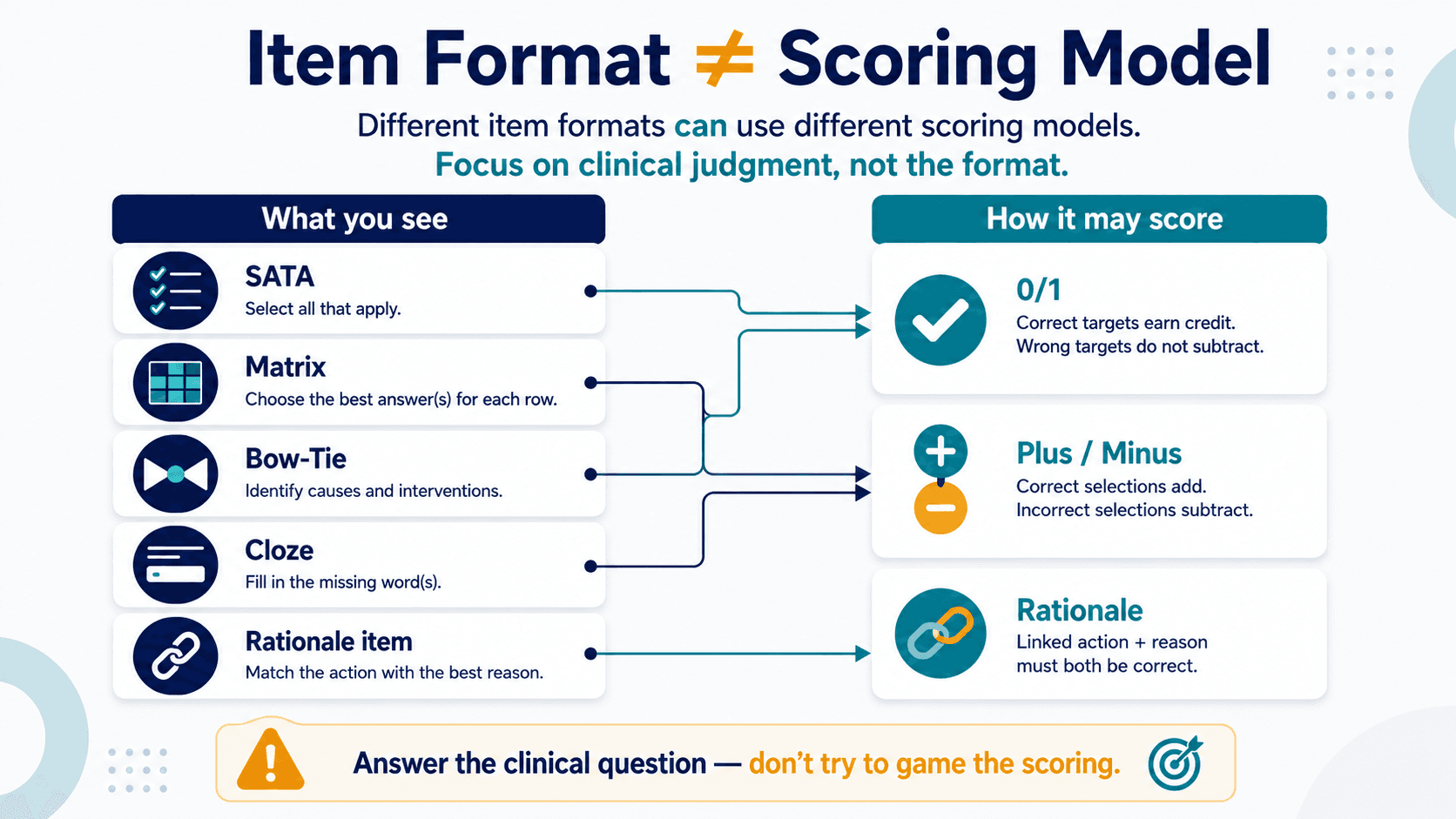
The same format can use different scoring — read the response rule, not the format’s appearance.
Select-all-that-apply (SATA)
Scoring model: Plus/minus
- Response rule:
- Select every option that applies — as many or as few as fit.
- Common mistake:
- Padding the list “to be safe.”
- Safer behavior:
- Select only options you can clinically defend; each wrong pick subtracts a point.
Matrix / grid
Scoring model: 0/1 for single-response rows; plus/minus for multi-response rows
- Response rule:
- One choice per row (single-response) or multiple per row (multi-response).
- Common mistake:
- Right action placed in the wrong row or column.
- Safer behavior:
- Read each row’s cue and answer it row by row — format alone doesn’t fix the scoring model.
Bow-tie
Scoring model: 0/1 across the five targets (max 5)
- Response rule:
- Place one condition, two actions to take, and two parameters to monitor (five targets).
- Common mistake:
- Leaving a target blank.
- Safer behavior:
- Fill every target with your best reasoned choice — a wrong token never subtracts from the rest.
Cloze / drop-down table
Scoring model: 0/1 per independent blank
- Response rule:
- Choose one option per blank from each drop-down.
- Common mistake:
- Guessing blanks instead of reasoning each one.
- Safer behavior:
- Answer every blank; independent blanks don’t penalize each other.
Rationale (linked pair)
Scoring model: Rationale (linked-pair) scoring
- Response rule:
- Choose an action and the reason that justifies it.
- Common mistake:
- Right action, wrong reason.
- Safer behavior:
- Decide the action and its reason together — the pair scores only when both cohere.
Worked Example: Plus/Minus on a SATA Item
On a select-all-that-apply item, every correct selection adds a point and every incorrect selection subtracts one (floored at zero). Watch how one extra pick changes the score.
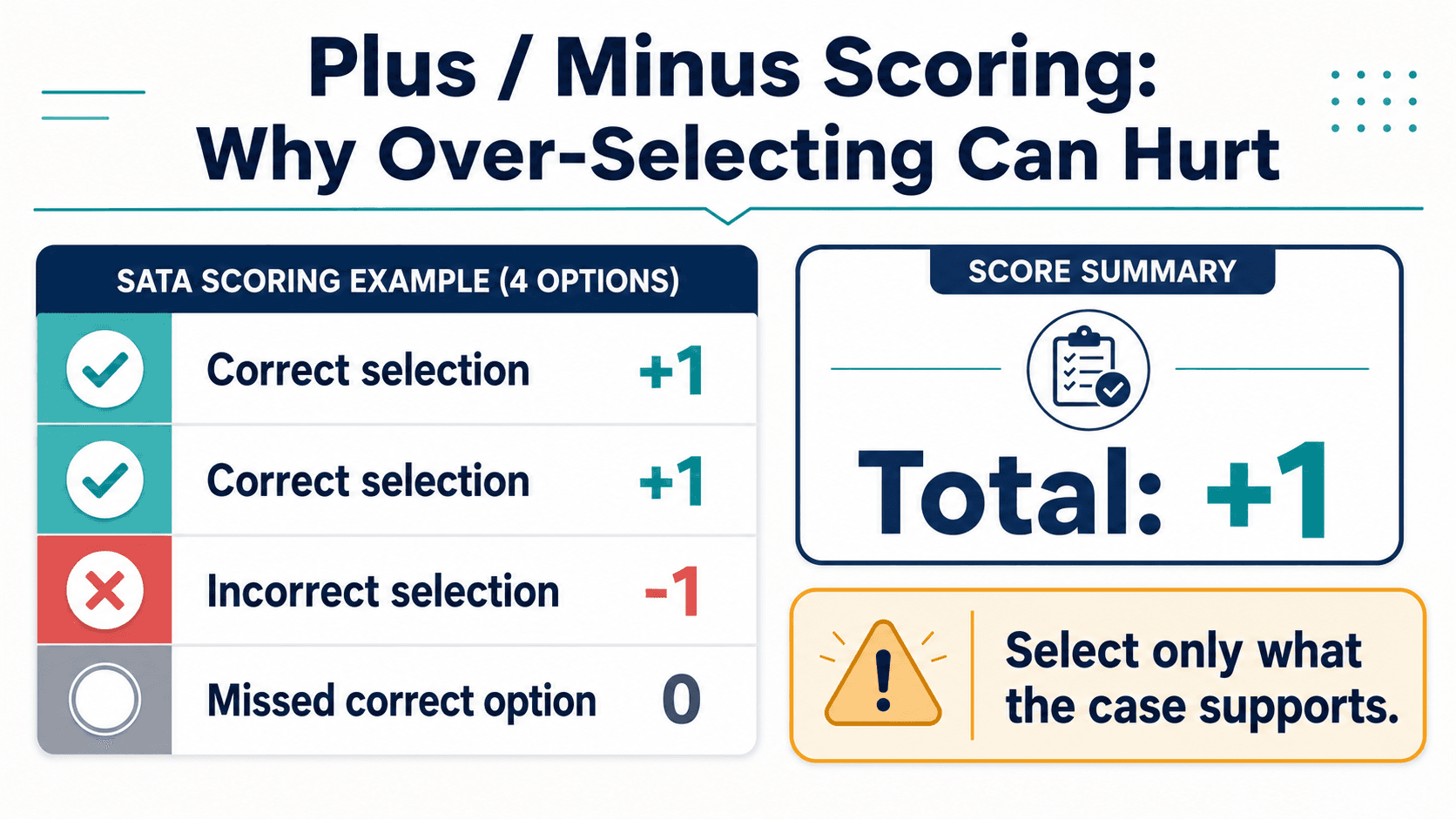
Each correct selection adds a point; each incorrect one subtracts, with the item total floored at zero.
Item
Two hours after a client with heart failure receives IV furosemide, the nurse reviews these findings. Which require follow-up? (Select all that apply.)
- Serum potassium 3.2 mEq/L (reference range 3.5–5.0 mEq/L · correct – hypokalemia)
- Blood pressure 88/54 mmHg (correct – hypotension)
- Reports new dizziness when standing (correct – orthostatic symptom)
- Urine output 70 mL/hr (distractor – expected diuretic response)
- Trace ankle edema, unchanged (distractor – chronic finding in HF)
Your response
You select the potassium and the blood pressure (both correct) but also select the trace ankle edema (a distractor), and you leave the dizziness unselected.
Score math
+1 (potassium) +1 (blood pressure) −1 (ankle edema) = +1 point
Lesson
The wrong pick cost a point, and the unselected dizziness left a safe point on the table. Selecting the three defensible findings and skipping both distractors would have earned +3. On plus/minus items, choose what you can defend — no more, no less.
Worked Example: 0/1 Scoring on a Bow-Tie Item
Bow-tie items look intimidating, but the scoring is forgiving. A bow-tie has five targets: one central condition, two actions to take, and two parameters to monitor. Each target is scored independently on the 0/1 rule — up to 5 points — and a wrong token never subtracts from the boxes you got right. For a deeper walkthrough of the five-target layout, see our guide to bow-tie items.
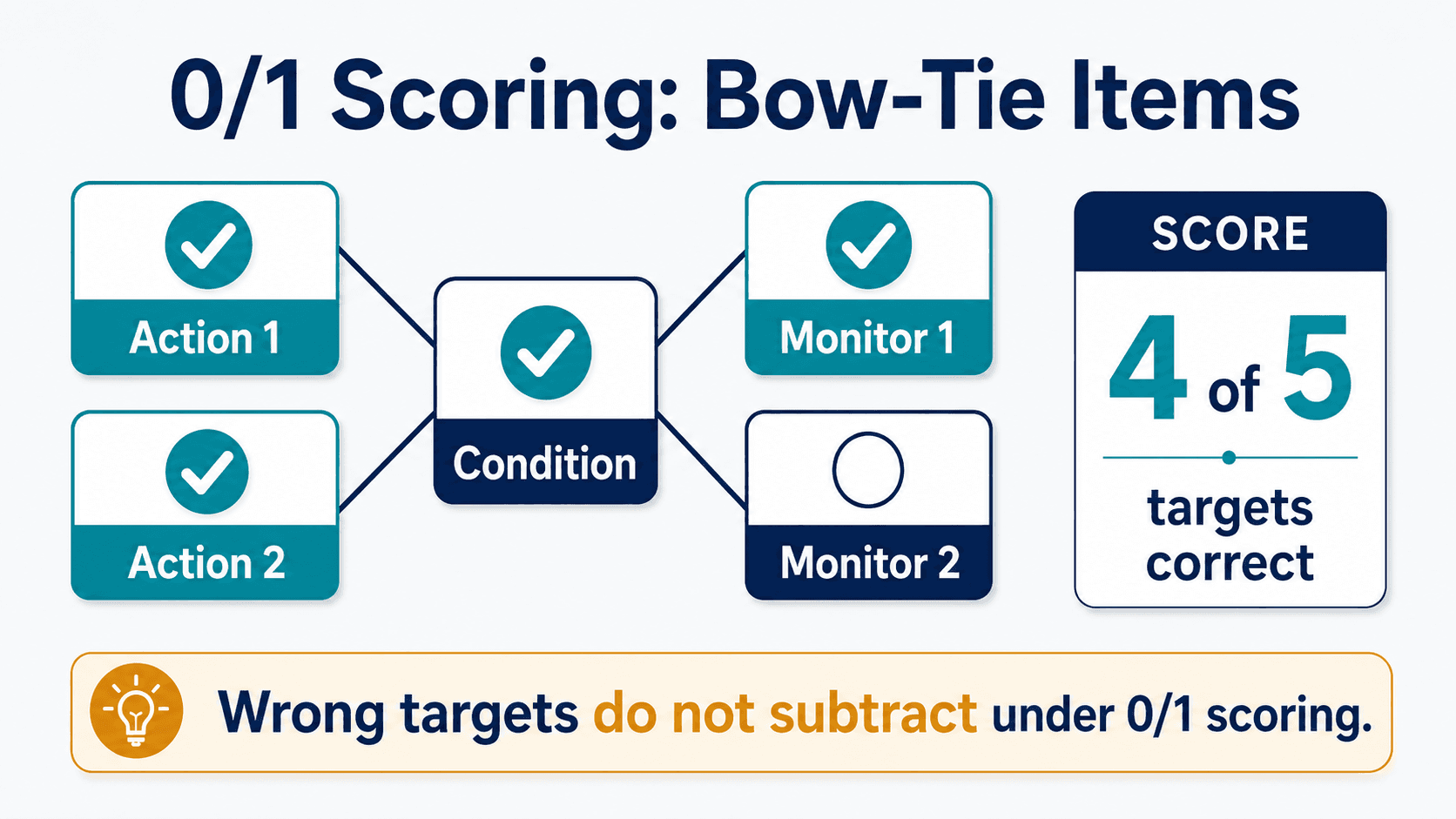
Five independent targets, each scored 0/1 to a maximum of 5 — a missed target never pulls down the ones you got right.
Item
A client is in septic shock. Complete the bow-tie: identify the condition, two actions to take, and two parameters to monitor.
Answer key
Condition — septic shock; Actions — administer prescribed isotonic IV fluids, administer prescribed broad-spectrum antibiotics; Parameters — serum lactate, mean arterial pressure (MAP).
Your response
You place the correct condition, both actions, and one of the two parameters (serum lactate), but miss the second parameter (MAP).
Score math
4 of 5 targets correct, each scored 0/1 = 4 points
Lesson
The missed parameter earns 0, but it does not pull down the four you placed correctly. Fill every target with your best reasoned choice — a blank target earns 0, and a wrong token never costs you the boxes you got right.
Worked Example: A Rationale (Linked-Pair) Item
Rationale items link two responses that depend on each other — an action and the reason behind it. The pair earns a point only when both halves are correct together.
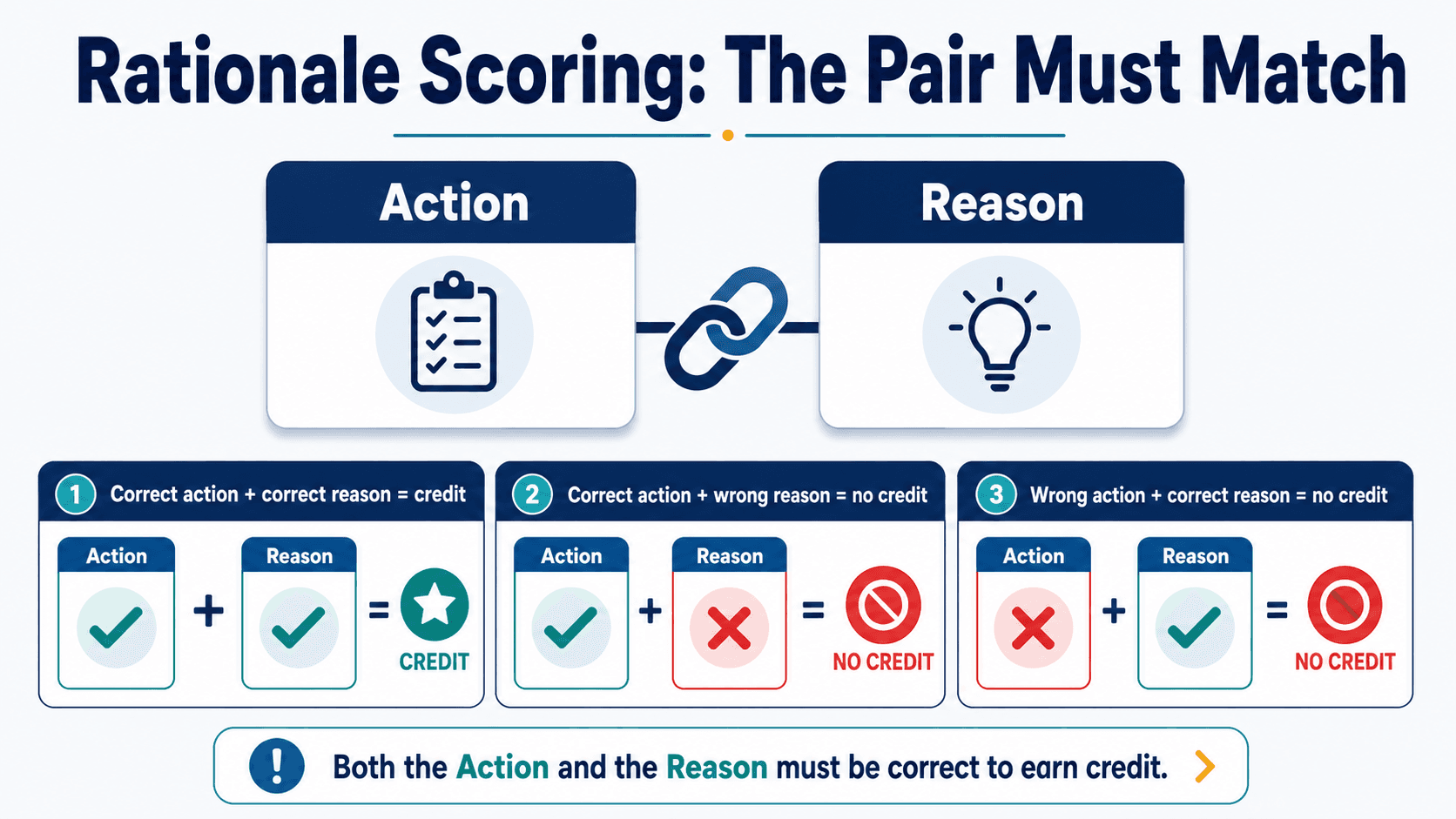
The linked pair earns its point only when the action and its reason are both correct together.
Item
A conscious client reports shakiness and diaphoresis; point-of-care blood glucose is 54 mg/dL (below the 70 mg/dL hypoglycemia threshold). Complete the sentence by choosing from each drop-down:
“The nurse should first [action] because the client is showing signs of [reason].”
Correct pair
Action — give the prescribed or protocol-based 15 g of fast-acting oral carbohydrate; Reason — hypoglycemia.
Score math
Both halves correct (carbohydrate + hypoglycemia) = 1 point
Right action, wrong reason (carbohydrate + “dehydration”) = 0 points for the pair
Lesson
Rationale scoring credits the pair only when the action and its justification cohere. A correct action attached to the wrong reason does not demonstrate the clinical judgment the item measures, so the pair earns nothing — even though giving the carbohydrate would still have helped the client. Decide the action and its reason together.
How Item Scores Feed CAT Pass/Fail
Every item you answer — including partial-credit items — updates the exam’s estimate of your ability. Partial-credit scoring simply gives that estimate more information than a flat right/wrong: a multi-point item can provide more detailed scoring information than a single all-or-nothing response. But the score on any one item is not added to a running “points” total, and no single item passes or fails you. Partial credit affects the information from an item; it does not create a visible running score.
The computerized adaptive test re-estimates your ability after each item and ends using one of three rules: the 95% confidence-interval rule, the maximum-length rule, or the run-out-of-time rule. Pass/fail is decided by where your ability estimate sits relative to the passing standard — not by a point tally and not by how many items you saw. For the full pass/fail mechanics and the test-day behavior that follows from them, see NCLEX Scoring Explained.
Practice Partial-Credit NGN Items
Work bow-tie, SATA, matrix, and drop-down rationale practice items that model these scoring patterns, with practice feedback designed to help you review the selections, targets, rows, or reasoning pairs you missed.
Practice Partial-Credit NGN ItemsRN Test Pro practice feedback is educational guidance, not official NCLEX scoring. It does not predict your pass/fail result.
How to Review Lost Partial-Credit Points
When you lose points on a partial-credit item in practice, the fix is rarely “study harder” in general — it is identifying which specific slip cost the credit. Run each missed item through this loop.
Over-selection
On a plus/minus item, did you add an option you could not fully defend? Each extra wrong pick cancels a correct one.
Missed target
On a 0/1 item, did you leave a target blank or pick a weaker option? With no penalty, an unfilled target earns 0.
Wrong row or cell
On a matrix item, did you place the right action in the wrong row, or choose the wrong column for the right cue?
Mismatched pair
On a rationale item, was your action correct but the reason wrong? The pair scores only when both halves cohere.
Exhibit miss
Did you answer before opening every exhibit tab? You can move on without opening them all, but review each tab and make a selection first — labs, the MAR, vital signs, and notes often change the right choice.
Wording misread
Did you miss a qualifier — “first,” “most likely,” “requires follow-up,” “select 3” — that changed what the item actually asked?
A reusable partial-credit error-log template
Capture one entry per missed item — short enough to write in under a minute, specific enough to act on. Copy the six fields as your template, then see them filled in for a bow-tie miss.
Template — copy for each miss
- Item type
- Which format — SATA, matrix, bow-tie, cloze, or rationale?
- Scoring model
- 0/1, plus/minus, or rationale?
- Error type
- Over-selection, missed target, wrong row, mismatched pair, exhibit miss, or misread?
- Cue or target missed
- Which specific cue, target, row, or blank did you miss?
- Correct reasoning
- Why is the right answer right?
- Retest date
- When will you re-quiz this topic?
Filled example — bow-tie
- Item type
- Bow-tie — septic shock priorities
- Scoring model
- Multi-point 0/1 (5 targets)
- Error type
- Missed target — left a parameter blank
- Cue or target missed
- Mean arterial pressure (MAP) as a perfusion target
- Correct reasoning
- MAP tracks perfusion in shock; monitor it alongside serum lactate
- Retest date
- In 3 days, then again in 1 week
Common Mistakes by Scoring Model
Each scoring model has a signature mistake. Knowing which one a format invites is half the defense.
Single-answer 0/1
Mistake: Hunting for partial credit that is not there.
A one-key multiple-choice item is all-or-nothing. Commit to the single best answer instead of hedging.
Multi-point 0/1
Mistake: Leaving targets blank.
A blank target earns 0, and a wrong pick doesn’t subtract from the targets you got right — but it still earns 0 for its own slot and can take the place of a better answer. Fill every box with your best reasoned choice.
Plus/minus
Mistake: Padding the answer to feel safe.
Each incorrect selection subtracts a point, so over-selecting erases credit you already earned.
Rationale
Mistake: Right action, wrong reason.
The pair scores only when both halves cohere. Reason through why before you lock in the action.
How RN Test Pro practice models these scoring patterns
- Bow-tie, Select-N, matrix, and drop-down rationale practice items that model the 0/1, plus/minus, and rationale scoring patterns.
- Practice feedback designed to help you review missed selections, targets, rows, or reasoning pairs.
- Educational rationales that explain why an action and its reason do — or do not — cohere.
RN Test Pro practice feedback is educational guidance, not official NCLEX scoring and not a pass/fail prediction. The worked examples above are illustrative teaching scenarios, not real NCLEX items.
Key Takeaways
- Partial credit applies when an item has multiple scored response opportunities, such as multiple selections, rows, blanks, targets, or linked response pairs. Single-key items stay all-or-nothing 0/1.
- The three official methods are zero/one, plus/minus, and rationale scoring.
- Zero/one never subtracts; multi-point 0/1 sums independent target scores, and a bow-tie tops out at 5.
- Plus/minus subtracts for incorrect selections and is floored at zero, so over-selecting can cost you.
- Rationale scoring credits a linked pair only when both the action and its reason are correct together.
- Item scores feed your ability estimate; pass/fail is decided by the CAT’s confidence-interval, maximum-length, or run-out-of-time rule — not a running point total.
- Don’t reverse-engineer scoring from an item’s appearance — read the prompt and response rules and answer what the data supports.
Frequently Asked Questions
Does the NCLEX really give partial credit?
Yes. On the NCLEX, items with multiple scored response opportunities — multiple selections, rows, blanks, targets, or linked response pairs — can be scored with partial credit, using three official methods: zero/one, plus/minus, and rationale scoring. NCSBN frames this as scoring for items for which more than one key exists. Single-answer items are still scored all-or-nothing — you earn the point only if that one answer is right.
Are traditional SATA items scored with partial credit?
Yes. SATA existed before the Next Generation NCLEX, but under current NCSBN guidance select-all-that-apply items are listed under plus/minus scoring. Each correct selection adds a point and each incorrect selection subtracts one, with the total floored at zero — it never goes negative. That is why over-selecting on a SATA item can cancel credit you already earned. SATA is not a new NGN format; only its partial-credit scoring reflects current guidance.
What is the difference between zero/one and plus/minus scoring?
Zero/one awards a point for each correct response and subtracts nothing, so your score is just the number of targets you got right. Plus/minus adds a point for each correct selection and subtracts one for each incorrect selection, with the total floored at zero. The practical difference: on plus/minus items, over-selecting can cancel credit you already earned; on zero/one items it cannot.
Can a wrong pick drop my item score below zero?
No. On plus/minus items a negative total rounds up to zero, so even selecting every distractor cannot finish below 0 on that item. That floor keeps one item from dragging you down too far — but incorrect picks still erase correct ones up to that floor, so careful selection still matters.
How is a bow-tie item scored?
A bow-tie item has five targets — one central condition, two actions to take, and two parameters to monitor. Each target is scored independently on the 0/1 rule for a maximum of 5 points, and a wrong token does not subtract from the others. You earn credit for every target you complete correctly, even if you miss one.
Does earning partial credit decide whether I pass?
Not by itself. Partial-credit scores give the computerized adaptive test more precise information about your ability, but pass/fail is decided by where your ability estimate sits relative to the passing standard. The exam ends using the 95% confidence-interval rule, the maximum-length rule, or the run-out-of-time rule — not a running point total or a per-item threshold.
Turn missed points into a study schedule
Use your practice results to see which scoring models and Client Needs areas need work, then fit that review into a ready-made schedule — adjusted from your own performance, not an official NCLEX result.
View study schedulesSources and Alignment Note
How this guide was reviewed
Scoring details reflect NCSBN’s published NCLEX scoring-model guidance and the NCLEX candidate FAQ, reviewed July 2026. The worked examples are illustrative teaching scenarios, not retired NCLEX items. RN Test Pro is independent and not affiliated with or endorsed by NCSBN. NCLEX® is a registered trademark of the National Council of State Boards of Nursing, Inc.
Related Resources
NCLEX Scoring Explained
How the CAT algorithm turns item scores into pass or fail.
NGN Question Types
Every NGN item format and the clinical skill it tests.
NCLEX Question Types
A full tour of classic and NGN item formats in one place.
How NGN Case Studies Train Clinical Judgment
Where partial-credit items live inside the six-step case study.
Bow-Tie Items
The five-target format and how its 0/1 scoring works.
Clinical Judgment (NCJMM)
The framework the partial-credit item types measure.
Adaptive Study Plan
Turn your weak scoring models into a focused, data-driven plan.