NCLEX Scoring: How CAT, Passing Standards, and Partial Credit Decide Pass/Fail
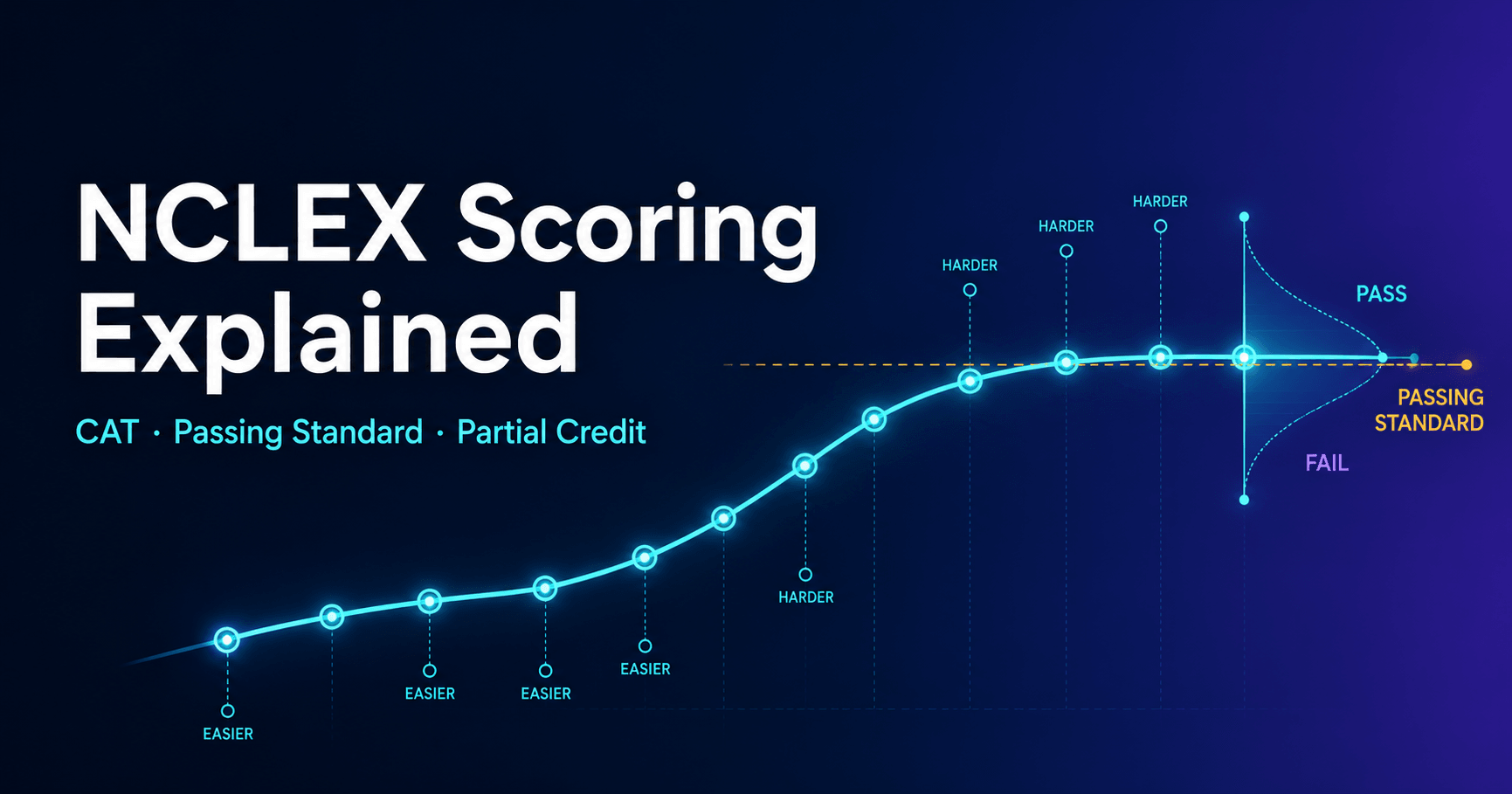
The NCLEX does not use a simple percentage score. It uses computerized adaptive testing to estimate your ability and compare it with the passing standard. This page explains the official scoring first, then how to read RN Test Pro practice reports.
Quick Answer
- The NCLEX is a computerized adaptive test (CAT).
- Your ability estimate updates after each answered item.
- The exam compares that ability estimate with the passing standard.
- Pass/fail is decided by the 95% confidence, maximum-length, or run-out-of-time rule.
- Items with more than one key may be scored with partial credit.
- RN Test Pro practice reports are study guidance, not official NCLEX predictions.
Reviewed against the 2026 NCLEX Candidate Bulletin, the 2026 NCLEX-RN and NCLEX-PN Test Plans, the NCLEX CAT page, and NCSBN scoring guidance. RN Test Pro is independent and not affiliated with NCSBN. NCLEX® is a registered trademark of the National Council of State Boards of Nursing, Inc.
Official NCLEX scoring in one screen
- CAT
- The exam adapts as you answer — it re-estimates your ability and picks the next item accordingly.
- Ability estimate
- An estimate of entry-level nursing ability, based on your responses and the difficulty of the items you answered.
- Passing standard
- The minimum ability level set by NCSBN that you must reach to pass.
- Stop rules
- The exam ends on 95% confidence, at the maximum length, or when you run out of time.
- Partial credit
- Some items with more than one correct key can award partial credit rather than all-or-nothing.
- Result
- You receive a pass/fail decision — not a percentage score.
How NCLEX Scoring Actually Works
The NCLEX is a computerized adaptive test (CAT). Instead of counting correct answers and converting them to a percentage, it builds an estimate of your ability and compares that estimate with the passing standard — the minimum ability NCSBN judges necessary to practice safely at the entry level. The passing standard is set by the NCSBN Board of Directors and reviewed periodically; the current NCLEX-RN and NCLEX-PN values are shown below, and you should always confirm them on the official NCLEX passing-standard page.
Current NCLEX Passing Standards
These are NCSBN's published ability thresholds, expressed on the same logit scale used to report ability. The applicable stopping rule determines how the ability estimate and, where required, its uncertainty are used to decide the result. The current published standards:
NCLEX-RN
Registered nurse licensure
0.00 logits
Effective through March 31, 2029
NCLEX-PN
Practical / vocational nurse licensure
-0.18 logits
Effective through March 31, 2029
A logit is a psychometric unit of measurement, not a raw score. You never calculate it on test day — the computer does it for you and simply returns a pass or fail. Because NCSBN reviews the standard periodically, always confirm the current values on the official NCLEX passing-standard page before relying on them.
How Computer Adaptive Testing (CAT) Works
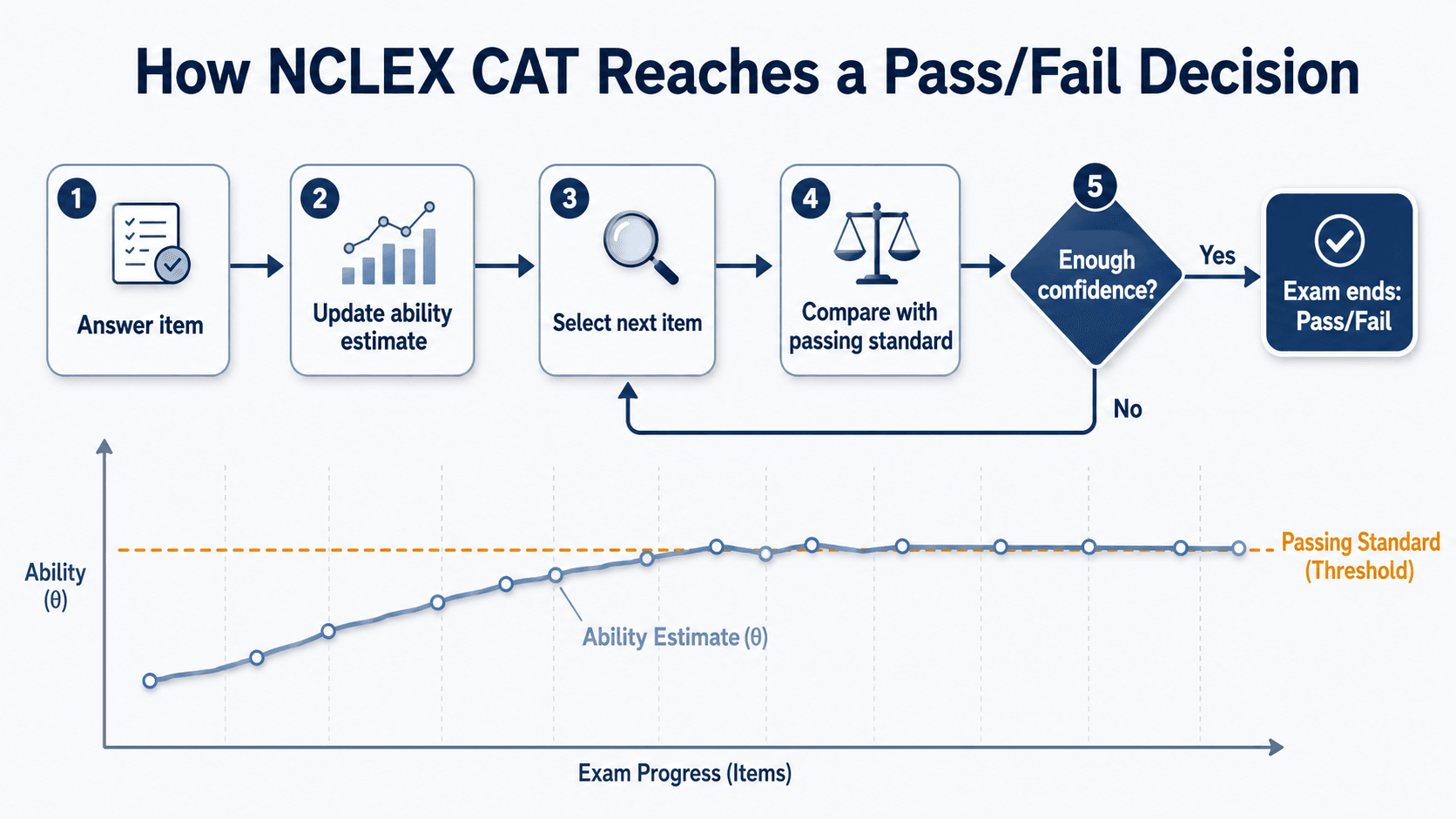
After each item, the computer re-estimates your ability based on all of your previous answers and item difficulty, then selects the next item that provides useful information about your ability. Here is the cycle:
Begin the ability estimate
Your first scored items begin the estimate of your ability, which every later answer then refines.
Re-estimate ability after each item
After each item, the computer re-estimates your ability based on all of your previous answers and the difficulty of those items.
Select the next informative item
The next item is chosen from an appropriate test-plan category to provide useful information about your ability — it is not simply made harder or easier.
Stop when a rule is met
The exam ends when a stop rule is satisfied: 95% confidence in the decision, the maximum number of items, or the time limit.
Want the longer walk-through, including what the question count does and does not tell you? See how computer adaptive testing works.
The Stop Rules: 95% Confidence, Maximum Length, or Time
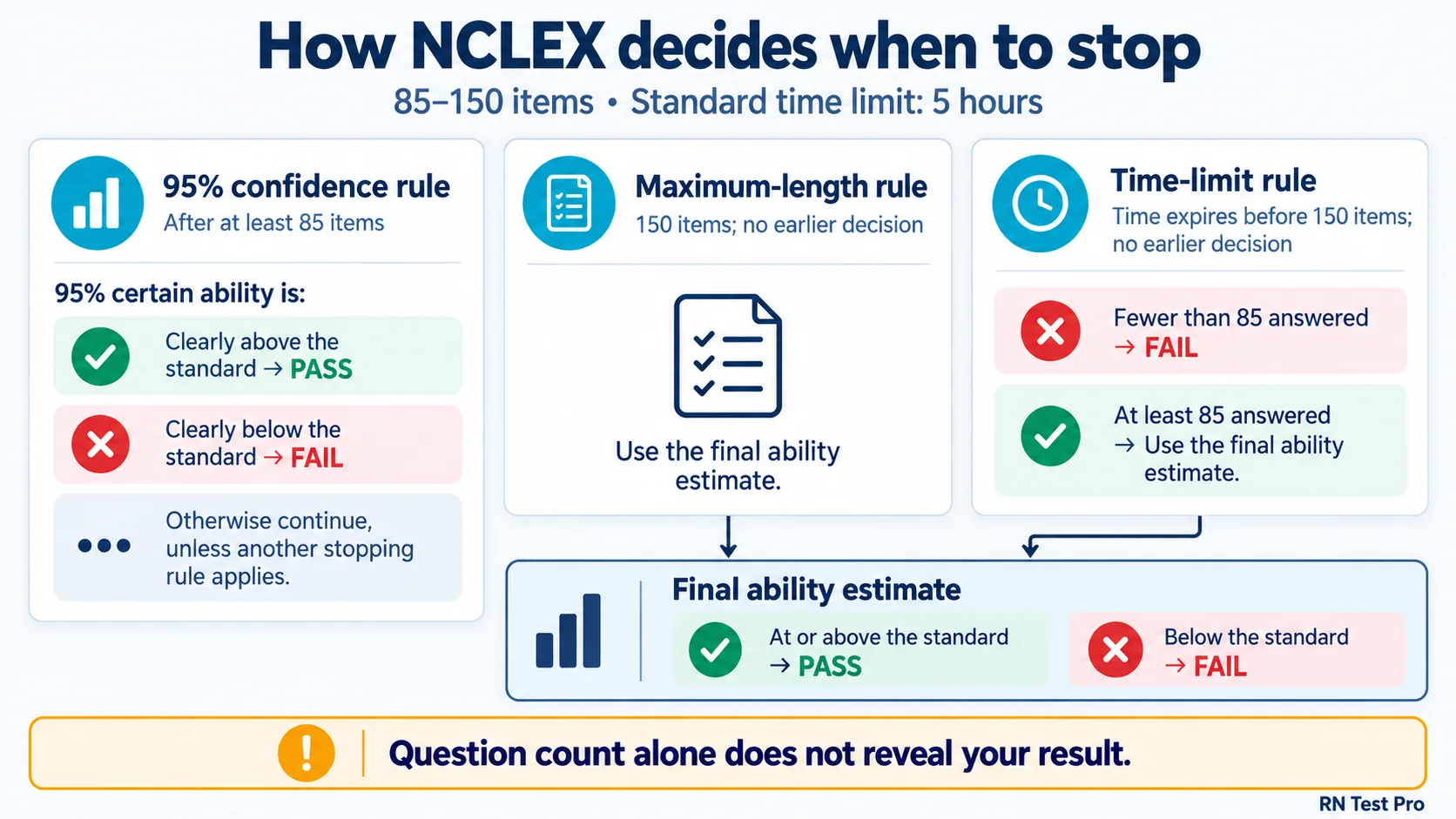
The exam doesn't end after a fixed number of questions. It ends when one of three official stop rules is met. Every valid scored NCLEX exam produces a pass/fail result. Administrative issues such as invalidated or cancelled results are separate from the scoring rules.
95% Confidence Interval Rule
The exam stops once the computer is 95% certain your ability is clearly above (pass) or clearly below (fail) the passing standard. This can happen as early as the 85-item minimum.
Maximum-Length Exam Rule
If no earlier decision is reached and time remains, the exam can continue to the 150-item maximum. At maximum length, the final ability estimate determines the result.
Run-Out-of-Time (R.O.O.T.) Rule
If time runs out first, you fail automatically when fewer than 85 items were answered. If you reached at least 85, your final ability estimate from completed items decides pass or fail.
At the 150-item maximum
When the exam reaches the 150-item maximum, it stops because the item limit has been reached, and the exam disregards the 95% confidence interval rule at that point. The pass/fail decision then uses only your final ability estimate from the scored items you completed, compared with the passing standard: if that estimate is at or above the passing standard, you pass; if it is below the passing standard, you fail.
Question count is not a result
- Stopping at 85 items does not prove you passed.
- Reaching 150 items does not prove you failed.
- Getting hard questions or a run of SATA items does not reveal your result.
Why NCLEX Doesn't Use a Percentage Score
Because the exam adapts, two candidates can answer the same number of questions correctly yet demonstrate very different ability. NCLEX scoring weighs which items you answered correctly, not just how many. Three measurement ideas drive that:
An estimate of your demonstrated ability based on the difficulty and scoring of the items you've answered. Theta is not a percentage — it's a measure on a logit scale used in adaptive testing. NCLEX compares your theta to the passing standard set by NCSBN to determine pass/fail.
Learn more about theta and readiness →How challenging an item is, calibrated by NCSBN from pretest data. Difficulty is not a fixed multiplier for the points available on that item, which is one reason raw percentage correct does not translate directly into NCLEX scoring.
How useful an item is for estimating ability near a particular estimate. Harder does not automatically mean more informative: items that are far too easy or far too difficult for a candidate tell the computer little.
Partial-Credit Scoring: Items With More Than One Key
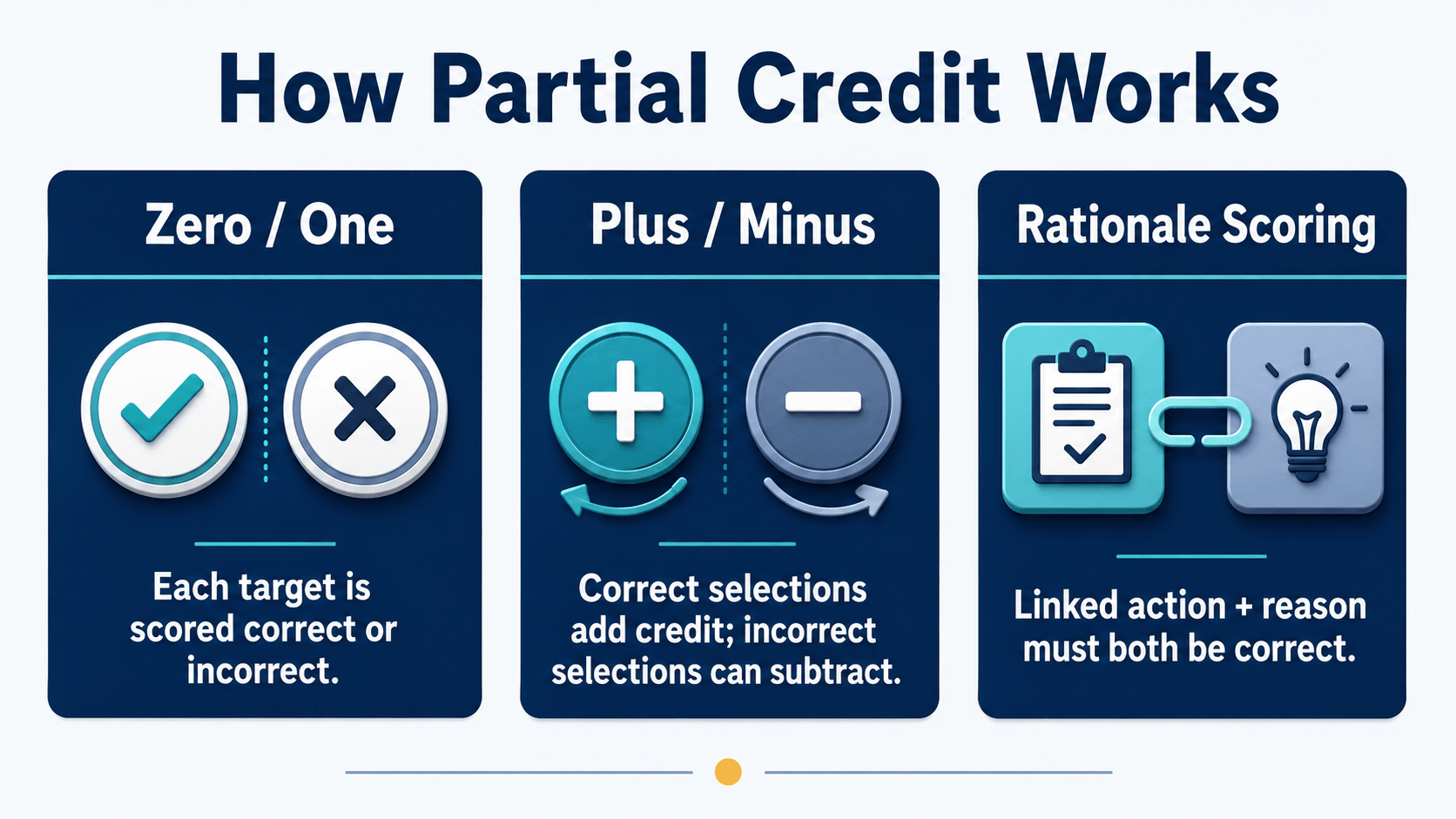
On the NCLEX, items for which more than one correct key exists may be scored with partial credit. The deciding factor is whether the item has more than one correct key — not whether it is a “multi-response” question or a “newer” format. Single-response items that have only one correct key stay all-or-nothing. NCSBN uses three official scoring methods:
Plus/minus (+/−)
Correct selections add credit; incorrect selections subtract it.
Each correct selection earns a point and each incorrect selection loses one, summed for the item. The item score is floored at zero, so a single item can never produce a negative score. NCSBN applies plus/minus to standard multi-response Select All That Apply (SATA) items, where you choose as many or as few options as apply. Other item formats may use zero/one or rationale scoring instead, depending on the item.
Zero/one (0/1)
Each target is scored right-or-wrong, with no penalty for distractors.
A single-response item is simply correct (1) or incorrect (0). A multi-point item awards credit target by target and sums the result — wrong picks do not subtract from the targets you got right. NCSBN applies 0/1 to formats such as bow-tie, Select-N, matrix multiple-choice, and drop-down cloze items.
Rationale
A linked pair earns credit only when both halves are correct.
Rationale scoring credits clinically linked responses — an action and the reason for it — only when both parts are correct together, in the "[action] because of [reason]" structure. It is all-or-nothing on the pair, which is what makes it different from the independent, per-target 0/1 rule.
Worked example: scoring a bow-tie item
A bow-tie item has five targets: one condition, two actions to take, and two parameters to monitor. NCSBN scoring guidance lists bow-tie under zero/one scoring with a maximum score of five points — each correctly placed target earns one point, and a wrong token does not subtract from the others. Complete four of the five targets correctly and you earn four points. That is different from rationale scoring, where a linked pair earns credit only when both halves are correct.
Why this matters: partial credit recognizes the steps you get right, but safe nursing still depends on catching critical findings and unsafe options. For worked SATA, bow-tie, and rationale examples, see how partial-credit scoring works, then use the item-by-item strategies below.
How to Apply the Scoring Rules on Test Day
You cannot control CAT or reverse-engineer your standing from the item counter. You can protect the credit available on the item in front of you and make practice feedback more useful.
Open the relevant exhibits before answering
NGN items embed labs, vital signs, the MAR, and nurses' notes in tabs. Review the relevant exhibits first and let the data drive the choice, not your first impression of the stem.
Protect plus/minus credit
A wrong check can cancel a correct one (the item is floored at zero), so pick only the options you can clinically defend — not extras added to feel safe.
Complete every required target
Where an incorrect choice costs nothing, an empty response still earns nothing. Commit a reasoned answer to every row, blank, or required selection.
Judge each part on its own merits
Many items award credit per correct response, so the rows or blanks you get right still bank points even if one part is wrong. Treat each target as a fresh clinical decision.
Turn every practice miss into a repair
Name the error type — content gap, missed cue, over-selection, unsafe priority, scope or delegation, exhibit miss, or wording misread — then redo a similar item and track repeated patterns in your study plan.
2026 NCLEX Format Facts
Both NCLEX-RN and NCLEX-PN are variable-length computerized adaptive tests with the same exam shape under the 2026 NCLEX Candidate Bulletin. The passing standard you must reach is set by NCSBN and may be updated periodically; the current RN and PN values appear in the passing-standards section above, and you should confirm them on the official NCLEX passing-standard page.
NCLEX-RN
Registered nurse licensure
- Computerized adaptive test (CAT)
- 85-item minimum
- 150-item maximum
- 5-hour time limit
- 15 unscored pretest items
- No skipping or returning to a previous item once an answer is confirmed
- Pass/fail result — not a percentage score
NCLEX-PN
Practical / vocational nurse licensure
- Computerized adaptive test (CAT)
- 85-item minimum
- 150-item maximum
- 5-hour time limit
- 15 unscored pretest items
- No skipping or returning to a previous item once an answer is confirmed
- Pass/fail result — not a percentage score
Key point: the 15 pretest items are unscored and look identical to scored items. You can't tell them apart, so treat every question seriously. Your final ability estimate is based only on the scored items you completed.
Official NCLEX Scoring vs RN Test Pro Practice Feedback
Two different things happen on the same kind of psychometric scale. NCLEX produces an examination pass/fail result; your nursing regulatory body sends the official result and makes licensing decisions. RN Test Pro produces practice feedback on a separate scale. Here is what each is — and what each is not.
Official examination result
Pass or fail
- NCLEX produces an examination pass/fail result.
- Uses NCSBN's own scoring algorithm and item bank.
- Measures ability against the NCSBN passing standard.
- Your nursing regulatory body sends the official result and makes the licensing decision.
RN Test Pro practice feedback
Practice & study guidance
- Adaptive practice and practice feedback on a separate scale.
- Not the official NCLEX algorithm.
- Uses no official NCLEX item bank.
- Study guidance, not a pass/fail guarantee.
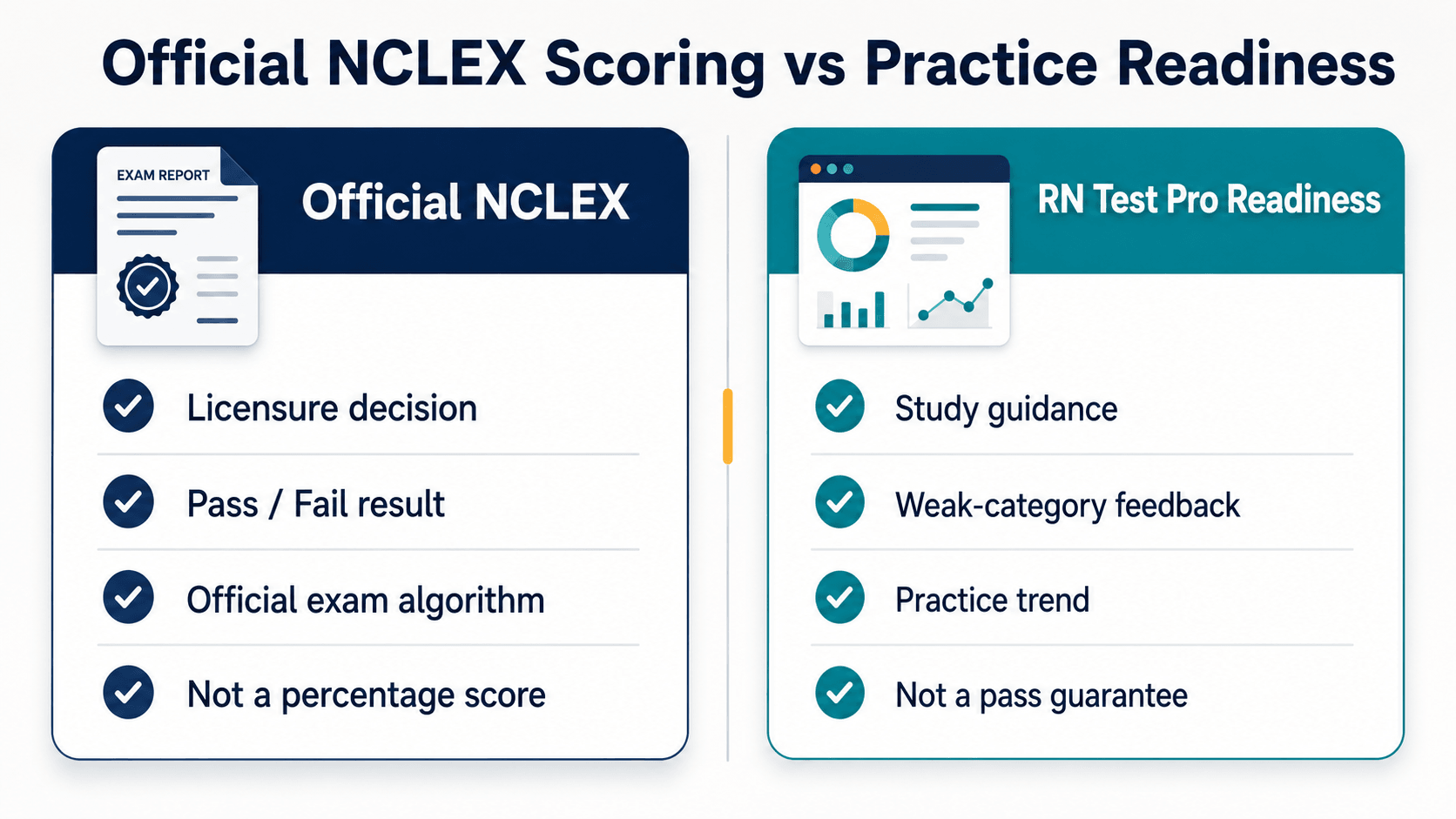
Use RN Test Pro practice feedback as study guidance — what to review next, which Client Needs categories are weakest, and how your session results change over time. It is not a promise of your official NCLEX result.
Take the free competency test
50 free questions with AI analysis, a 7-day study plan and your performance by category — study guidance, not an official NCLEX prediction.
Understanding Your RN Test Pro Practice Report
The report depends on the practice mode. Practice quizzes, including the free competency test, show your score, performance by category and an AI analysis. With Full Access, the CAT exam simulation and Adaptive Practice add the model-based results described below. None of these reports is an official NCLEX score, and none establishes exam readiness.
RN Test Pro estimates your performance on our practice items only. It does not know your official NCLEX theta or NCSBN's official item difficulties; the difficulty values it uses are preset and have not been calibrated from learner responses.
What the report shows
- CAT exam simulation: a simulated pass or fail for that session, decided by RN Test Pro's practice confidence, maximum-length, or time-limit rule against a threshold on its own scale; the final ability estimate (theta) with its standard error; the reason the session ended; and a chart of the estimate across the session with a confidence band.
- Adaptive Practice: the final ability estimate with its standard error, whether it sits above or below the practice passing value, and one of the ability labels listed below.
- Category performance: CAT and Adaptive Practice results include a radar chart and a bar chart of accuracy by Client Needs category and how many items each category received against its test-plan target. Practice-quiz results show performance by category without the adaptive-result charts.
- Session history: your stats page lists past sessions and their results, including an ability estimate for sessions that produce one.
Ability labels on Adaptive Practice results
Adaptive Practice translates the final estimate into one of five labels. These are product labels for preset score bands — "Average" does not mean an observed average among NCLEX candidates or RN Test Pro users — and none of them is an exam-readiness verdict:
Very High
θ of +1.5 or higherShown when your final Adaptive Practice estimate is at or above +1.5 logits on RN Test Pro's practice scale.
Above Average
+0.5 to +1.5Shown when the estimate is at or above +0.5 and below +1.5 logits.
Average
−0.5 to +0.5Shown when the estimate is at or above −0.5 and below +0.5 logits.
Below Average
−1.5 to −0.5Shown when the estimate is at or above −1.5 and below −0.5 logits.
Needs Improvement
below −1.5Shown when the estimate is below −1.5 logits.
How Our Platform Reports Results
Our practice reports use adaptive and psychometric principles for NCLEX preparation. RN Test Pro is independent and not affiliated with NCSBN — we are not the official NCLEX algorithm — but we apply similar preparation concepts so practice familiarizes you with one-question-at-a-time testing and ability-estimate feedback. Here's how to interpret the figures you see:
Practice Estimates and Category Accuracy
CAT and Adaptive Practice results include a model-based theta estimate (logits) computed from your responses and preset item-difficulty values. Category accuracy and the estimate summarize different aspects of practice; neither should be treated alone as an exam-readiness judgment.
A Simulated Result, Not a Prediction
The CAT exam simulation reports pass or fail for that practice session under RN Test Pro's stopping rules on its own practice scale. Neither that result nor an Adaptive Practice ability label predicts your official NCLEX outcome.
Confidence Intervals Matter
The results chart displays a model-based interval calculated from the reported standard error. Its width can change as responses are added. A narrower band represents smaller uncertainty within this practice model; it does not establish accuracy against NCLEX outcomes.
Category-Level Insights
Beyond the overall estimate, we show accuracy by Client Needs category. Use it to choose what to review next; it does not establish that every topic in a category has been covered.
Important: your practice report reflects your performance on RN Test Pro practice questions, not the official NCLEX. Our scoring methodology applies adaptive and psychometric principles for preparation purposes only — it is not the official NCLEX algorithm and uses no official NCLEX item bank. Many factors affect actual exam performance. Use the report as a guide for preparation focus, not as a guarantee of pass or fail.
What to Do With This Information
You cannot control the algorithm, but you can control your preparation. Put the scoring facts to work:
- During the exam, do not try to decode the algorithm — you cannot tell how you are doing from the questions you are shown.
- Answer the current item as safely as you can, then move on. You cannot go back to change it.
- During prep, review your weakest Client Needs categories first.
- Track your partial-credit losses: a missed cue, over-selection, the wrong action or reason, or a missed exhibit.
- Use readiness data to build a study plan, not as a pass prediction.
Ready to act on this? Build a study plan around your weakest categories, or start with free practice and review your category feedback. Practice reports are study guidance, not an official NCLEX prediction.
Common Scoring Myths
You need 70% correct to pass
NCLEX doesn't use percentage scoring. Ability is measured against the passing standard, and each response is weighted by item difficulty — so the same percentage correct can point to very different ability levels. Answering harder items correctly demonstrates more ability than answering easier ones.
Stopping at 85 means I passed
You can pass or fail at 85 items, the minimum for both NCLEX-RN and NCLEX-PN. The exam may stop under the confidence rule after the minimum is completed; if time expires after 85 items, the time-limit rule uses the final ability estimate instead. Question count alone does not reveal your result.
Reaching 150 means I failed
150 is the maximum, not a death sentence. Reaching 150 simply means your ability estimate stayed close to the passing standard long enough that the algorithm needed every available item to decide. Many candidates take all 150 items and pass.
Hard questions mean I'm passing
A question can feel hard for many reasons that have nothing to do with statistical difficulty: the topic is weak for you, the wording is unfamiliar, the scenario is one you haven't practiced, or you're tired. Statistical item difficulty is calibrated by NCSBN — you cannot perceive it during the exam.
Lots of SATA means I'm doing well
Item format is not the same as item difficulty. SATA, matrix, bow-tie, and cloze items appear at a wide range of difficulty levels. Seeing a string of multi-response items tells you nothing reliable about how the exam is going.
All SATA items are all-or-nothing
Standard multi-response Select All That Apply items are scored with plus/minus partial credit — correct selections add credit and incorrect ones subtract it, with the item score floored at zero. Other formats may use zero/one or rationale scoring instead; the exact method depends on the item.
Scoring FAQ
How does partial credit work on the NCLEX?
Items for which more than one correct key exists can be scored with partial credit, using three official methods: zero/one, plus/minus, and rationale scoring. Single-response items that have only one correct key stay all-or-nothing. The method depends on the item, not on whether it looks new — traditional Select All That Apply items, for example, are scored with plus/minus partial credit. For worked examples of each method, see our partial-credit scoring guide.
How is a bow-tie item scored?
A bow-tie item has five targets — one condition, two actions to take, and two parameters to monitor. Each correct target can earn credit under zero/one scoring, for a maximum of five points, and a wrong token does not subtract from the others. That is different from rationale scoring, where linked responses must both be correct.
Is RN Test Pro's scoring the same as the actual NCLEX?
No. RN Test Pro uses adaptive and psychometric principles for preparation purposes, but it is not the official NCLEX algorithm and uses no official NCLEX item bank. Our practice platform estimates your ability and adapts question difficulty in spirit similar to CAT, but the official NCLEX is administered by NCSBN using their proprietary scoring system. Use your practice readiness as study guidance, not as a guarantee of pass or fail. For official information, consult the NCSBN website. RN Test Pro is independent and not affiliated with NCSBN.
Why doesn't NCLEX show a percentage score?
Percentage doesn't account for difficulty. Two candidates with 70% correct could have very different ability estimates if one answered hard questions and the other answered easy ones. Adaptive testing produces a single ability estimate (theta) that accounts for both accuracy and difficulty, and that estimate is compared with the passing standard. This is more fair — it recognizes that correctly answering difficult questions demonstrates more ability than correctly answering easy ones.
What happens if I run out of time?
If time runs out before the system reaches a confident pass/fail decision, the result depends on whether you reached the minimum of 85 items. If you did not reach 85 items, you fail automatically. If you reached 85 or more items, the system uses your final ability estimate from the items you completed to determine pass or fail.
Can I pass with the minimum questions?
Yes. You can pass or fail at 85 items, the minimum for both NCLEX-RN and NCLEX-PN. The exam may stop under the confidence rule after the minimum is completed; if time expires after 85 items, the time-limit rule uses the final ability estimate instead. Question count alone does not reveal your result.
What does the ability label on my Adaptive Practice results mean?
Adaptive Practice shows one of five labels — Very High, Above Average, Average, Below Average, or Needs Improvement — based on where your final practice estimate falls on RN Test Pro's scale. For example, Above Average means at least +0.5 and below +1.5 logits on RN Test Pro's practice scale. The labels are preset score bands, not an observed average among candidates, and not an exam-readiness verdict or a prediction of your official result.
How should I use my practice report?
Review it after each session to choose what to study next, starting with the Client Needs categories where your accuracy is lowest, and use the session history on your stats page to see how your estimates change over time. One session's estimate does not establish exam readiness.
Sources and Alignment Note
How this guide was reviewed
Official NCLEX scoring and format details on this page reflect NCSBN’s published guidance, reviewed June 2026: the 2026 NCLEX Examination Candidate Bulletin, the 2026 NCLEX-RN and NCLEX-PN Test Plans, the NCLEX Computerized Adaptive Testing page, the NCLEX Candidate FAQ, and NCSBN’s current scoring-model guidance. The passing standards quoted here — NCLEX-RN at 0.00 logits and NCLEX-PN at -0.18 logits, effective through March 31, 2029 — are drawn from the NCLEX Passing Standard page; always confirm the current values there, since NCSBN reviews the standard periodically. Readiness levels, theta reporting, and category insights describe RN Test Pro’s practice platform, not the official exam. RN Test Pro is independent and is not affiliated with, endorsed by, or sponsored by NCSBN, and does not guarantee any NCLEX result. NCLEX® is a registered trademark of the National Council of State Boards of Nursing, Inc.
- NCLEX — 2026 NCLEX Examination Candidate Bulletin (effective April 2026)
- NCLEX — 2026 NCLEX-RN and NCLEX-PN Test Plans
- NCLEX — Computerized Adaptive Testing (CAT)
- NCLEX — Candidate FAQ (scoring and stop rules)
- NCSBN — What are the current scoring models?
- NCLEX — Passing Standard
- NCLEX — Next Generation NCLEX (NGN)
Related Topics
CAT Computer Adaptive Testing
How NCLEX adapts question difficulty and when the exam stops.
How Partial-Credit Scoring Works
Worked SATA, bow-tie, and rationale examples for each scoring method.
Results & Score Reports
What your official NCLEX results mean and how to read quick results.
NGN Question Types
Bow-tie, trend, matrix, and the other Next Generation item formats.
Bow-Tie Items
The five-target bow-tie format and how 0/1 scoring awards its points.
Readiness Scoring
How we estimate your theta and what it means for your preparation.
Take the free competency test
50 free questions with AI analysis, a 7-day study plan and your performance by category. Practice reports are study guidance, not pass predictions.
Start the free test