NCLEX Study Tips: How to Prepare Effectively
An effective NCLEX study plan focuses on clinical judgment, not just content review. Learn how to structure your preparation, use active recall, and practice with questions at the right difficulty for your ability.
10 min read — Passing the NCLEX isn't about cramming content. It's about building the clinical judgment skills to make safe decisions under pressure. Here's how to study smarter, not harder.
Quick Links
The Foundation: Clinical Judgment Over Content
Many students study for the NCLEX by memorizing facts, lab values, and medication lists. While content knowledge matters, the NCLEX tests clinical judgment—whether you can apply knowledge to make safe decisions.
This means:
- Understanding "why" not just "what"
- Practicing application, not just recall
- Learning to prioritize and recognize patterns
- Developing systematic approaches to clinical scenarios
How Our System Builds Clinical Judgment
Our adaptive platform trains clinical judgment through realistic case studies. Questions are chosen for YOUR ability level—challenging enough to build skills, not so hard that you're overwhelmed. Each rationale explains the clinical reasoning, not just the correct answer.
Evidence-Based Study Strategies
1. Spaced Repetition
Research consistently shows that spaced repetition outperforms cramming. Review content at increasing intervals:
- First review: Within 24 hours of learning
- Second review: 2–3 days later
- Third review: 1 week later
- Fourth review: 2–4 weeks later
Our adaptive system automatically surfaces topics at optimal intervals based on your performance.
2. Active Recall
Testing yourself is more effective than re-reading notes. After reviewing content, close your notes and explain the concept from memory. Practice questions should be the core of your preparation, not an add-on.
3. Interleaved Practice
Mix topics rather than studying one subject at a time. For example, instead of doing 50 pharmacology questions, mix pharmacology, prioritization, and infection control. This builds the ability to recognize what type of problem you're facing—a crucial skill for NCLEX.
4. Elaboration
Connect concepts to clinical application. Don't just memorize that hypokalemia causes muscle weakness—understand why (potassium is needed for muscle contraction) and connect it to ECG changes (flattened T waves, U waves). This depth of understanding transfers to new scenarios.
Structuring Your Study Plan
Daily Practice
Aim for 50–100 practice questions daily during active study:
- Morning: 30–50 questions focused on one category
- Afternoon: 20–50 mixed questions or case studies
- Evening: Review rationales and notes
Weekly Structure
Plan your week around Client Needs categories:
- Monday: Management of Care + Safety
- Tuesday: Pharmacological Therapies
- Wednesday: Reduction of Risk Potential
- Thursday: Physiological Adaptation
- Friday: Health Promotion + Psychosocial
- Saturday: Basic Care + Mixed Practice
- Sunday: Review weak areas + Rest
Practice Tests
Take full-length practice tests periodically:
- Week 1: Diagnostic test to identify baseline
- Week 4: Mid-point assessment
- Week 6: Practice test building stamina
- Week 7: Final practice test before exam
Question Analysis Strategy
Every question is a learning opportunity. Don't just check if you got it right—analyze:
For Correct Answers
- Could you explain why it's correct?
- Why are the other options wrong?
- What clinical judgment skill was tested?
- Is there another approach that would work?
For Incorrect Answers
- What did you miss in the question?
- What knowledge gap led to the wrong answer?
- What systematic approach would have helped?
- Write a note for future review
Start Effective Practice
Questions chosen for YOUR ability level. Our adaptive system applies evidence-based learning principles automatically.
Start Adaptive Practice →Test-Taking Strategies
Read the Question Stem First
Before reading the scenario, read the question. This helps you focus on relevant information and avoid being overwhelmed by details.
Identify Key Words
Watch for words that change the priority:
- "First" / "Initial" / "Priority": What must be done before anything else
- "Best" / "Most appropriate": Multiple options may be correct; choose the best
- "Teach" / "Educate": Focus on patient understanding, not just nurse knowledge
Use ABCs and Maslow
For prioritization questions:
- ABCs: Airway, Breathing, Circulation—in that order
- Maslow: Physiological needs before safety before psychosocial
- Stability: Unstable patients before stable patients
- Acute vs. Chronic: Acute changes take priority
Evaluate Each Option
For multiple-choice, read all four options before selecting. For SATA, evaluate each option independently—don't assume a certain number must be correct.
Managing Stress and Burnout
Take Breaks
Study sessions longer than 90 minutes lose effectiveness. Take a 10–15 minute break between sessions. Move, hydrate, and rest your eyes.
Maintain Balance
The week before the exam, taper intense study. Focus on light review and confidence-building. Get adequate sleep. Exercise. Spend time with supportive people.
Build Confidence
Track your progress. Note improvements in weak areas. Celebrate small wins. Confidence affects performance—believe in your preparation.
Common Mistakes to Avoid
Cramming Content Without Application
Memorizing facts without practicing application wastes time. The NCLEX tests clinical judgment—you need to apply knowledge, not just recall it.
Ignoring Rationales
Skipping rationales for correct answers misses learning opportunities. Understanding why an answer is correct—and why others are wrong—builds clinical reasoning.
Practicing at the Wrong Level
Questions too easy don't challenge you. Questions too hard frustrate without building skills. Adaptive practice finds your level automatically.
Neglecting Self-Care
Sleep, nutrition, and exercise affect cognitive performance. Burnout before the exam undermines all your preparation. Take care of yourself.
Study Schedule Templates
30-Day Intensive NCLEX Study Plan
Best for: Recent graduates with strong content knowledge who need focused practice before test day.
| Week | Focus Areas | Daily Questions | Key Activities |
|---|---|---|---|
| Week 1 | Diagnostic + Management of Care | 100-150/day | Full diagnostic test, identify weak areas |
| Week 2 | Pharmacology + Risk Reduction | 120-150/day | Drug flashcards, NGN case studies |
| Week 3 | Physiological Adaptation + Weak Areas | 150/day | Targeted practice, timed sessions |
| Week 4 | Full-Length Tests + Confidence | 75-100/day | 2 full-length tests, light review |
Time commitment: 5-7 hours/day. Not recommended for those working full-time.
60-Day Balanced NCLEX Study Plan
Best for: Most candidates—allows time for content review and progressive practice.
| Week | Focus Areas | Daily Questions | Weekly Goal |
|---|---|---|---|
| Weeks 1-2 | Management of Care, Safety | 50-75/day | Diagnostic + baseline scores |
| Weeks 3-4 | Pharmacology + Risk Reduction | 75-100/day | Complete drug flashcard deck |
| Weeks 5-6 | Physiological Adaptation + Health Promotion | 100-120/day | NGN case study practice |
| Weeks 7-8 | Weak Areas + Full-Length Tests | 100-150/day | 2 full-length practice exams |
Time commitment: 3-5 hours/day. Sustainable for most schedules.
90-Day Comprehensive NCLEX Study Plan
Best for: Those working part-time, parents, or anyone needing a gentler pace with thorough content mastery.
| Weeks | Focus Areas | Daily Questions | Milestones |
|---|---|---|---|
| Weeks 1-3 | Management of Care, Safety, Infection Control | 50/day | Diagnostic test, establish baseline |
| Weeks 4-6 | Pharmacology + Medication Administration | 50-75/day | Complete pharmacology flashcards |
| Weeks 7-9 | Reduction of Risk + Physiological Adaptation | 75-100/day | Mid-point assessment |
| Weeks 10-11 | Health Promotion + Psychosocial | 100/day | NGN case study focus |
| Weeks 12-13 | Weak Areas + Mixed Practice | 100-125/day | Full-length practice test |
Time commitment: 2-4 hours/day. Ideal for those balancing work or family.
Balancing Work and NCLEX Study
Time Management Strategies for Working Students
- Morning study sessions: Study before work when your brain is fresh. Even 45-60 minutes before your shift adds up to 5-7 hours per week.
- Use commute time: Listen to NCLEX podcasts or review audio flashcards during your drive (hands-free only).
- Micro-sessions on breaks: 10-15 question sets during work breaks maintain momentum without burnout.
- Block dedicated weekend time: Reserve 4-6 hours on your days off for full practice sessions and review.
- Communicate with your employer: Many employers support NCLEX prep—ask about schedule flexibility.
Sample Schedule: Working 3x12-Hour Shifts
On Work Days:
- • 6:00-7:00 AM: 50 questions before shift
- • Breaks: 10-15 questions each break
- • Evening: Light review only (15 min)
- • Priority: Sleep and recovery
On Days Off:
- • Morning: 100-150 questions
- • Afternoon: Rationale review + weak areas
- • Evening: Flashcards or light review
- • Total: 4-6 hours focused study
Pro Tips for Work-Study Balance
- • Protect your sleep: Never sacrifice sleep for study—memory consolidation happens during rest.
- • Batch similar tasks: Do all pharmacology questions on one day, all prioritization on another.
- • Use vacation time wisely: Consider taking 3-5 days off before your exam for intensive review.
- • Set boundaries: Let friends and family know your study schedule so they can support you.
- • Track your progress: Seeing improvement motivates you through tough days. Our dashboard shows weekly trends.
NCLEX-Style Clinical Scenarios
Practice with realistic clinical scenarios to build confidence and improve clinical judgment. These examples mirror NCLEX question formats and test your ability to apply knowledge in clinical situations:
Scenario 1: Prioritization in Heart Failure
A 68-year-old patient with heart failure (HF) presents to the emergency department with acute shortness of breath, crackles in the bilateral lung bases, and 3+ pitting edema in the lower extremities. The nurse has the following tasks to prioritize:
- • Administer furosemide 40 mg IV push
- • Obtain a 12-lead ECG
- • Draw a BMP and troponin level
- • Insert a Foley catheter
Correct Priority:
Administer furosemide 40 mg IV push.
Rationale:
- The priority is to reduce preload and alleviate pulmonary edema (ABCs: Breathing).
- Furosemide acts quickly to remove excess fluid, improving oxygenation.
- The ECG and labs are important but secondary to addressing acute respiratory distress.
- Inserting a Foley catheter is non-urgent and can wait until the patient is stabilized.
Scenario 2: Pharmacology Safety (ACE Inhibitor Allergy)
A patient with hypertension is prescribed lisinopril. The nurse reviews the patient's chart and notes a history of angioedema related to a previous ACE inhibitor. The patient asks, "Why can't I take lisinopril? It worked well for my blood pressure before."
Correct Response:
"Lisinopril is an ACE inhibitor, and your history of angioedema puts you at risk for a life-threatening allergic reaction. We'll switch you to a different class of medication, such as an ARB (e.g., losartan) or a calcium channel blocker (e.g., amlodipine), to manage your blood pressure safely."
Rationale:
- ACE inhibitors (e.g., lisinopril) cause angioedema due to bradykinin accumulation.
- Patients with a history of angioedema should never take ACE inhibitors due to the risk of recurrence.
- ARBs (e.g., losartan) are structurally different and less likely to cause angioedema, though caution is still advised.
- Calcium channel blockers (e.g., amlodipine) are a safe alternative and do not affect bradykinin pathways.
Scenario 3: Delegation to LPNs
A charge nurse is delegating tasks on a busy medical-surgical unit. Which task is most appropriate to assign to a licensed practical nurse (LPN)?
- • Assessing a patient's pain level post-operatively (RN scope)
- • Administering oral antihypertensive medication to a stable patient
- • Developing a care plan for a new admission (RN scope)
- • Teaching a patient about insulin self-administration (RN scope)
Rationale:
- LPNs can administer medications to stable patients but cannot perform assessments, develop care plans, or provide patient education.
- Tasks requiring clinical judgment, such as assessments, teaching, and care planning, must be handled by an RN.
- Always verify the patient's stability before delegating medication administration.
Scenario 4: NGN Case Study (Bowtie Format)
A 72-year-old patient with type 2 diabetes is admitted with a diabetic foot ulcer. The wound culture returns positive for methicillin-resistant Staphylococcus aureus (MRSA). The nurse is presented with the following interventions:
- • Initiate contact precautions (gown and gloves)
- • Administer vancomycin as prescribed
- • Monitor blood glucose levels every 4 hours
- • Educate the patient on wound care techniques
- • Consult the infectious disease team
Correct Interventions:
Initiate contact precautions, administer vancomycin, and consult the infectious disease team.
Rationale:
- Contact precautions are required for MRSA to prevent transmission.
- Vancomycin is the antibiotic of choice for MRSA infections.
- Consulting the infectious disease team ensures specialized management for complex infections.
- While monitoring blood glucose and wound care education are important, they are not the immediate priority for infection control.
Study Schedule Template
8-Week NCLEX Study Plan
| Week | Focus Areas | Daily Goals | Weekly Assessment |
|---|---|---|---|
| Week 1 | Management of Care, Safety & Infection Control | 50 questions/day, review rationales | Diagnostic quiz (50 questions) |
| Week 2 | Pharmacological Therapies, Reduction of Risk | 60 questions/day, flashcards for drugs | Timed quiz (60 questions, 2 min/question) |
| Week 3 | Physiological Adaptation, Health Promotion | 70 questions/day, focus on NGN cases | Case study simulation (2 NGN cases) |
| Week 4 | Psychosocial Integrity, Basic Care | 80 questions/day, alternate formats | Mid-point assessment (100 questions) |
| Week 5 | Weak Areas (from Week 4) | Targeted practice (topics from weak areas) | Compare Week 4 vs Week 5 scores |
| Week 6 | Mixed Review + NGN Case Studies | 90 questions/day, full NGN cases | Timed case study (2 NGN cases, 30 min) |
| Week 7 | Full-Length Practice Tests | 100 questions/day, simulate test day | Full-length test (150 questions, 3 hours) |
| Week 8 | Confidence Building + Light Review | 30–50 questions/day, review flashcards | Final readiness assessment (50 questions) |
Adjust this plan based on your weak areas. Our interactive study planner can customize this for your schedule.
Managing Stress and Burnout
Take Strategic Breaks
Study sessions longer than 90 minutes lose effectiveness. Use the Pomodoro Technique:
- Study for 50 minutes, then take a 10-minute break
- After 4 cycles, take a 30-minute break
- Use breaks for movement (walking, stretching) or mindfulness
Pro Tip: Use break time to step away from screens. Try a 5-minute meditation or deep-breathing exercise to reset your focus.
Maintain Work-Life Balance
Schedule non-study activities as intentionally as you schedule study time:
Do:
- Exercise 3–4 times per week (yoga, walking, gym)
- Prioritize 7–8 hours of sleep nightly
- Eat balanced meals; stay hydrated
- Spend time with supportive friends/family
Avoid:
- All-nighters (harm memory consolidation)
- Skipping meals (causes energy crashes)
- Isolating yourself (increases stress)
- Excessive caffeine (leads to anxiety and crashes)
Build Confidence with Visualization
Use visualization to prepare mentally for test day:
- Find a quiet space and close your eyes
- Imagine arriving at the testing center calm and prepared
- Visualize answering questions with confidence
- Picture yourself successfully completing the exam
- Finish by imagining receiving your passing results
Frequency: Practice this 5–10 minutes daily, especially in the week before the exam. Combine with affirmations like "I am prepared" or "I trust my training."
FAQ: NCLEX Study Tips
How many hours per day should I study for the NCLEX?
Most successful NCLEX candidates study 3-5 hours per day during active preparation. Quality trumps quantity—one focused 3-hour session beats 6 hours of distracted studying. If you're working full-time, aim for 2-3 hours on weekdays and 4-6 hours on weekends. Our adaptive platform helps maximize limited study time by focusing on your specific weak areas rather than wasting time on content you've already mastered.
What are the best resources for adaptive testing practice?
The best adaptive practice resources use Item Response Theory (IRT) to select questions based on your ability level. Look for platforms that: (1) Use the same CAT algorithm as NCLEX, (2) Provide detailed rationales explaining clinical reasoning, (3) Offer performance analytics by Client Needs category, and (4) Include NGN-style case studies. Our platform meets all these criteria—adaptive questions are chosen for YOUR ability, not random selection.
How do I handle burnout during NCLEX prep?
Burnout is real and counterproductive. Signs include: dreading study sessions, inability to focus, declining practice scores, and physical exhaustion. To recover:
- Take 2-3 days completely off from studying—no flashcards, no questions.
- Rebuild with shorter sessions: start with 30-minute blocks.
- Change your environment: study at a library or coffee shop instead of home.
- Add physical activity: exercise reduces cortisol and improves cognitive function.
- Connect with peers: study groups provide accountability and emotional support.
- If burnout persists, reassess your timeline—rushing leads to failure.
A well-rested brain learns faster than an exhausted one. Taking breaks is not wasted time.
How do I know when I'm ready to take the NCLEX?
You're ready when you consistently perform at least 10% above the passing threshold on adaptive practice tests. Our platform tracks your performance using the same NCLEX scoring algorithm. When your readiness score reaches 90% or higher, you're statistically likely to pass. Other signs include: feeling confident with clinical judgment questions, recognizing patterns in questions, and identifying priority actions quickly.
What should I do if I keep getting the same type of question wrong?
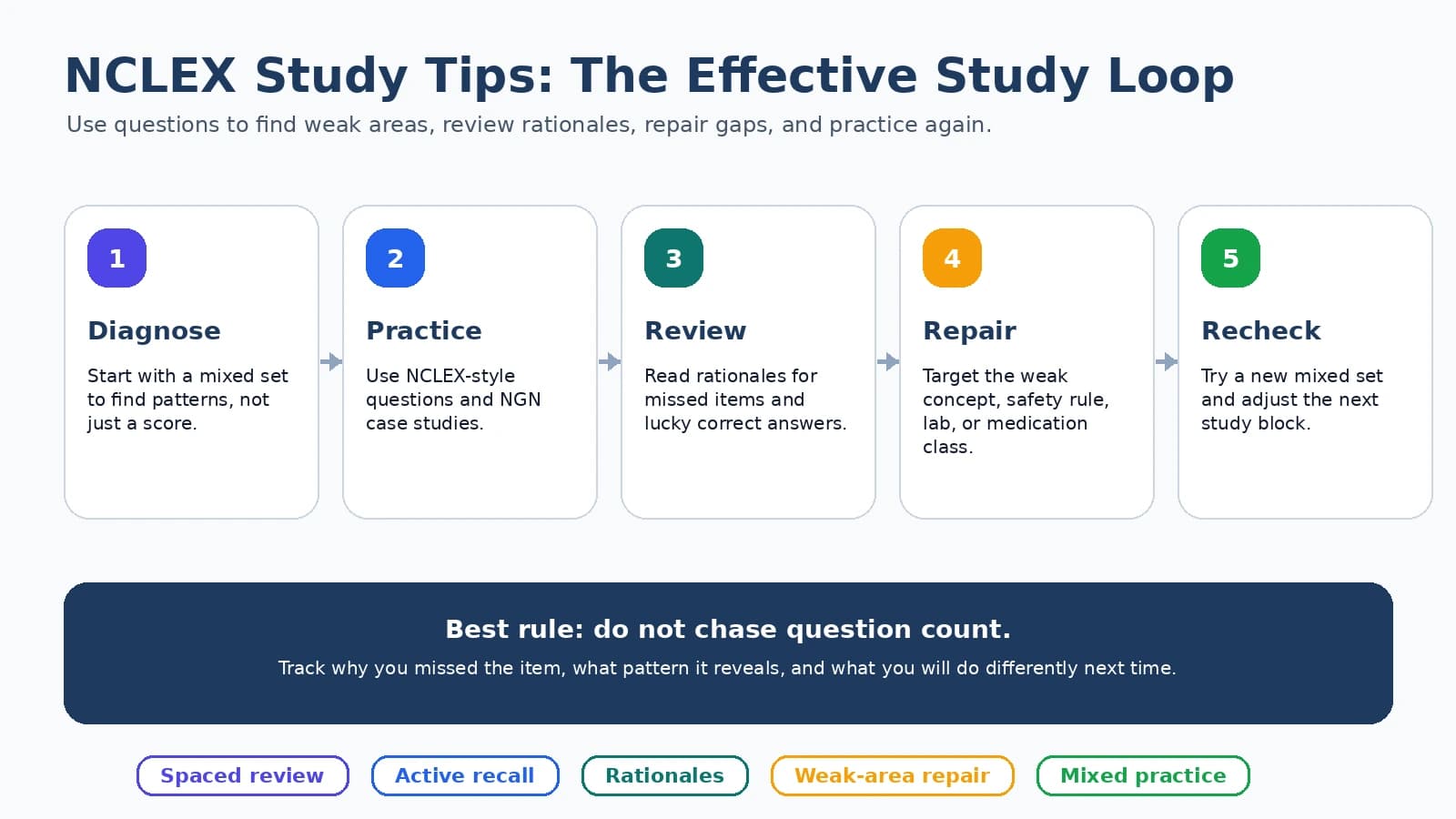
First, cluster these questions by topic (e.g., pharmacology, prioritization). For each topic, create a 'learning loop': (1) Review the rationales for all related questions, (2) Study the underlying concept using reputable sources (e.g., our NCLEX Client Needs pages), (3) Create flashcards for key facts, (4) Practice 10–20 new questions on that topic, and (5) Reassess after 24 hours. Our adaptive system automatically detects repeat mistakes and targets them with focused practice.
How do I balance studying with work/family commitments?
Use a 'micro-study' approach: replace passive activities with active learning. For example:
- Listen to NCLEX podcasts during commutes or workouts.
- Use flashcard apps during short breaks (5–10 questions at a time).
- Create a study-friendly home environment: keep notes visible (e.g., on a whiteboard).
- Block 3–4 hours weekly for full adaptive practice sessions.
- Communicate your study schedule to family/friends to minimize interruptions.
Quality matters more than quantity. One hour of focused, uninterrupted practice is more effective than three hours of distracted studying.
How can I improve my speed on the NCLEX?
Practice with timed questions to build pacing awareness. The NCLEX allows ~2 minutes per question, but NGN case studies may require more time. Use these strategies:
- Read the question stem first to focus your thinking.
- Eliminate obviously wrong answers quickly.
- For SATA questions: treat each option as true/false.
- If stuck, mark the question and return later—don't dwell.
- Use direct answers for knowledge-based questions and systematic approaches for clinical judgment.
Speed comes with familiarity. The more you practice realistic questions, the faster you'll recognize patterns.
What's the best way to review rationales?
Don't just read rationales—engage with them actively:
- After answering a question, note whether you got it right or wrong and why.
- Read the rationale and highlight new information.
- Write down 1–2 key takeaways for each question.
- Create flashcards for critical facts (e.g., lab values, drug side effects).
- Review your flashcards weekly using spaced repetition.
Tip: For incorrect answers, analyze the mistake: Did you misread the question? Miss a key detail? Apply the wrong concept? This reflection prevents repeat errors.
How can I effectively practice clinical scenarios like those in the NGN?
Practice clinical scenarios by focusing on the clinical judgment process, not just content knowledge. Use this systematic approach:
- Start with case studies that have multiple patient interactions (e.g., our NGN bowtie cases).
- Identify key findings (assessment data, lab values, patient statements).
- Determine the most urgent problem using ABCs, Maslow, and stability principles.
- Create a prioritized plan of care with rationales for each decision.
- Practice delegation questions: determine which tasks can be delegated to different nursing roles.
- Review your decisions against evidence-based guidelines and rationales.
Our adaptive platform includes NGN-style case studies with evolving patient conditions to simulate real-world clinical judgment.
Clinical Judgment Examples
Example 1: Pharmacology Priority Question
Scenario: A 68-year-old patient with atrial fibrillation is prescribed warfarin. His INR today is 4.8 (therapeutic range 2-3). The nurse reviews his medication list and finds he's also taking acetaminophen for osteoarthritis pain.
NCLEX Question: Which action should the nurse take FIRST?
- A. Hold the next dose of warfarin and notify the provider.
- B. Assess for signs of bleeding (bruising, petechiae, tarry stools).
- C. Administer vitamin K as prescribed.
- D. Educate the patient about avoiding NSAIDs.
Clinical Judgment Application:
- Recognize cues: INR 4.8 indicates supratherapeutic anticoagulation → increased bleeding risk.
- Analyze: Option A addresses the immediate issue (hold dangerous drug), but assessment (Option B) comes first in the nursing process.
- Prioritize: Assess before intervening. Vital signs, bleeding assessment inform next actions.
- Apply ABCs: Bleeding could affect circulation (C in ABCs).
Correct Answer: B — Assessment always comes before intervention, especially with a potential bleeding risk.
Study Tip Application: This question tests clinical judgment, not just warfarin knowledge. Practice similar questions to recognize the assessment-first pattern.
Example 2: Delegation and Prioritization
Scenario: You're a charge nurse on a medical-surgical unit with 4 patients:
- Patient A: Post-op day 1 abdominal surgery, complaining of incisional pain (7/10).
- Patient B: New admission with COPD exacerbation, O2 saturation 88% on room air.
- Patient C: Diabetic patient requesting assistance with insulin administration.
- Patient D: Stable patient ready for discharge, needs discharge teaching.
NCLEX Question: Which patient should you see FIRST?
- A. Patient A (post-op pain)
- B. Patient B (COPD exacerbation)
- C. Patient C (diabetic needing insulin)
- D. Patient D (discharge teaching)
Clinical Judgment Application:
- ABCs: Patient B has hypoxia (O2 saturation 88% < 90%) → affects Breathing.
- Stability: Hypoxia is an acute, life-threatening issue vs. chronic/pain/teaching.
- Maslow: Physiological needs (oxygenation) come before safety (pain management, medication) or psychosocial (teaching).
- Pattern Recognition: NCLEX frequently tests "hypoxia first" when O2 saturation < 90%.
Correct Answer: B — Hypoxia is an immediate threat to survival.
Study Tip Application: Practice identifying "highest priority" by applying ABCs systematically. Create flashcards with O2 saturation thresholds (<90% = emergency).
Key Takeaways
- Focus on clinical judgment, not just content memorization
- Use evidence-based strategies: spaced repetition, active recall, interleaving
- Practice 50–100 questions daily with thorough rationale review
- Structure study around Client Needs categories
- Practice at your ability level with adaptive questions
- Take care of yourself—burnout undermines preparation
Related Topics
- NCLEX Study Plan Explained — Detailed guide to creating your personalized NCLEX study schedule
- NCLEX Practice Quizzes — Start adaptive practice with questions chosen for your ability level
- Adaptive vs Static Practice — Why adaptive question selection outperforms static banks
- NCLEX Study Tips for Adaptive Testing — Specialized strategies for CAT-based preparation
- NCLEX Exam Format — Understand how the Computerized Adaptive Testing (CAT) system works
- What is the NCLEX? — Comprehensive overview of the nursing licensure examination
- NCLEX Study Plan Guide — How to structure your preparation for maximum effectiveness
- About Our Platform — Learn about our mission and adaptive NCLEX preparation approach
Assess Your Readiness for the NGN
Take a free diagnostic experience to identify strengths and gaps before you move deeper into NCLEX prep.
Get Started