What Is the NCLEX? 2026 Guide for RN and PN Candidates
The NCLEX is the licensure exam used to decide whether a nursing candidate is ready for safe entry-level practice. This guide explains the 2026 format, RN vs PN differences, CAT scoring, NGN clinical judgment, and how to prepare.
Quick Answer: What the NCLEX Is
NCLEX stands for National Council Licensure Examination. It is a computer adaptive licensure exam that measures whether your nursing ability meets the minimum standard for safe entry-level practice. It is not a school exam, a fixed-percentage test, or a simple content quiz.
There are two versions: the NCLEX-RN for registered nurse candidates and the NCLEX-PN for practical or vocational nurse candidates. Both test nursing knowledge, clinical judgment, safety, and decision-making in patient-care situations.
NCLEX-RN vs NCLEX-PN
The NCLEX-RN and NCLEX-PN are related but not interchangeable. They reflect different nursing roles and different scopes of practice, so you should not study as if they are the same exam.
| Area | NCLEX-RN | NCLEX-PN |
|---|---|---|
| Candidate path | Registered nurse program graduate | Practical/vocational nursing program graduate |
| Scope emphasis | Management of care, delegation, prioritization, complex care coordination | Coordinated care, direct bedside care, recognizing changes, reporting concerns within PN/LVN scope |
| Client Needs emphasis | Broader clinical judgment, pharmacological and parenteral therapies, physiological adaptation | Safe care coordination, basic care and comfort, pharmacology basics, risk reduction |
| What to study | Prioritization, delegation, management of care, pharmacology, NGN case reasoning | Coordinated care, safety, basic care and comfort, recognizing and reporting changes |
Choose NCLEX-RN preparation if you are preparing for registered nurse licensure, or NCLEX-PN preparation if you are preparing for practical or vocational nurse licensure. If you are unsure, check with your nursing program and the nursing regulatory body where you plan to apply.
2026 NCLEX Format at a Glance
Both the NCLEX-RN and NCLEX-PN are computer adaptive tests. Under the 2026 Candidate Bulletin, both exams can range from 85 to 150 items with a five-hour time limit. The NCLEX does not give a percentage score — it estimates your ability as you answer and decides whether that ability is at or above the passing standard.
| Feature | NCLEX-RN | NCLEX-PN |
|---|---|---|
| Format | Computer adaptive test (CAT) | Computer adaptive test (CAT) |
| Minimum items | 85 | 85 |
| Maximum items | 150 | 150 |
| Time limit | 5 hours | 5 hours |
| Measures | Entry-level RN ability | Entry-level PN/VN ability |
| Result type | Pass / fail | Pass / fail |
Source note
Exam-format facts on this page are based on official NCLEX and NCSBN materials, including the 2026 Candidate Bulletin and test plans. Always confirm current item counts, fees, and rules against official NCLEX and NCSBN resources. RN Test Pro is an independent study resource and is not affiliated with, endorsed by, or sponsored by NCSBN.
How Computerized Adaptive Testing Works
The NCLEX uses computer adaptive testing (CAT), so it does not give every candidate the same fixed list of questions. After each answer, the system updates its estimate of your ability and then selects the next item based on that estimate, the test plan, and how much information the item adds to the pass or fail decision.
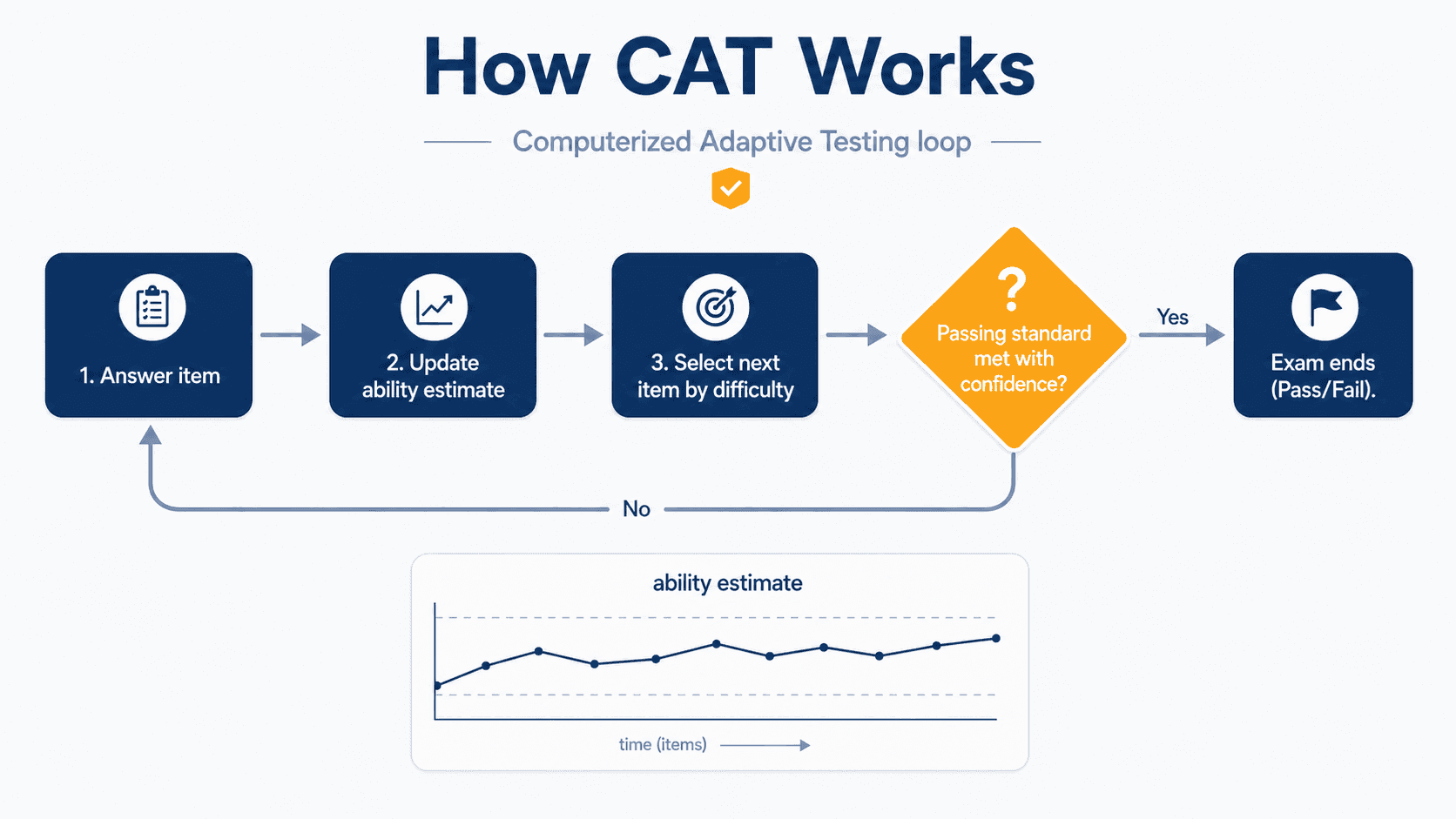
Each answer updates the ability estimate; the algorithm checks the stop rule before selecting the next item.
This matters because:
- The number of questions you receive does not prove whether you passed or failed.
- A short exam can be a pass or a fail.
- A long exam can be a pass or a fail.
- You cannot judge your result by how many SATA or difficult-feeling questions you saw.
- You should focus on the current item, not on trying to decode the algorithm.
The exam ends under one of three official rules: when the system is confident your ability is clearly above or below the passing standard, when you reach the maximum number of items, or when you run out of time and a final ability estimate is used. A better mindset is to answer each question safely, submit it, and move forward. For a deeper walkthrough, see how CAT works on the NCLEX and our NCLEX scoring guide.
What NGN Means
The Next Generation NCLEX (NGN) added more direct measurement of clinical judgment. Instead of only asking what you remember, NGN-style questions often ask you to interpret patient data, notice what matters, and decide which action is safest. The framework behind this is NCSBN’s Clinical Judgment Measurement Model, which breaks decision-making into recognizing cues, analyzing them, prioritizing action, and evaluating outcomes.
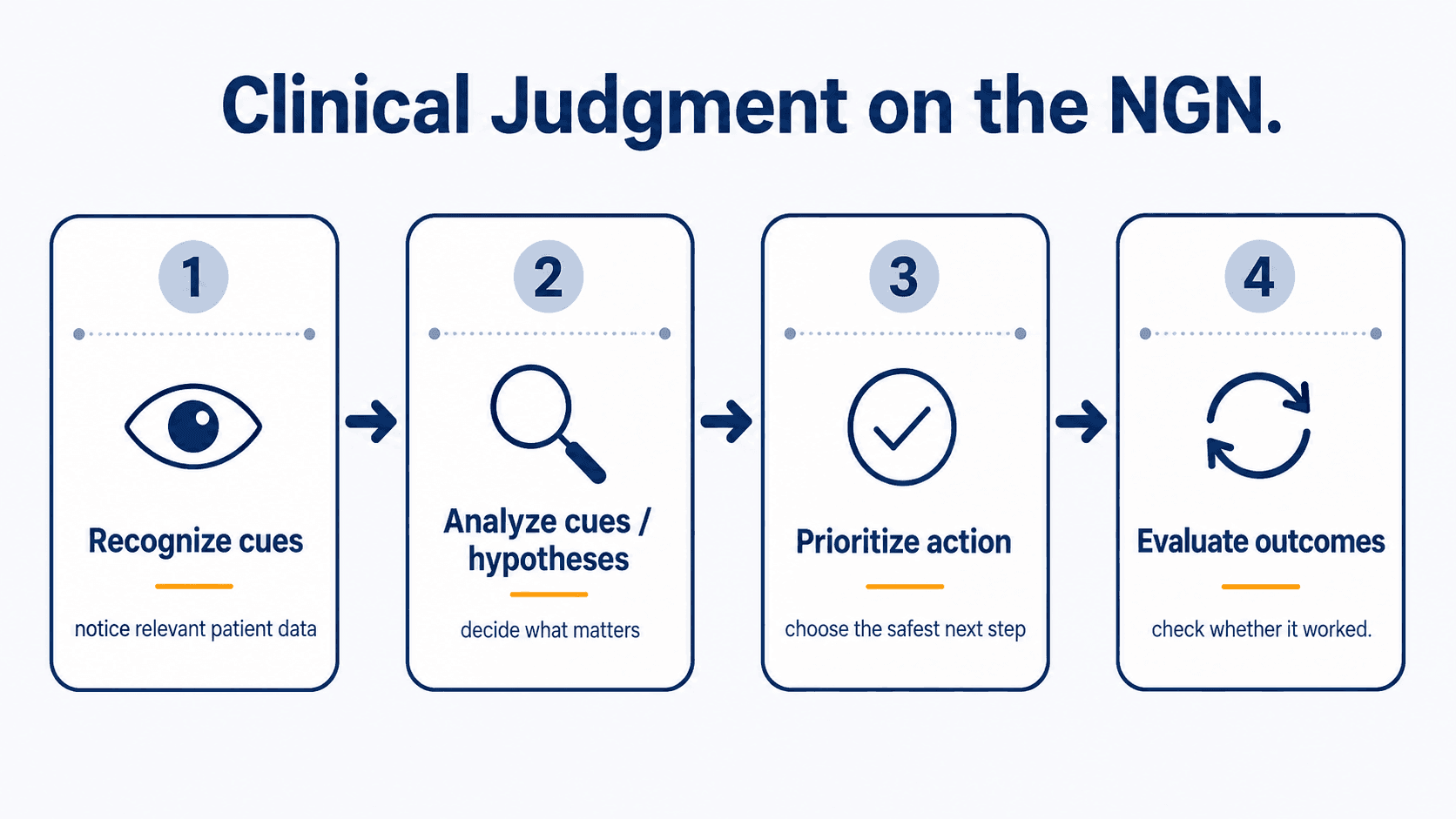
Clinical judgment on the NGN: recognize cues, analyze them, prioritize the safest action, then evaluate the outcome.
NGN questions may use formats such as case studies, matrix items, bow-tie items, highlight items, drag-and-drop items, extended multiple-response items, and trend items that use changing patient data. The goal is to measure how you think through patient-care situations. For a format-by-format breakdown, see our NCLEX question types guide and the Next Generation NCLEX overview.
What the NCLEX Tests
The NCLEX is organized around Client Needs categories, including safe and effective care environment, health promotion and maintenance, psychosocial integrity, and physiological integrity, with subcategories such as pharmacological therapies, reduction of risk potential, basic care and comfort, and physiological adaptation.
The exam also integrates nursing processes across those categories, including:
- Clinical judgment
- Nursing process
- Communication and documentation
- Teaching and learning
- Caring
- Culture and spirituality
In practice, this means you should not study only by memorizing isolated facts. You also need to practice using those facts to make safe patient-care decisions.
A Simple NCLEX-Style Example
A nurse is caring for four clients. Which client should the nurse assess first?
- A. A client requesting help ambulating to the bathroom
- B. A client with a routine dressing change due in 30 minutes
- C. A client with new confusion, slurred speech, and oxygen saturation of 88%
- D. A client asking when discharge paperwork will be ready
Best answer: C.
New confusion, slurred speech, and a low oxygen saturation point to an acute change in condition that may involve oxygenation or neurologic compromise. The nurse should assess this client first and escalate based on findings. The other clients have real needs, but none is the highest priority here. For more on this kind of reasoning, see prioritization and delegation.
How to Prepare for the NCLEX
A strong NCLEX plan combines content review with clinical judgment practice.
1. Learn the exam format
Understand CAT, NGN item types, the pass/fail structure, and why question count does not predict results.
2. Review core nursing content
Prioritize high-yield areas such as safety, infection control, pharmacology, prioritization, delegation, maternity, pediatrics, mental health, adult health, and physiological adaptation.
3. Practice clinical judgment
Do not only ask, “What is the correct fact?” Ask: What cues matter most? What is changing? What is the safest first action? Who can safely perform this task? What outcome would show the intervention worked?
4. Review rationales carefully
The best learning often happens after the question. Review why the correct answer is right and why each other option is wrong.
5. Use adaptive and mixed practice
Because the real exam is adaptive and spans multiple Client Needs areas, your practice should include mixed questions, NGN case studies, and targeted review of weak areas. You can build an NCLEX study plan around your results.
Take the free competency test
50 free questions with AI analysis, a 7-day study plan and your performance by category — see where you stand before you choose a plan.
Start the free testCommon NCLEX Myths
“If I get 85 questions, I passed.”
Not necessarily. The minimum number of questions can result in either a pass or a fail.
“If I get 150 questions, I failed.”
Not necessarily. A maximum-length exam means the system needed more information before making a final decision.
“The NCLEX is just memorizing facts.”
No. Facts matter, but the exam also tests how you use nursing knowledge to make safe decisions.
“SATA questions mean I am doing well.”
Not necessarily. Item format alone does not tell you your result.
“I need to know everything before testing.”
No candidate knows everything. The goal is safe entry-level nursing competence, not perfection.
NCLEX Registration: Basic Overview
The exact process depends on your nursing regulatory body, but the general path is:
- Apply for licensure or registration with the nursing regulatory body where you want to be licensed.
- Register for the NCLEX with Pearson.
- Wait for eligibility approval and your Authorization to Test (ATT).
- Schedule your exam.
- Take the exam.
- Receive official results from your nursing regulatory body.
Always check your nursing regulatory body and official NCLEX resources for current requirements, deadlines, fees, and testing rules.
When Do NCLEX Results Come Out?
Official results come from your nursing regulatory body, not from RN Test Pro. Some U.S. candidates may be able to access unofficial quick results after the exam if their board participates in that service, but unofficial results do not authorize practice as a licensed nurse. Do not rely on unofficial tricks, question count, or test shut-off time to decide whether you passed. For the days around your exam, see our NCLEX test day strategies.
NCLEX FAQ
What is the NCLEX?
The NCLEX (National Council Licensure Examination) is the licensure exam used to decide whether a nursing candidate has the minimum ability needed for safe, effective entry-level practice. It is not a school-style percentage test.
How many questions are on the NCLEX in 2026?
Under the 2026 Candidate Bulletin, both the NCLEX-RN and NCLEX-PN are variable-length computer adaptive tests with 85 to 150 items and a five-hour time limit. The exact number you receive depends on your performance.
How is the NCLEX-RN different from the NCLEX-PN?
Both share the same Client Needs framework, but the expected role differs. RN items place more emphasis on management of care, delegation, and broader clinical judgment. PN/LVN items emphasize coordinated care, direct care, recognizing changes, and reporting concerns within PN scope.
Does the number of questions tell me if I passed?
No. A short exam can be a pass or a fail, and a maximum-length exam can be a pass or a fail. Question count reflects how long the exam needed to make a confident decision, not your result.
What does NGN mean?
NGN stands for Next Generation NCLEX. It added formats such as case studies, bow-tie, matrix, drag-and-drop, and trend items that measure clinical judgment more directly by asking you to interpret patient data and decide the safest action.
How should I study for the NCLEX?
Combine core content review with clinical judgment practice. Use mixed, adaptive practice, review rationales for both correct and incorrect options, and target your weakest Client Needs areas rather than doing random questions.
When do NCLEX results come out?
Official results are released by your nursing regulatory body. Some U.S. candidates can access unofficial quick results after the exam if their board participates, but unofficial results do not authorize practice. Always confirm timing and rules with your board and official NCLEX resources.
Where can I confirm official NCLEX facts?
Check exam-format details against the official NCLEX Candidate Bulletin and test plans from NCSBN. RN Test Pro is an independent study resource and is not affiliated with or endorsed by NCSBN.
More NCLEX Study Guides
Follow a ready-made NCLEX study schedule
Get a 7-day study plan from your AI analysis after every quiz, then follow a ready-made 30-, 60- or 90-day schedule and adapt it to your available time.
View study schedules