NCLEX Self-Care Strategies: Avoid Burnout While Studying
NCLEX prep can get intense fast. The problem is not that you care too much — it is that constant pressure, poor sleep, skipped meals, and nonstop question sets make studying less effective. Self-care is not a reward you earn after studying; it is part of the study plan.
Quick Answer: Self-Care Is Part of the Study Plan
You cannot reason clearly if your study plan destroys sleep, nutrition, movement, and recovery. The safest NCLEX prep rhythm includes:
- consistent sleep whenever possible
- regular meals and hydration
- short movement breaks
- focused study blocks instead of all-day cramming
- rationale review instead of raw question volume
- one meaningful recovery block each week
- social or professional support when stress starts interfering with daily life
Self-care does not guarantee a pass. Sleep, movement, stress management, and distributed practice support the attention, memory, and clinical judgment you need while preparing — they do not guarantee a score. To turn that into a workable schedule, use the adaptive NCLEX study plan.
Normal Stress vs. Burnout-Like Warning Signs
Some exam stress is expected. The goal is to notice when stress starts interfering with how you function, then respond early.
Green: normal stress
What it may look like: Nervous before practice, mild frustration, temporary fatigue after studying
What to do: Continue the plan; use short breaks and rationale review
Yellow: warning signs
What it may look like: Sleep disruption, irritability, repeated concentration problems, dread of studying, headaches or muscle tension
What to do: Reduce volume, add recovery, shorten sessions, review missed-question patterns
Red: needs support
What it may look like: Persistent hopelessness, panic symptoms, inability to function, isolation, major appetite or sleep changes, thoughts of self-harm
What to do: Pause the aggressive study plan and seek professional or urgent support
Adjust your study plan when symptoms persist, worsen, or interfere with sleep, work, relationships, school responsibilities, or daily functioning. And do not use self-care as one more checklist to fail — it is a set of supports, not a test.
Your NCLEX Self-Care Rhythm
Use the rhythm as a weekly check, not a perfection checklist. If one area is weak, adjust that area first.
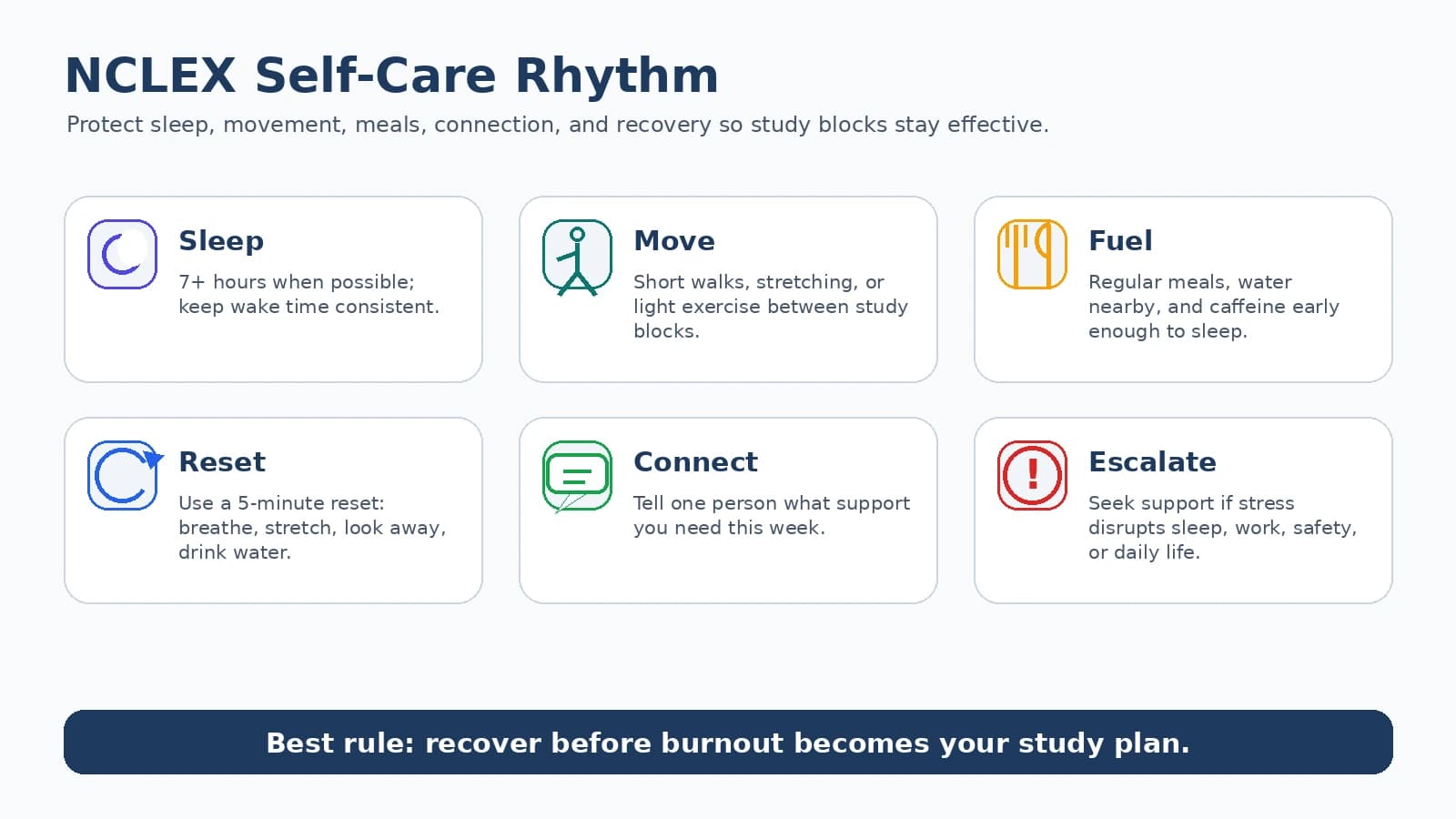
Sleep, movement, fuel, reset, connection, and support — check each weekly and shore up the weakest first.
Sleep: Protect Memory and Judgment
Sleep is not wasted study time. Most adults need at least 7 hours of sleep. If your study plan regularly cuts sleep below what you need, your concentration and emotional control suffer — exactly the abilities the NCLEX measures.
Better sleep habits during prep
- Keep a consistent wake time when possible.
- Stop heavy studying before bed.
- Reduce stimulating screen use near bedtime if it delays sleep.
- Keep your sleep space cool and comfortable.
- Avoid using late caffeine to force one more study block.
- Move difficult study tasks earlier in the day if nights are unreliable.
If you work nights or rotating shifts, protect your main sleep episode first — short review beats sleep-deprived cramming. Our guide to studying while working full time has shift-specific schedules, and test-day strategies covers sleep and logistics for the final stretch.
Movement: Use Small Breaks, Not Perfection
You do not need an intense fitness plan to support NCLEX prep. Adults are generally encouraged to get at least 150 minutes of moderate-intensity physical activity each week, plus muscle-strengthening activity on two days — but during exam prep, start with what is realistic:
Movement helps most when it is repeatable. Do not turn exercise into another source of pressure.
Food, Hydration, and Caffeine
NCLEX prep is easier when your energy is stable. Keep the habits practical rather than prescriptive:
Practical fuel habits
- Eat regular meals when possible.
- Keep water near your study area.
- Pair caffeine with food if it makes you jittery.
- Avoid trying a new supplement or energy drink close to exam day.
- Choose snacks that do not cause an energy crash.
- Do not replace sleep with caffeine.
There is no universal hydration number that fits every person. Medical conditions, medications, pregnancy, and kidney or heart problems can change what is safe — follow your own medical guidance when needed. For some people, moderate caffeine helps alertness, but late or high caffeine can worsen anxiety and sleep, so avoid new test-week changes.
A Five-Minute Reset Between Study Blocks
Use this when you feel tense, scattered, or frustrated after a practice set. Slow breathing can help interrupt panic-like arousal and refocus your attention.
The reset
- Stand up and step away from the screen.
- Breathe slowly for about 60 seconds.
- Stretch your shoulders, neck, hands, and back.
- Look at something far away to rest your eyes.
- Drink water.
- Write one sentence: “The next block is about ___.”
The goal is not to erase stress. It is to interrupt the spiral before it ruins the next study block.
How to Adjust Your Study Plan When Stress Rises
Do not respond to burnout by adding more questions. Adjust the kind of work instead.
If you feel mentally foggy
Switch from timed sets to review mode. Use flashcards, missed-question review, or one focused topic.
If you keep missing the same topic
Stop doing mixed sets for a day. Repair the weak area, then return to mixed practice.
If you are skipping rationales
Lower the question count. The learning happens in the rationale review, not the raw volume.
If your sleep is getting worse
Move heavy study earlier, reduce evening intensity, and protect a wind-down period.
If you dread every study session
Shorten the next session and make the task specific: 15 questions, one rationale theme, or one NGN exhibit. Then reassess.
If you need to rescale the whole timeline rather than a single session, the 30/60/90 NCLEX study plan helps you pick a realistic one, and our NCLEX study tips cover active recall and rationale review.
After a Bad Practice Score
A bad score is data. It is not a verdict. Use this reset instead of spiraling:
- 1Wait about 10 minutes before reviewing if you feel upset.
- 2Identify the top two error types.
- 3Separate knowledge gaps from reasoning errors.
- 4Pick one topic to repair today.
- 5Write one rule from the missed questions.
- 6Stop when your review quality drops.
Do not punish yourself with an extra marathon set — that usually creates more fatigue and more careless misses. Remember that practice scores are study feedback, not official pass/fail predictions; for why question counts and CAT myths should not drive anxiety, see the Computer Adaptive Testing guide and the NCLEX question types guide.
What Not to Do During NCLEX Prep
Avoid these burnout traps. Consistency matters more than panic.
- Cutting sleep to add more questions
- Doing large question sets without reviewing rationales
- Drinking more caffeine every time you feel tired
- Studying only topics you already know
- Isolating from everyone until test day
- Doom-scrolling NCLEX forums after practice
- Treating question count or practice score as your identity
- Restarting your entire study plan after one bad day
When to Seek Professional Support
Normal exam stress should still allow you to function. Consider professional support if stress, anxiety, or mood symptoms are persistent, worsening, or interfering with sleep, work, school, relationships, eating, or daily responsibilities. Getting support is not a failure — it is the same judgment you would want a patient to use when symptoms are no longer manageable alone.
Support options may include
- school counseling services
- employee assistance programs
- a primary care clinician
- a licensed mental health professional
- a trusted faculty member, mentor, or advisor
If you feel unsafe or may hurt yourself, seek help right away through local emergency services or a local crisis line. In the US, you can call or text 988 (the Suicide and Crisis Lifeline). You deserve support.
Pick a schedule you can sustain
Adaptive NCLEX-style practice, NGN-style questions, rationales, and performance feedback can help you focus limited study time — without replacing sleep or recovery. Use the feedback to adjust your plan, not as an official pass/fail prediction.
View study schedulesPrefer to start with questions? Practice adaptive NCLEX-style questions and let your results shape a sustainable plan.
Sources and Alignment Note
How this guide was reviewed
Reviewed against current public-health guidance on adult sleep, physical activity, stress management, and mental-health warning signs. This page is educational and does not replace medical or mental-health care. RN Test Pro is independent and not affiliated with or endorsed by NCSBN. NCLEX® is a registered trademark of the National Council of State Boards of Nursing, Inc.
Related Resources
Study While Working Full Time →
Sustainable schedules and fatigue guardrails for working candidates.
30/60/90 Study Plan →
Choose a realistic timeline and adjust it as stress changes.
NCLEX Explained →
Format, scoring, and registration context in one place.
RN NCLEX Prep →
Adaptive practice built for the RN candidate path.
PN NCLEX Prep →
Adaptive practice built for the PN candidate path.
NCLEX Study Tips →
Evidence-based methods to study smarter, not just longer.