NCLEX Test Day Checklist: What to Bring, What to Expect, and How to Stay Focused
Test day is not the time to learn the rules for the first time. This guide separates official test-day rules from practical strategy so you can reduce avoidable problems and protect your focus.
Quick Answer: What Matters Most on NCLEX Test Day
Test day comes down to a few priorities: arrive early, bring acceptable ID that matches your registration, follow every Pearson VUE security procedure, remember that all breaks count against your five-hour limit, answer one item at a time, and do not expect results at the test center.
Official-rules reminder
Your acceptable ID is the non-negotiable entry item — not your ATT number. Breaks are optional and count against testing time. Test-center staff cannot give you your result. Official results come only from your nursing regulatory body. Always confirm specifics against the current NCLEX test-day rules and what to bring page.
Your Test-Day Checklist
Use this as a final review the day before your appointment. It maps the night before, the morning of, the exam itself, and what happens afterward.
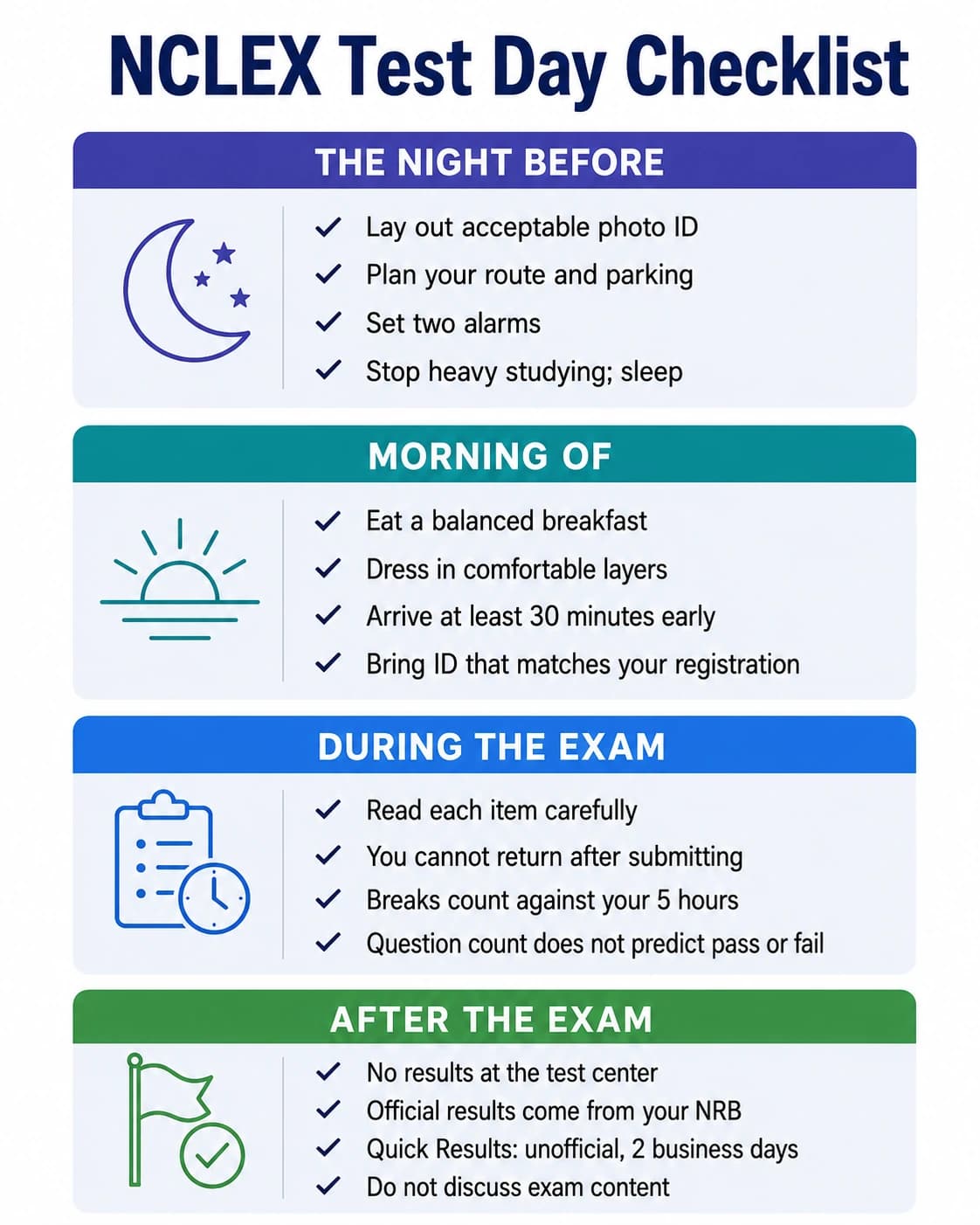
A quick before/during/after reference for NCLEX test day.
The Week Before and Night Before
Do not turn the last 24 hours into a cramming marathon. The point of the final stretch is to reduce avoidable problems, not to learn new content.
The week before
- Confirm your exam date, time, and test-center location.
- Verify the name on your acceptable ID matches your registration. For ATT, scheduling, and name-match details, see NCLEX registration and eligibility.
- Complete light mixed practice — not a brand-new content overhaul.
- Review rationales from missed questions.
- Taper intense study in the final 24 hours.
The night before
- Choose comfortable clothing with simple layers.
- Set two alarms and plan your route and parking.
- Prepare your acceptable ID.
- Decide what snack or drink will stay in your locker, if allowed.
- Stop heavy studying early enough to sleep. Sleep matters more than one more rushed review session.
What to Bring and What to Leave Out
When in doubt, follow the current NCLEX Candidate Bulletin, Pearson VUE rules, and your appointment instructions. The single critical item is acceptable ID. The quick version:
- Bring: your acceptable photo ID — it must match your registration exactly. This is the non-negotiable entry item.
- Keep accessible, but not in the testing room: your ATT/appointment confirmation and any phone or devices (powered off and stored per center rules).
- Leave out: study notes, watches, and large jewelry or accessories — you cannot use notes during the exam or on breaks.
This is the short list, not the rulebook. For the complete, authoritative requirements — acceptable ID types, security screening, and storage rules — use the canonical NCLEX test-day rules and what to bring page.
What Happens at Check-In
At the Pearson Professional Center, expect a standardized security process. You may be asked to do the following.
- 1Present valid, acceptable photo ID that matches your registration.
- 2Provide a digital signature.
- 3Have your photograph taken.
- 4Provide a palm vein scan or other biometric.
- 5Complete security screening (you may be asked to turn out pockets).
- 6Store electronic devices and belongings as directed.
- 7Read and agree to the candidate rules / confidentiality statement.
Friends, relatives, or children cannot wait inside the test center while you take the exam.
Breaks: What Candidates Need to Know
The NCLEX gives you up to five hours total. That time includes the introductory screen, the optional scheduled breaks, and any unscheduled breaks. The first optional break is offered after two hours of testing; the second after three and a half hours.
Break rules that matter
- Breaks are optional.
- All breaks count against your testing time.
- You must leave the testing room, and re-entry requires security procedures.
- You may need a palm vein scan before and after a break.
- Do not access prohibited items or review study notes during breaks.
A smart break is not about forcing yourself to stop. It is about protecting focus. Scheduled breaks are optional and count against your five-hour time — so if fatigue is building, use one to reset, stretch, drink water, and return calmly.
During the Exam: How to Protect Your Focus
Read for the task
Before choosing an answer, identify what the question is actually asking. The stem wording usually tells you. For more on SATA, matrix, and NGN formats, see the NCLEX question types guide.
| Stem wording | What to look for |
|---|---|
| First / priority / immediate | The most urgent safe action. |
| Best / most appropriate | The answer that best fits the full scenario. |
| Requires follow-up | The abnormal or unsafe finding. |
| Further teaching needed | The incorrect client statement. |
| Which finding is expected? | The normal or anticipated finding in context. |
| Select all that apply | Judge each option independently. |
Use time awareness, not panic timing
The NCLEX is variable length — you may receive 85 to 150 total items. Use time awareness rather than a rigid stopwatch rule: avoid rushing through short stems, do not get stuck on one item, check the clock occasionally, and remember that breaks count against your total time. Choose your answer and move on mentally.
Don't decode the exam while taking it
The exam can end between 85 and 150 items when an official stopping rule is met. Question count does not tell you whether you passed — stopping at 85 can be a pass or a fail, and reaching 150 can be a pass or a fail. Item format is not a signal either: a SATA, matrix, bow-tie, or case-study item is not a secret message from the algorithm.
Your job is the current item
Answer the item in front of you safely, then move on. For why exam length and item format do not predict your result, see our NCLEX scoring myths article, the NCLEX scoring guide, and the CAT guide.
Use the provided noteboard appropriately
The test center provides an erasable noteboard and marker. Use it only as allowed and only to organize your thinking during the exam. Do not rely on a memory dump — the more useful skill is recognizing the client problem and choosing the safest action.
If Something Goes Wrong
Raise your hand and notify the test administrator if you have a computer problem, need a new noteboard, need a break, have a testing-environment concern, believe an irregularity affected your exam, or have finished and need to be dismissed.
If you believe a testing irregularity affected your exam, report it before leaving the test center. Do not troubleshoot the computer yourself, move workstations, leave the room without authorization, or discuss exam content.
After the Exam: Results, Quick Results, and What Not to Trust
You will not receive your result at the test center, and test-center staff do not have access to it. Here is where results actually come from.
Official results
Official results come only from your nursing regulatory body (NRB). NCSBN states official results are sent within six weeks of the exam. This is the result that authorizes licensure.
Quick Results
Some U.S. candidates can purchase unofficial Quick Results two business days after the exam if their NRB participates. Quick Results are unofficial and do not authorize you to practice as a licensed nurse.
Don't rely on the PVT
The “Pearson VUE Trick” is not an official result method and should not guide major decisions. Use official results from your NRB, or Quick Results where available.
Do not ask test-center staff for your result, do not rely on unofficial tricks, do not discuss exam content, and do not assume question count means pass or fail.
Final-Week Practice Plan
In the last week, your goal is confidence and stability. Taper intensity as the exam approaches. For a fuller structure, see our NCLEX study tips and NCLEX study plan.
7 to 4 days before
- Complete mixed practice sets.
- Review rationales from missed questions.
- Identify two or three remaining weak areas.
- Practice NGN-style questions without overloading yourself.
3 to 2 days before
- Do light review only.
- Review test-day logistics.
- Stop adding new resources.
- Prioritize sleep and hydration over extra cramming.
1 day before
- Review your checklist.
- Confirm your route and acceptable ID.
- Do a short confidence-building review only.
- Sleep.
Practice Adaptive NCLEX-Style Questions
Build readiness with adaptive NCLEX-style practice, NGN-style items, and detailed rationales. Use practice results to find weak areas before exam day — not as official licensure results.
Start PracticingSources and Alignment Note
How this guide was reviewed
Reviewed against the 2026 NCLEX Candidate Bulletin, NCLEX Exam Day guidance, Pearson VUE candidate rules, NCLEX Results guidance, and NCLEX Quick Results information. RN Test Pro is independent and not affiliated with or endorsed by NCSBN. NCLEX® is a registered trademark of the National Council of State Boards of Nursing, Inc.
Want the official logistics in one place? Review the NCLEX test-day rules and what to bring page before your appointment.
Related Resources
Test Day Rules & What to Bring →
The canonical logistics page: ID, security, and what to expect.
Registration & Eligibility →
ATT, scheduling, eligibility, and name-match details.
NCLEX Scoring Guide →
Why exam length does not predict pass or fail.
RN NCLEX Prep →
Adaptive practice built for the RN candidate path.
PN NCLEX Prep →
Adaptive practice built for the PN candidate path.
NCLEX Scoring Myths →
The truth about 85 vs 150 questions and item formats.