Computer Adaptive Testing: How NCLEX Selects Your Questions
Learn how NCLEX Computer Adaptive Testing selects items near your ability, applies stopping rules, and why exam length does not predict your result.
What Is Computer Adaptive Testing?
Computer Adaptive Testing (CAT) means the exam adapts to you. CAT uses responses to operational scored items to update the ability estimate. If testing continues, it selects the next eligible item or item set while meeting test-plan and exam-security requirements. Pretest items do not affect the ability estimate or pass/fail decision.
CAT targets items near your estimated ability, where you have roughly a 50% chance of answering correctly. That is why long streaks of correct or incorrect answers are not how the exam is designed to behave.
This isn't random—it's a psychometric system designed to estimate your ability with the fewest possible questions. The goal is efficiency: determine whether you're above or below the passing standard as quickly as the statistics allow.
2026 NCLEX CAT Facts
Both NCLEX-RN and NCLEX-PN are variable-length CAT exams under the April 2026 Candidate Bulletin. Anchor the mechanics to the official format before interpreting what an exam length might mean.
| Feature | NCLEX-RN | NCLEX-PN |
|---|---|---|
| Format | Computerized adaptive test | Computerized adaptive test |
| Minimum items | 85 | 85 |
| Maximum items | 150 | 150 |
| Time limit | 5 hours | 5 hours |
| Pretest items | 15 (unscored) | 15 (unscored) |
| Skip and return? | No | No |
| Question count predicts outcome? | No | No |
The total range is 85–150 items in 5 hours, including 15 unscored pretest items. Pretest items collect data for future exams, look like regular questions, and cannot be identified by candidates, so treat every item seriously. They do not affect the ability estimate or pass/fail decision.
How CAT Determines Question Selection
The NCLEX uses Item Response Theory (IRT) to estimate ability throughout the exam. Here's how CAT handles scored responses and continued selection:
- Process the submitted response — An operational item may be scored correct or incorrect, or receive partial credit when its format supports it. Pretest items are excluded from ability estimation and pass/fail.
- Update your ability estimate (theta) — The system uses accumulated responses to operational scored items and their calibrated difficulty, rather than simply counting correct answers.
- Recalculate uncertainty and check a stopping rule — The system determines whether the confidence, maximum-length, or time rule ends the exam.
- Select the next eligible item or item set — If testing continues, the algorithm selects an item or item set suited to the current estimate while meeting test-plan and exam-security requirements. NGN case studies are six-item sets, so selection is not independently re-run after every response within a set.
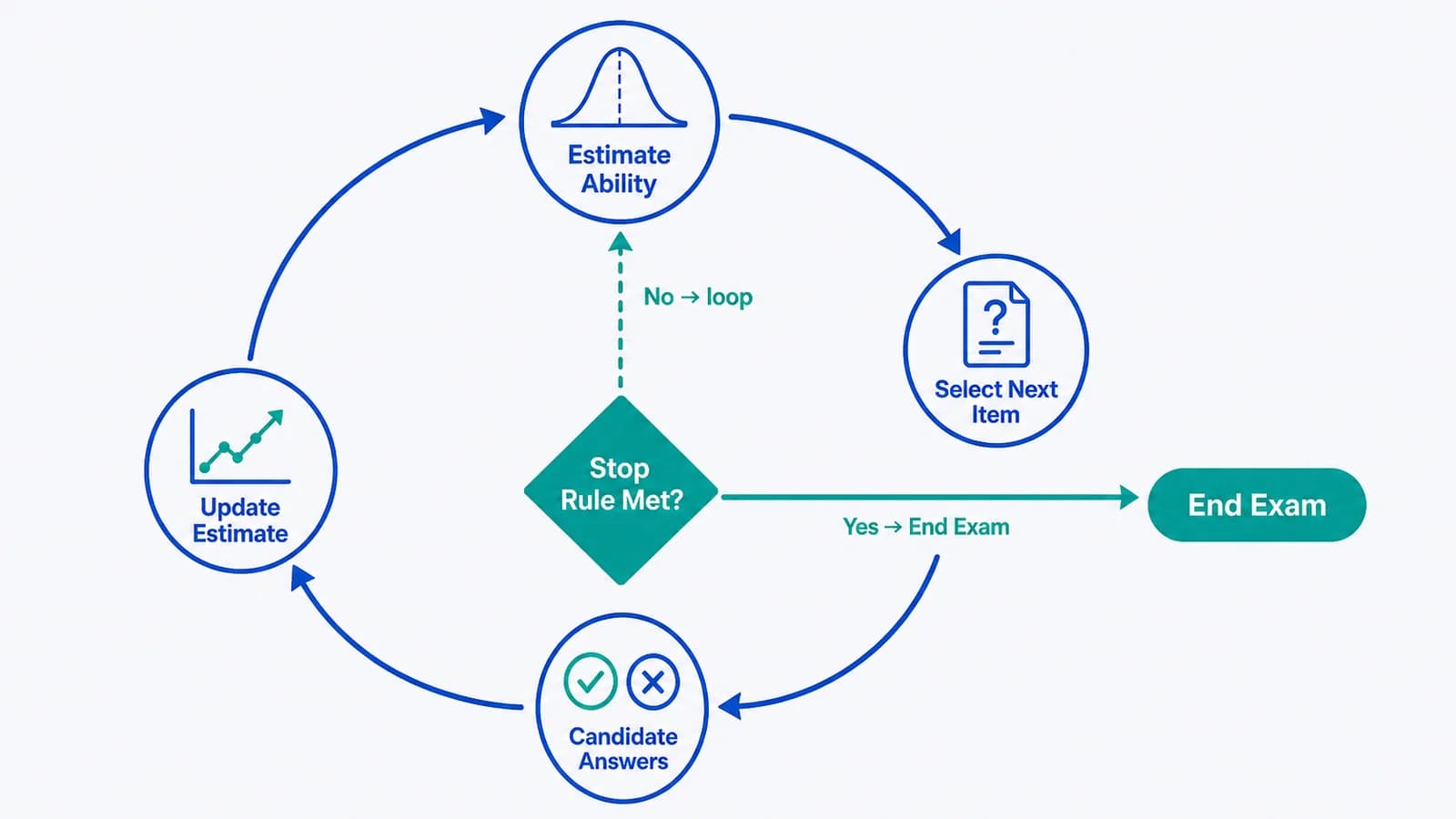
Responses to operational scored items update the ability estimate; pretest items affect neither the estimate nor pass/fail. If testing continues, CAT selects the next eligible item or item set after checking a stopping rule.
The CAT Process, Step by Step
Initial Ability Estimate
The exam starts with a relatively low-difficulty item. CAT uses responses to operational scored items to update the ability estimate; pretest items do not affect the estimate or pass/fail decision.
Real-Time Adjustment
CAT uses responses to operational scored items to update the ability estimate. If testing continues, it selects the next eligible item or item set while meeting test-plan and exam-security requirements. Pretest items do not affect the ability estimate or pass/fail decision.
Confidence Building
As CAT gathers responses to more operational scored items, the confidence interval around your ability estimate generally narrows. After the minimum, 95% confidence can end the exam; maximum length and time are the other limits.
Decision Point
The exam stops when confidence is reached, when you hit the maximum questions, or when time expires. Each scenario has specific pass/fail determination rules.
What Theta Means Without Overcomplicating It
Theta is a statistical estimate of ability. You will not see your theta during the NCLEX, and you do not need to compute it. The important concept is that CAT is not just counting how many items you got right. It uses responses to operational scored items, their calibrated difficulty, and the scoring those responses receive to update the estimate. Pretest items do not affect the ability estimate or pass/fail decision.
Responses to operational scored items can change the estimate. Early in the exam, the estimate may move more. Later it tends to stabilize as more scored information is gathered. If testing continues, CAT selects the next eligible item or item set while meeting test-plan and exam-security requirements; within a six-item NGN case-study set, selection is not independently re-run after every response. Around the estimate is a confidence interval—a band representing uncertainty that generally narrows as the exam gathers evidence.
The exam compares the estimate and its uncertainty with the passing standard. Under the 95% confidence rule, testing can stop after the minimum when the system is confident the candidate is on one side of that standard.
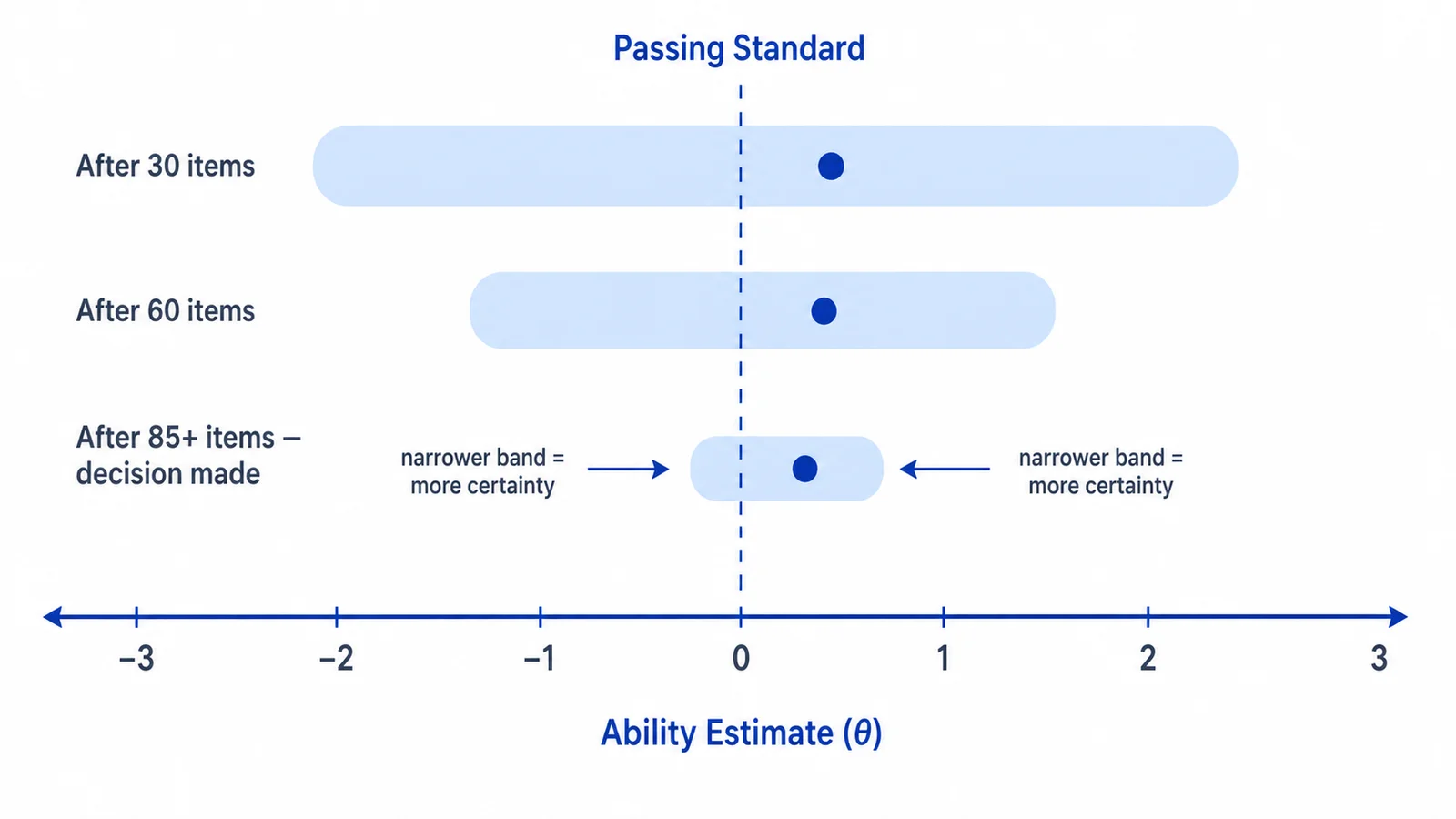
The confidence band around the ability estimate generally narrows as CAT gathers responses to more operational scored items.
Stopping Rules and Outcomes
| Scenario | Rule Detail | Outcome |
|---|---|---|
| 95% Confidence Rule (Most Common) | After the minimum, the exam can stop when it is 95% confident your ability is clearly above or below the passing standard. Candidates whose estimated ability separates clearly from the passing standard may finish at 85, whether the estimate is above or below it. Early stopping reflects confidence in the ability estimate—not a simple streak of correct or incorrect answers. | Pass or fail with 95% confidence |
| Maximum-Length Exam Rule (150 Items) | If your ability estimate stays close to the passing standard, the exam may continue to the maximum number of items. The final ability estimate from completed scored items determines pass or fail. | Pass/fail based on final estimate |
| Run-Out-Of-Time (R.O.O.T.) Rule | If time expires before the exam reaches a decision: if you didn't reach the minimum, fail. If you did reach the minimum, the exam uses your final ability estimate from completed scored items to decide pass or fail. | Fail if <85 items; otherwise, final ability estimate decides |
Pacing matters because of the R.O.O.T. rule. You do not need to rush, but spending too long on individual items can leave you short of the 85-item minimum or with less evidence in the final estimate when the 5-hour window closes.
Content Balancing
CAT doesn't just follow ability. The NCLEX algorithm balances test-plan content percentages, required clinical-judgment coverage, item information, and exposure controls. You won't get only pharmacology questions just because that's where you're struggling; the exam must cover its required areas.
How NGN and Partial Credit Fit Into CAT
The Next Generation NCLEX added more clinical-judgment measurement through case studies and newer item formats. Items with more than one correct key may receive partial credit using NCSBN's 0/1, +/-, or rationale scoring model, depending on item type.
NGN does not replace CAT. CAT still drives exam delivery; NGN changes the kinds of clinical-judgment tasks and response scoring that can appear inside the adaptive exam. Scores from operational items become part of the response evidence used to update the ability estimate; pretest items do not affect the estimate or pass/fail. NGN case studies are six-item sets, so selection is not independently re-run after every response within a set. See the Next Generation NCLEX overview for the formats and scoring models in context.
Hard Questions, SATA, and Other CAT Myths
The exam's internal measurements are not visible to candidates. Perceived item difficulty, format, response time, and total item count are therefore poor clues about a result.
Myth: Getting harder questions means I'm passing.
Reality: Harder-feeling questions may mean the exam is challenging you near your estimated ability, but perceived difficulty is not a reliable pass/fail signal. A question can feel hard because the content is weak for you, not because the item is statistically high difficulty.
Myth: If I get 150 questions, I probably failed.
Reality: No. Question count does not reveal the result; see the stopping-rules table for the maximum-length rule.
Myth: SATA questions are always harder than multiple-choice.
Reality: Format does not equal difficulty. Multiple-response items appear at a range of difficulty levels, and item format alone tells you nothing about how the exam is going.
Myth: I can game the algorithm by answering slowly.
Reality: CAT scores correctness and partial credit on applicable items, not response time. Pacing matters because of the 5-hour time limit, not because the algorithm rewards slow thinking.
How to Prepare for a CAT Exam
- Practice one-question commitment. You cannot submit, advance, and return. Train yourself to read carefully, choose the safest answer, submit, and move on mentally.
- Build clinical judgment, not just recall. Identify the clinical task in front of you: assessment, priority, delegation, teaching, safety, or evaluation.
- Use mixed practice. CAT moves across Client Needs categories, so train across content areas and NGN-style case thinking.
- Learn pacing. Some items, especially case studies, take longer. Keep a steady pace and avoid getting trapped on a single item.
- Stop interpreting the exam during the exam. You cannot identify pretest items, see theta, or know when the exam will stop. Focus on answering the current item safely.
How RN Test Pro Uses Adaptive Practice
Our practice platform uses IRT-based ability estimation, difficulty-matched selection, confidence intervals, and content balancing to help you rehearse changing difficulty and one-question-at-a-time testing.
RN Test Pro is independent and not affiliated with NCSBN. Our practice system uses its own calibrated item bank and algorithms; it is not the official NCLEX algorithm and cannot reproduce NCSBN's exact selection logic. For the statistical background, see our IRT (Item Response Theory) explainer.
Experience Adaptive Practice
Try our diagnostic quiz to see how adaptive question selection works. Watch your ability estimate update in real-time.
Start Diagnostic QuizFrequently Asked Questions About CAT
Why does NCLEX end at 85 questions for some but 150 for others?
Question count does not reveal whether you passed or failed. The stopping-rules table above explains when the confidence, maximum-length, and run-out-of-time rules apply.
How does CAT select which question I see next?
CAT uses responses to operational scored items to update the ability estimate (theta). If testing continues, it selects the next eligible item or item set while meeting test-plan and exam-security requirements. NGN case studies are six-item sets, so selection is not independently re-run after every response within a set. Pretest items do not affect the ability estimate or pass/fail decision. This is more precise than simply 'harder if correct, easier if wrong,' and it does not mean candidates can infer performance from how difficult an item feels.
Can I tell if I'm doing well based on question difficulty?
No—and trying to gauge difficulty is unreliable and stressful. CAT uses calibrated item difficulty, which may not match your subjective experience. A question you find easy may be statistically difficult, and vice versa. Required content balancing also affects which eligible item appears next. Focus on each question rather than trying to infer a result.
What happens if I get the first few questions wrong?
Getting early questions wrong doesn't doom you. CAT uses responses to operational scored items throughout the exam to update the ability estimate; pretest items do not affect the estimate or pass/fail decision. Early wrong responses on scored items can lower the estimate, while stronger later performance on scored items can raise it. If testing continues, CAT selects the next eligible item or item set while meeting test-plan and exam-security requirements. NGN case studies are six-item sets, so selection is not independently re-run after every response within a set. The estimate is not locked in by the first few questions.
Does CAT penalize guessing or partial knowledge?
There is no separate guessing penalty. Wrong responses on scored items can lower the ability estimate. NCSBN specifically warns against rapid random guessing. Submit your best answer because you cannot skip an item and return later. Applicable operational items with more than one correct key may use NCSBN's 0/1, +/-, or rationale partial-credit model, depending on item type. The resulting item score contributes to the ability estimate. If testing continues, CAT selects the next eligible item or item set while meeting test-plan and exam-security requirements. NGN case studies are six-item sets, so selection is not independently re-run after every response within a set. Pretest items do not affect the ability estimate or pass/fail decision.
Is it true that getting 'easier' questions means I'm failing?
No. Perceived difficulty is not a reliable result signal. If testing continues, CAT selects the next eligible item or item set using responses to operational scored items, calibrated item difficulty, test-plan coverage, and exam-security requirements. Pretest items do not affect the ability estimate or pass/fail decision. A topic you know well may simply feel easier to you. Keep working the current item instead of trying to decode the sequence.
Can I skip NCLEX questions and come back later?
No. You must answer each item before moving on. Once you confirm and advance, you cannot return to a previous question.
Are SATA questions always harder?
No. Item format does not automatically equal difficulty. Multiple-response items appear at a range of calibrated difficulty levels.
Should I study with adaptive practice?
Adaptive practice can help you get used to changing difficulty and one-question-at-a-time testing. Combine it with content review, NGN case practice, and clinical-judgment training for balanced preparation.
Sources
Official NCLEX references
CAT mechanics and 2026 exam-format details were reviewed against NCSBN’s official candidate resources. Reviewed August 2026.
Follow a ready-made NCLEX study schedule
Get a 7-day study plan from your AI analysis after every quiz, then follow a ready-made 30-, 60- or 90-day schedule and adapt it to your available time.
View study schedules