NGN Bow-Tie Questions
Select one potential condition, two actions to take, and two parameters to monitor.
Bow-tie items are a Next Generation NCLEX (NGN) item type that evaluates clinical judgment through pattern recognition. The scenario supplies the client findings. You use those findings to select five response targets: one potential condition, two actions to take, and two parameters to monitor.
What Are Bow-Tie Questions?
Your task is to use the scenario findings to identify the most likely condition, choose two appropriate nursing actions, and select two relevant parameters to monitor. Findings inform the response but do not appear as a response column.
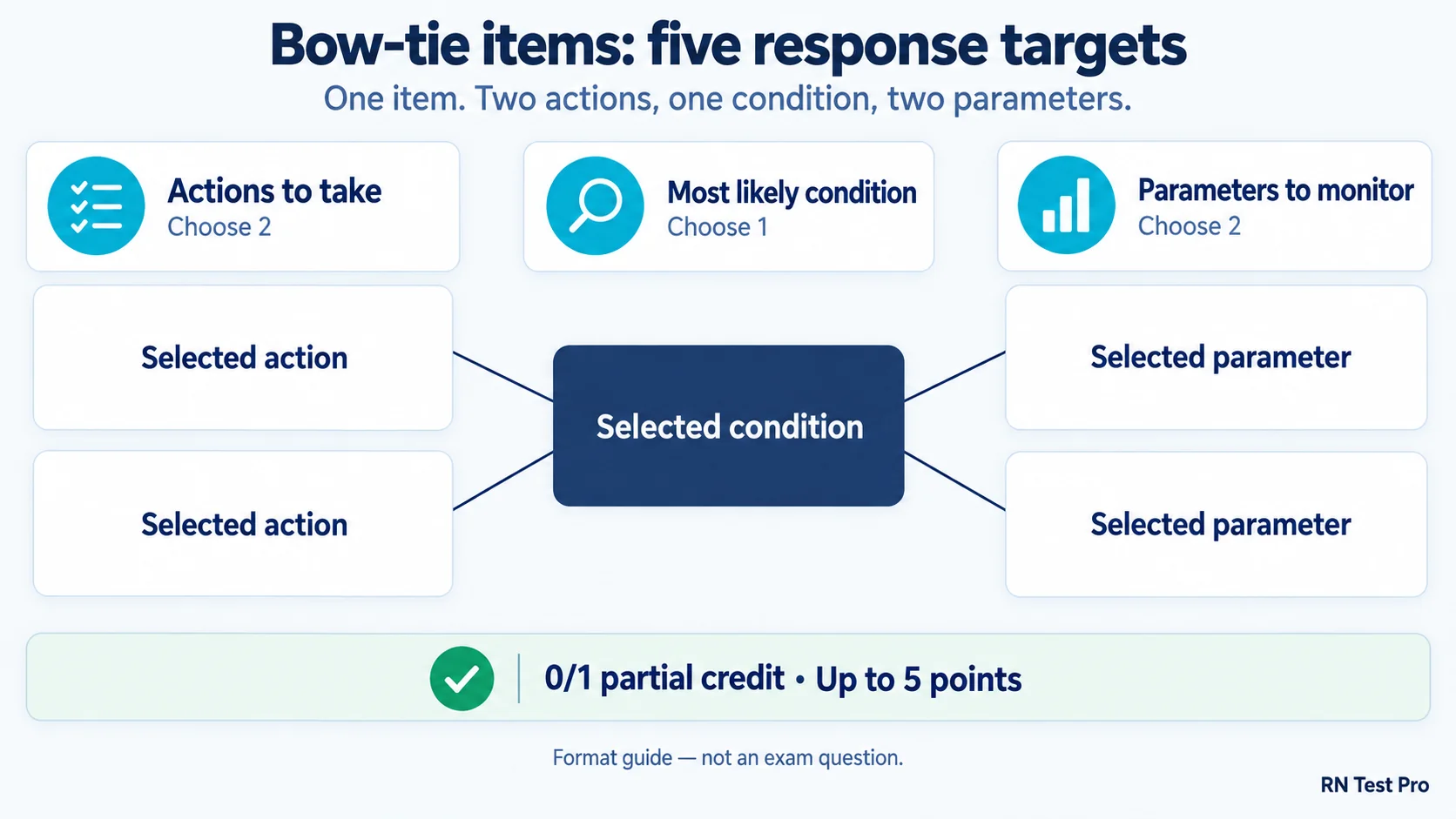
Actions to Take
Choose two nursing actions that directly address the potential condition identified from the scenario.
Examples
- Administer a prescribed medication
- Notify the healthcare provider
- Implement fall precautions
- Provide patient education
Potential Condition
Choose one condition that best explains the findings supplied in the client scenario.
Examples
- Acute respiratory distress
- Fluid volume excess
- Uncontrolled pain
Parameters to Monitor
Choose two clinical measures to monitor after taking action. These are response targets, not findings selected from the scenario.
Examples
- Pain rating
- Oxygen saturation
- Respiratory rate
- Daily weight
Practice Bow-Tie Questions Now
Bow-tie items are live with per-target 0/1 scoring — drill them in standalone practice, or face them adaptively in Adaptive Practice and the CAT exam.
Start PracticingRecognizing Clinical Patterns
Strong bow-tie answers start with the scenario findings and keep all five response targets focused on the same potential condition:
Scenario findings
Tachypnea >24/min; SpO2 <90% on room air; Use of accessory muscles; Cyanosis
Actions to take
- Apply oxygen via nasal cannula
- Elevate the head of the bed
Potential condition
Acute Respiratory Distress
Parameters to monitor
- Oxygen saturation
- Respiratory rate
Scenario findings
2+ pitting edema in lower extremities; Weight gain of 3 kg in 24 hours; Crackles in lung bases; Jugular venous distention
Actions to take
- Restrict fluid intake as ordered
- Administer diuretics as prescribed
Potential condition
Fluid Volume Excess
Parameters to monitor
- Daily weight
- Peripheral edema
Scenario findings
Patient rates pain 8/10; Guarding behavior; Increased heart rate and blood pressure; Facial grimacing
Actions to take
- Administer prescribed analgesics
- Use non-pharmacologic measures (positioning, distraction)
Potential condition
Pain Management
Parameters to monitor
- Pain rating
- Heart rate and blood pressure
A 5-Step Approach to Bow-Tie Questions
Analyze the Scenario Findings
Read every finding in the scenario carefully. Identify abnormal values, concerning statements, and clusters that point to a specific problem.
Tip: Don't jump to a conclusion after a single finding — consider the whole picture.
Select One Potential Condition
Use the scenario findings to choose the one potential condition that best explains the client's presentation.
Tip: Airway and breathing issues always outrank comfort or education needs.
Select Two Actions to Take
Choose two interventions that directly address the potential condition and stay within nursing scope.
Tip: Both actions should respond to the same potential condition.
Select Two Parameters to Monitor
Choose two clinical measures that show how the client is responding after the actions are taken.
Tip: Select measurable parameters that relate directly to the potential condition.
Review All Five Targets
Confirm that you selected one condition, two actions to take, and two parameters to monitor, all supported by the scenario findings.
Tip: The findings remain in the scenario; they are not a response column.
Common Pitfalls and How to Avoid Them
Selecting Irrelevant Actions
Choosing interventions that don't address the potential condition supported by the scenario findings.
How to avoid: Ask whether each action directly addresses the one condition you selected.
Treating Findings as Response Targets
Trying to place scenario findings into the bow-tie instead of using them to choose the five response targets.
How to avoid: Use the findings as evidence, then select one condition, two actions, and two parameters to monitor.
Prioritization Errors
Addressing comfort or education before a life-threatening problem. NGN tests whether you recognize what is most urgent.
How to avoid: Apply ABCs and Maslow systematically — airway, breathing, and circulation come first.
Scope Violations
Selecting actions outside nursing scope (e.g., “order a chest X-ray” instead of “notify the provider for an order”).
How to avoid: Nurses implement, monitor, and evaluate — they don't independently order diagnostics or prescribe.
How 0/1 Scoring Works
Bow-tie items use zero/one scoring for each of five targets. You earn one point for each correct target, and an incorrect target does not subtract from the others.
- Each item has five targets: one potential condition, two actions, and two parameters to monitor
- Each correctly placed response earns one point
- An incorrect target earns zero without subtracting from the other targets
- The maximum score is five points
Example
If you complete four of the five targets correctly, you receive four points under the 0/1 model.
Practice Strategies for Bow-Tie Mastery
Study Clinical Scenarios
Practice using scenario findings to name one potential condition, two matching actions, and two parameters to monitor.
Use the Nursing Process
Use assessment findings to identify the condition, then connect safe actions with the parameters that need monitoring.
Drill NGN Formats
Get comfortable with the five-target bow-tie layout and its per-target 0/1 scoring.
Frequently Asked Questions
What is an NGN bow-tie question?
A bow-tie is a Next Generation NCLEX item with five response targets: one potential condition, two actions to take, and two parameters to monitor. The findings are supplied in the client scenario and are used as evidence; they are not a response column.
How are bow-tie questions scored?
Bow-tie items use zero/one (0/1) scoring for five targets: one potential condition, two actions to take, and two parameters to monitor. Each correct target earns one point, for a maximum of five points; a wrong target does not subtract from the others.
How should I approach a bow-tie question if I'm unsure?
First analyze the scenario findings and identify the one potential condition they support. Then choose two actions that directly address that condition and stay within nursing scope. Finally, choose two related parameters to monitor.
What is the difference between the response areas?
The center response is one potential condition, one side contains two actions to take, and the other contains two parameters to monitor. Findings such as vital signs, labs, symptoms, and patient statements appear in the scenario rather than in a response area.
What are common mistakes on bow-tie questions?
Frequent errors include choosing a condition that does not fit the scenario findings, selecting actions unrelated to that condition, choosing outcomes instead of parameters to monitor, and forgetting that the item requires exactly one condition, two actions, and two parameters.
Related Topics
Matrix Questions
Row-by-column grid items where you choose a response in each row for the NGN.
Trend Questions
Analyze how a patient's data changes over time.
Clinical Judgment (CJMM)
The clinical judgment measurement model that informs NGN item design.
Back to NGN Next Generation
Explore every NGN question type and strategy.
Follow a ready-made NCLEX study schedule
Get a 7-day study plan from your AI analysis after every quiz, then follow a ready-made 30-, 60- or 90-day schedule and adapt it to your available time.
View study schedules