How the NCLEX Is Scored in 2026: RN vs PN Passing Standards
The NCLEX does not give you a percentage, a letter grade, or a point total. Instead it compares your estimated ability to a fixed passing standard—0.00 logits for the RN exam and -0.18 logits for the PN exam (through March 2029). Learn what those numbers mean, what actually determines pass or fail, and why question count does not predict your result.
Quick Answer: How the NCLEX Is Scored
The NCLEX is not a classroom test where every student answers the same questions. It is a computerized adaptive test, often called CAT. The exam estimates your nursing ability after each answer — it does not simply count the percentage of questions you got right.
The exam ends when one of the official pass/fail decision rules applies: the computer becomes 95% certain your ability is clearly above or clearly below the passing standard after the minimum number of items, you reach the maximum number of items, or you run out of time. The result is pass or fail. Candidates who fail receive a Candidate Performance Report with content-area feedback.
2026 NCLEX Scoring Facts
Anchor these exam-format numbers before anything else. Both versions of the NCLEX share the same shape.
| Feature | NCLEX-RN | NCLEX-PN |
|---|---|---|
| Format | Computerized adaptive test | Computerized adaptive test |
| Minimum items | 85 total items | 85 total items |
| Maximum items | 150 total items | 150 total items |
| Time limit | 5 hours | 5 hours |
| Pretest items | 15 (unscored) | 15 (unscored) |
| Skip and return? | No | No |
| Result | Pass or fail | Pass or fail |
Pretest items look like regular questions, but they are not used to estimate your ability or make the pass/fail decision. You cannot identify which items are pretest, so treat every item seriously.
What CAT Actually Does
CAT means the exam adapts to your performance. After you answer an item, the computer updates its estimate of your ability based on your response and the difficulty of the items answered so far. Then it selects another item that is useful for measuring your ability while still meeting test-plan requirements.
This does not mean the exam only gets harder when you are passing or easier when you are failing — that is too simple. CAT weighs your ability estimate, item difficulty, content coverage, and measurement value all at once. For a deeper look at how the algorithm chooses items, see our CAT explained article and the evergreen Computer Adaptive Testing guide.
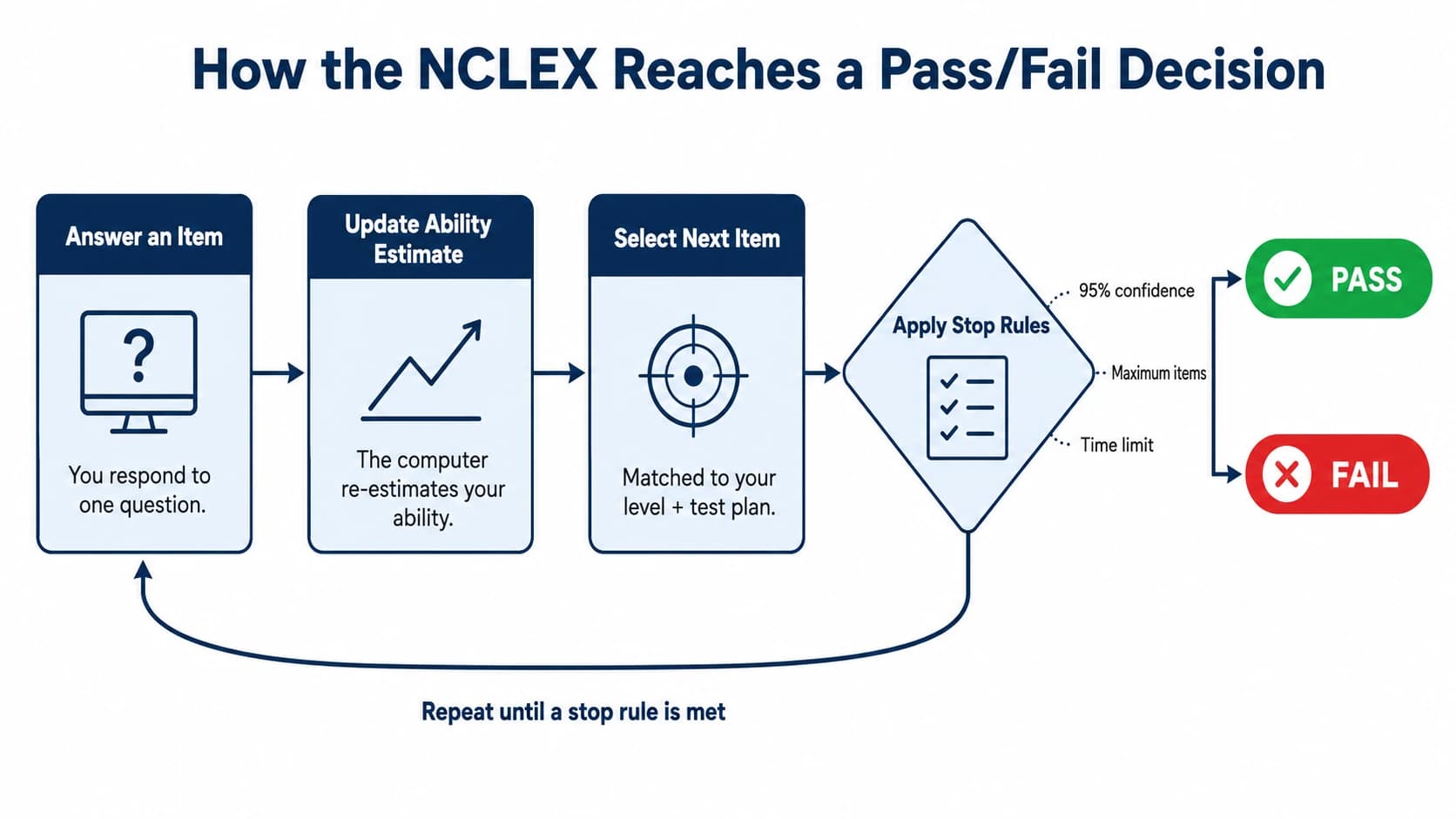
Each answer updates the ability estimate; the algorithm checks the stop rules before selecting the next item.
The practical takeaway: do not judge your result by how hard a question feels, do not assume a question format means you are doing well or poorly, and focus on answering the current item safely.
The Three Pass/Fail Decision Rules
The NCLEX can end in three main ways. Knowing them in advance helps reduce mid-exam panic.
95% Confidence Rule (most common)
After you reach the minimum number of items, the exam can stop when it is 95% certain your ability is clearly above or clearly below the passing standard. Clearly above the standard: pass. Clearly below the standard: fail.
Maximum-Length Rule
If your ability estimate stays close to the passing standard, the exam may continue to the maximum number of items. At that point the 95% confidence rule no longer applies — your final ability estimate from completed scored items determines pass or fail.
Run-Out-of-Time Rule
If time expires before the exam reaches a decision: if you did not reach the minimum number of items, the result is fail. If you did reach the minimum, your final ability estimate from completed items decides pass or fail.
Pacing matters because of the run-out-of-time rule. You do not need to rush, but spending too long on individual items can leave you short of the minimum or with weaker estimates near the end of your 5-hour window.
Passing Standard: RN and PN Are Different
The passing standard is the minimum level of ability required for safe and effective entry-level nursing practice. RN and PN do not use the same standard.
| Exam | Passing standard | Effective through |
|---|---|---|
| NCLEX-RN | 0.00 logits | March 31, 2029 |
| NCLEX-PN | -0.18 logits | March 31, 2029 |
You do not need to calculate logits. A logit is a measurement unit used to compare ability estimates and item difficulty — not a clinical category. The useful idea is that the NCLEX compares your estimated ability with the passing standard for your exam.
What Question Count Does and Doesn't Mean
Question count is one of the biggest NCLEX anxiety traps. Before the details, the single most important point is below.
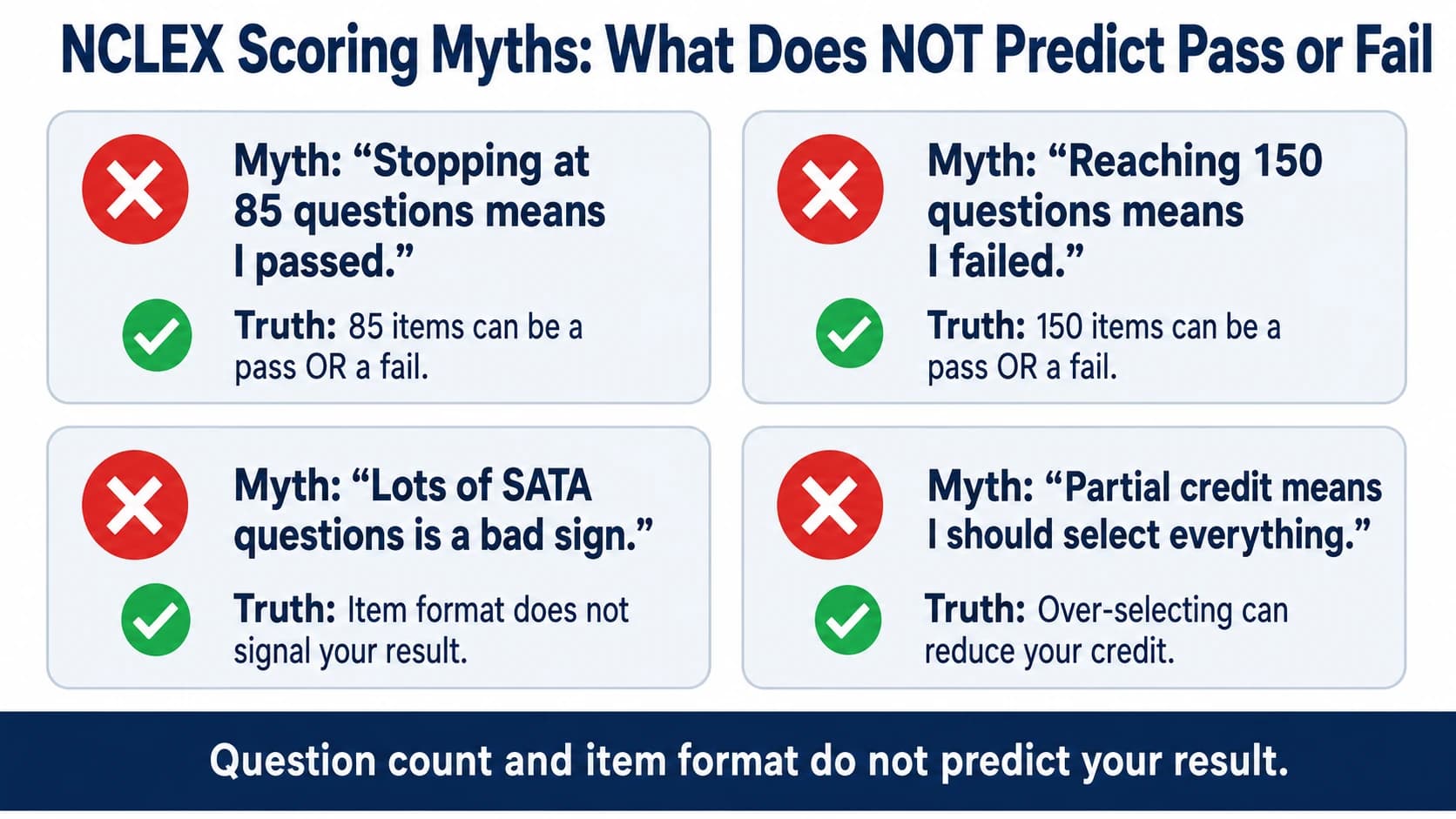
Question count and item format do not predict your result.
Myth: Stopping at 85 questions means I passed.
Reality: Stopping at the minimum does not prove a pass or a fail. It only means the exam reached a decision after the minimum number of items. That decision can land on either side of the passing standard.
Myth: Reaching 150 questions means I failed.
Reality: Reaching the maximum just means the exam needed the most information available before deciding. Candidates pass and fail at the maximum length.
Myth: If the questions feel hard, I'm passing.
Reality: Perceived difficulty is not a pass/fail signal. A question can feel hard because the content is weak for you, the wording is unfamiliar, or you are fatigued — not because you are doing well.
Myth: Lots of SATA or NGN items is a signal.
Reality: Item format is not a pass/fail signal. SATA, matrix, bow-tie, cloze, trend, and other formats can appear across different difficulty levels at any point in the exam.
The safest test-day mindset is simple: do not decode the exam while taking it. Answer the current item. For more on the 85 vs 150 question myth, see our scoring myths article.
How NGN Partial Credit Fits In
The Next Generation NCLEX includes partial-credit scoring for items with more than one correct key. Official partial-credit methods include the following.
Plus / minus scoring
Correct selections earn credit and incorrect selections can reduce the credit you earn for that item. This is why over-selecting can hurt you.
Zero / one scoring
The item is scored as fully correct or not correct, with no partial credit for that particular component.
Rationale scoring
Credit is based on whether your selections reflect sound clinical reasoning across the linked parts of the item.
Partial credit does not mean you should select everything. Under plus/minus scoring, incorrect selections can reduce the credit you earn for that item. The best strategy is to evaluate each option carefully and select only what is supported by the scenario. For the item formats themselves, see our NCLEX question types guide and the Next Generation NCLEX guide.
Why You Don't Receive a Numeric Score
The NCLEX reports pass/fail because it is a licensure exam, not a classroom exam. A raw percentage would be misleading because candidates receive different adaptive exams. Answering 70% of easier items is not the same as answering 70% of harder items. The exam is designed to determine whether your ability is at or above the passing standard, not to rank candidates.
If you fail, you receive a Candidate Performance Report. It shows your performance relative to the passing standard in test-plan areas and clinical judgment categories. It is meant to guide remediation, not provide a point score. To turn that into a plan, our scoring myths article and Client Needs categories explain how content coverage maps to the test plan.
Official NCLEX Scoring vs RN Test Pro Practice Feedback
It is important to be clear about the difference between the official licensure exam and any practice platform, including ours.
| Topic | Official NCLEX | RN Test Pro practice |
|---|---|---|
| Purpose | Licensure pass/fail decision | Study feedback and readiness guidance |
| Result | Official pass or fail | Practice performance and readiness indicators |
| Approach | NCSBN scoring system | Adaptive practice and psychometric-style feedback |
| Passing standard | Set by NCSBN | Internal practice target, not official licensure scoring |
| Use | Determines licensure result | Helps focus preparation |
| Prediction? | Official exam result | Not a pass/fail prediction |
RN Test Pro is independent and not affiliated with or endorsed by NCSBN. Practice scores are study tools, not official NCLEX results. For a fuller reference on how the standard is set and applied, read the full NCLEX scoring guide.
How to Study With Scoring in Mind
Use the scoring system to improve your preparation, not to create more anxiety.
Practice one item at a time
The NCLEX does not let you skip, submit, and return. Train the habit of reading carefully, choosing the safest answer, submitting, and moving on mentally.
Stop chasing a fixed percentage
There is no universal “70% equals pass” rule. Your performance depends on item difficulty, clinical judgment, content coverage, and consistency.
Practice partial-credit items carefully
For SATA, matrix, and other multi-key formats, judge each option against the scenario. Do not over-select just because partial credit exists.
Build clinical judgment
The NCLEX measures whether you can apply nursing knowledge safely. Practice recognizing cues, prioritizing hypotheses, taking action, and evaluating outcomes.
Review weak Client Needs areas
If your practice reports show weak categories, use them to guide targeted review. Do not rely only on an overall score.
Ready to build the routine around this? Start with our NCLEX study plan.
Practice Adaptive NCLEX-Style Questions
Rehearse one-question-at-a-time testing with adaptive practice and psychometric-style readiness feedback. Then focus your study where it matters most.
Start PracticingFrequently Asked Questions
How is the NCLEX scored?
The NCLEX does not give a numeric score. It estimates your ability as you answer using computerized adaptive testing (CAT), then makes a pass/fail decision using official stop rules. Candidates who fail receive a Candidate Performance Report with content-area feedback.
Does 85 questions mean I passed?
No. The minimum number of items can result in either pass or fail. It only means the exam reached a decision after the minimum, not what that decision was.
Does 150 questions mean I failed?
No. Reaching the maximum means the exam needed the most information available to reach a decision. Your result depends on your final ability estimate, not the question count.
What is the NCLEX passing standard?
The current NCLEX-RN passing standard is 0.00 logits and the NCLEX-PN passing standard is -0.18 logits, both effective through March 31, 2029. You do not need to calculate logits — the exam compares your estimated ability with the standard for your exam.
What is partial credit on NGN items?
Items with more than one correct key may use partial-credit scoring. Official methods include plus/minus, zero/one, and rationale scoring. Partial credit does not reward selecting everything — under plus/minus scoring, incorrect selections can reduce your credit.
Do RN Test Pro practice scores predict my NCLEX result?
No. RN Test Pro practice scores are study tools that help you focus your preparation. They are not official NCLEX results and not a pass/fail prediction. RN Test Pro is independent and not affiliated with or endorsed by NCSBN.
Sources and Alignment Note
How this guide was reviewed
Reviewed against the April 2026 NCLEX Candidate Bulletin, current NCLEX passing-standard page, 2026 NCLEX-RN/PN test-plan materials, NCLEX CAT guidance, NCLEX FAQ partial-credit guidance, and Candidate Performance Report guidance. RN Test Pro is independent and not affiliated with or endorsed by NCSBN. NCLEX® is a registered trademark of the National Council of State Boards of Nursing, Inc.
Related Resources
Full NCLEX Scoring Guide →
The canonical reference for how the passing standard is set and applied.
Computer Adaptive Testing Guide →
How CAT selects items, balances content, and reaches a decision.
Next Generation NCLEX →
Case studies, partial credit, and clinical judgment items.
NCLEX Study Plan →
Turn scoring knowledge into a structured preparation routine.
RN NCLEX Prep →
Adaptive practice built for the RN candidate path.
PN NCLEX Prep →
Adaptive practice built for the PN candidate path.